From Bipartisan Silencing to Cybernetic Survival: The Evolution of Darth Maul in ‘Star Wars: Maul — Shadow Lord’
Main Facts: The Return of the Zabrak
Nearly three decades after his cinematic debut in Star Wars Episode I: The Phantom Menace, the galaxy’s most resilient outcast is reclaiming the spotlight. Lucasfilm has officially announced the upcoming animated series Star Wars: Maul — Shadow Lord. This momentous project cements Darth Maul’s status as the only Star Wars villain—barring Boba Fett—to anchor an entire television series.
Set during the fragile dawn of the Galactic Empire, the show positions Maul as a fallen crime lord desperate to reclaim his lost empire following his devastating defeat at the Siege of Mandalore. Stripped of his influence, his allies, and his seat of power, the former Sith apprentice is on a relentless collision course with both Emperor Palpatine (Sidious)—who cast him aside for a younger, more powerful replacement—and the criminal underworld that ultimately abandoned him.
However, Shadow Lord introduces a surprising narrative twist: amidst his campaign for vengeance, Maul becomes intrigued by the prospect of taking on a new apprentice, a young Jedi Padawan named Devon. Spearheaded by a creative team including veteran Lucasfilm animation executive producer Athena Yvette Portillo, co-creator and showrunner Matt Michnovetz, supervising director Brad Rau, and director of photography Joel Aron, the series promises a mature, serialized narrative that pushes the aesthetic and thematic boundaries of the Star Wars animation franchise.
Chronology: Tracing the Arc of a Broken Sith
To fully grasp the narrative weight of Star Wars: Maul — Shadow Lord, one must trace the winding, tragic timeline of the character across multiple eras of the franchise:

- The Phantom Menace (32 BBY): Darth Maul bursts onto the screen as Darth Sidious’ deadly enforcer, captivating audiences in a legendary 15-minute lightsaber duel against Qui-Gon Jinn and Obi-Wan Kenobi. The sequence ends when a youthful Obi-Wan slices Maul in half, sending him plummeting down a reactor shaft on Naboo. For over a decade, his story appeared decisively over.
- The Clone Wars (Circa 20 BBY): Defying biological logic, Maul returns from the dead in the animated series The Clone Wars. Driven mad by isolation on the junk planet Lotho Minor, he is restored with cybernetic legs by his brother, Savage Opress. Together, they build a massive criminal empire, ultimately seizing control of Mandalore before falling victim to Darth Sidious’ wrath, which claims Savage’s life.
- Shadow Lord (Early Imperial Era): Filling the crucial narrative bridge between The Clone Wars, Solo: A Star Wars Story, and Star Wars Rebels, the new series explores Maul’s desperate attempts to rebuild his shattered power base, confront the rising Galactic Empire from the shadows, and mentor the Padawan Devon.
- Solo: A Star Wars Story (Circa 10 BBY): Maul makes a shocking live-action return, revealed as the hidden leader of the Crimson Dawn crime syndicate, communicating via hologram with Qi’ra.
- Star Wars Rebels (2 BBY): Maul’s arc reaches its poignant, tragic conclusion. Stranded on the ancient Sith world of Malachor, he seeks out a young Ezra Bridger to help him destroy the Sith once and for all. His obsession with vengeance finally catches up to him when he faces his old nemesis, Obi-Wan Kenobi, in the desert wastes of Tatooine, perishing in a brief, emotionally devastating duel.
Supporting Data: Artisanal Craftsmanship and Production Innovation
Star Wars: Maul — Shadow Lord breaks technical and artistic ground for Lucasfilm Animation, moving away from rapid turnaround times and episodic, "mission-of-the-week" storytelling toward a fully serialized format.
A Painterly Aesthetic
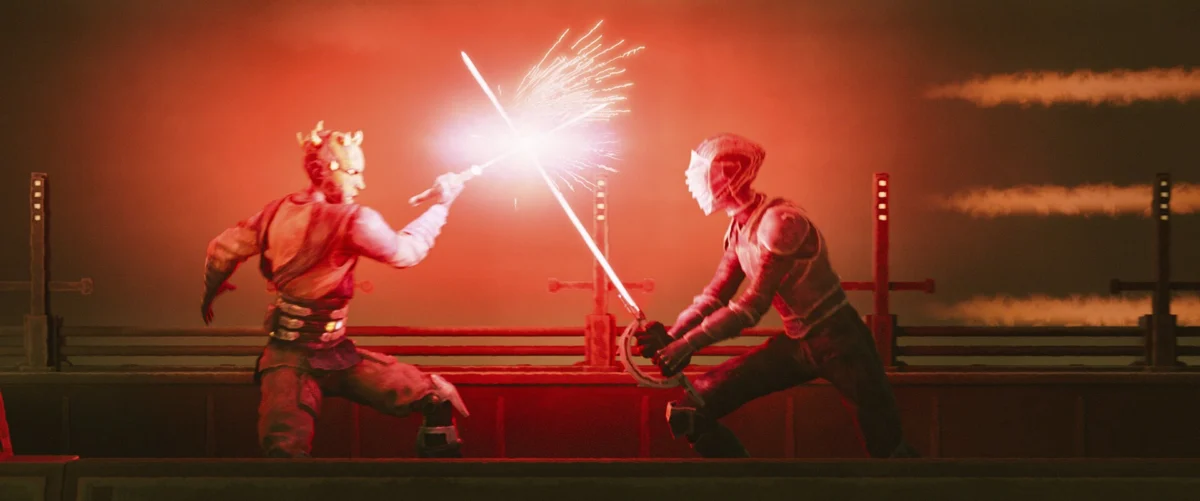
Director of photography Joel Aron, who previously pushed the envelope of computer-generated animation in The Star Wars: The Bad Batch, has implemented a radically tactile visual style for Shadow Lord. The series utilizes:
- Oil-on-canvas matte paintings.
- Real-world paintbrush strokes applied directly to glass panes.
- Practical, physical scale models for select starships, reducing the reliance on purely digital rendering and giving background environments a grittier, lived-in quality.
Sound Design and Visceral Combat
The artisanal approach extends directly into the sound booth. Sound designer David W. Collins incorporated raw, unedited screams from voice actor Sam Witwer directly into the audio profile of the lightsaber blade swishes. This unique synthesis captures the visceral, unbridled rage and psychological trauma defining Maul’s combat style—transforming the weapon from an "elegant weapon for a more civilized age" into a roaring, destructive fire cutting through air and flesh.
Iterative Post-Production
Because the series is entirely serialized rather than episodic, production faced unique hurdles regarding visual continuity. Executive Producer Athena Yvette Portillo revealed that Lucasfilm implemented a specialized post-production feedback loop:

"We didn’t want a situation where someone would say episode four looked better than the first," Portillo explained. "We would constantly go back to earlier episodes and pepper them with what we learn from later episodes. It’s like cooking. You’re taste testing the episodes, then going back in and adding spices to keep it consistent."
Official Responses: The Cast and Crew on Reinventing an Icon
For Sam Witwer, who has lent his voice and theatrical soul to Darth Maul since 2010, Shadow Lord represents the ultimate realization of a character study he has inhabited for over a decade.
"It’s been a real surprise that the character continues to evolve and to grow," Witwer told IndieWire. "The fun of it is reinventing him every time that we bring him out and learning new things about him. I’ve always had a lot of questions about Maul, and now I feel like I finally have the full vision of his arc throughout Star Wars for the first time in my life."
Supervising director Brad Rau emphasizes the complex psychological duality Maul brings to the narrative framework:

"He’s a survivor, and dedicated to his causes," Rau noted. "He’s also a manipulator, and a very charismatic one at that. He provides a kind of devil on the shoulder of our characters, to tempt them in some ways and reveal some uncomfortable truths in some ways. He’s, in some regards, a relatable character, due to the losses he’s suffered, and the mistakes he keeps repeating."
Co-creator and showrunner Matt Michnovetz discussed the conscious decision regarding how the overarching Imperial threat is framed within the narrative:
"We wanted to make it a menacing, strong, external force that would come in at the right time to push the story forward," Michnovetz said, noting the desire to differentiate the series from the gritty, ground-level oppression seen in live-action series like Andor.
Implications: A New Moral Gray Area for Star Wars Animation
The release of Star Wars: Maul — Shadow Lord carries profound implications for the future of the Star Wars canon, particularly within its animated ecosystem.

For years, animated entries have occasionally been stereotyped as family-friendly adventures ancillary to live-action films and prestige streaming dramas. Shadow Lord shatters this paradigm. By embracing a morally ambiguous universe where the lines between hero and villain blur, the series echoes the mature storytelling of Andor while filtering it through a uniquely operatic lens.
Furthermore, Maul’s dynamic with the young Padawan Devon serves as a thematic mirror to Ahsoka Tano’s journey. Both characters were systematically alienated from their respective institutions—the Jedi Order and the Sith—and left to navigate a hostile galaxy alone. However, while Ahsoka ultimately found a path toward healing and altruism, Maul’s trajectory is defined by a tragic inability to transcend his past trauma.
By exploring a version of Maul who momentarily seeks to mend his psychological void through mentorship—even while driven by dark impulses—Lucasfilm is offering audiences a deeper, more sympathetic, and deeply humanized portrait of a pop-culture monster. As long as Star Wars continues to expand its narrative horizons, Darth Maul proves that even characters sliced directly in half can find a way to stand tall, cast a long shadow, and redefine what it means to be a survivor in a galaxy far, far away.