Inside the Dreamscape: How Netflix’s ‘In Your Dreams’ Blends Childhood Nostalgia with Animation Magic
Introduction: The Boundless Canvas of Animation
Certain surreal scenarios belong strictly to the realm of slumber—such as realizing you have skipped an entire semester of classes only to show up on the final day of exams, or navigating a suburban neighborhood overrun by the undead. According to co-director Erik Benson and Alex Woo, the masterminds behind Netflix’s visually ambitious animated feature In Your Dreams, these bizarre narrative leaps are uniquely suited to the medium of animation.
Released to streaming audiences on Netflix, In Your Dreams is a delightfully chaotic, emotionally grounded adventure that leans heavily into the limitless possibilities of its dream-world setting. Featuring an impressive voice cast that includes Jolie Hoang-Rappaport, Elias Janssen, Omid Djalili, Simu Liu, and Cristin Milioti, the film explores the fragile psyche of a modern family through the wondrous, and sometimes terrifying, looking glass of the subconscious.
Main Facts: Plot, Cast, and Creative Vision
At its core, In Your Dreams follows siblings Stevie (voiced by Jolie Hoang-Rappaport) and Elliot (voiced by Elias Janssen). Their lives take an unexpected turn when they stumble upon an ancient, mysterious book detailing the legendary Sandman (voiced by Omid Djalili)—the mythical master of dreams who supposedly holds the power to alter reality. For the siblings, mastering the art of sleepwalking into the dream world transforms from a nightly routine into a desperate mission: they believe the Sandman can intervene and save their parents’ (Simu Liu and Cristin Milioti) struggling marriage.
While Elliot drifts off effortlessly aided by the melodic hum of a turtle-shaped white noise machine, Stevie must actively work to cross the threshold into sleep. The animation team brilliantly visualizes this transition, utilizing a physics-defying, floating camera that orbits Stevie as she lifts away from the real world and plunges into the kaleidoscopic architecture of the dreamscape.

Chronology of Production: Building the Cinematic Grammar
Developing an entirely original animated feature requires meticulous world-building, particularly when the laws of physics are meant to be constantly bent and rewritten. Co-director Alex Woo explained in an interview with IndieWire that establishing the "grammar and language" of the film’s universe was one of the earliest and most critical hurdles the production team faced.
Establishing the Rules of Sleep
"Every film has its own grammar and language, and you have to set up certain rules and pay them off," Woo noted. "The rules of how dreams work and how you go in and out of dreams, all that stuff needs to be established because you can’t take it for granted."
These transition sequences—where characters break through the membrane separating conscious reality from the subconscious—became some of Woo’s favorite shots in the entire movie, celebrated for their purely cinematic execution.
A Late-Stage Creative Breakthrough
Because animation allows for pixel-by-pixel precision that live-action filmmaking simply cannot replicate, the creative team was able to refine and experiment with the narrative structure right up until the project’s completion. For instance, Stevie’s witty, fourth-wall-breaking voiceover guide—which kicks off the movie’s opening dream sequence—was a relatively late addition to the script.

"We all had that sit-up moment when [the voiceover] comes in and you do that freeze frame. You talk to the audience. Suddenly, people are like, ‘Oh, this is not just a straightforward animated movie,’" Woo said, highlighting how these layered narrative choices elevate the project beyond a standard family comedy.
Supporting Data: Nostalgia as a Design Philosophy
Stylistically, In Your Dreams functions as a love letter to the cinematic touchstones of the 1980s and 90s, particularly the childhood favorites that shaped Woo’s artistic sensibilities growing up between cultures.
A Spielbergian and Miyazaki-Inspired Sandbox
- Steven Spielberg: The film’s very title character, Elliot, is explicitly named after the young protagonist of E.T. the Extra-Terrestrial. The film also incorporates stylistic nods to adventure classics like Hook, The Goonies, and Jim Henson’s Labyrinth. Viewers will spot a customized Spielbergian "zolly" (zoom-dollied) shot woven into the cinematography.
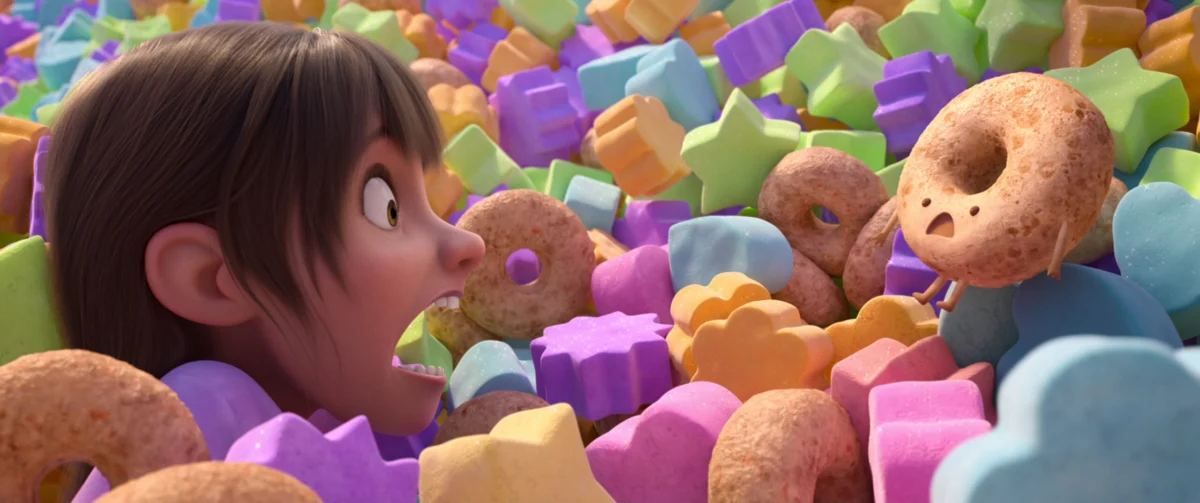
- Hayao Miyazaki: Having spent half his childhood in Hong Kong, Woo was deeply immersed in Asian animation. The cute, soot-sprite-like denizens of Stevie’s dream "Breakfast Town" heavily echo the susuwatari from Hayao Miyazaki’s My Neighbor Totoro. However, as the dream sequence deteriorates into a nightmare, those same creatures take on a grittier, high-stakes aesthetic reminiscent of The Goonies.
- Anime Tropes: The movie doesn’t shy away from modern pop-culture nods either, featuring an over-the-top power-up sequence worthy of Dragon Ball Z, alongside frantic, colorful transformation sequences ripped straight from Sailor Moon.
"Art’s all remix, right?" Woo reflected on his collage-like approach to world-building. "I thought a movie about the dream world was the perfect venue to pull all of these references and movies that I loved and put them in there because you can do so many types of worlds in a dream movie. You have so much latitude, aesthetically and creatively."
Official Responses: Navigating the Line Between Thrill and Trauma
One of the most delicate challenges faced by the directors and writers of In Your Dreams was calibrating the emotional intensity of the narrative. While the film is marketed as a family-friendly comedy adventure, it deals with heavy themes—marital discord, childhood anxiety, and the terrifying unknown of nightmares.

Testing the Limits of Fear
Woo leaned into his own childhood memories of consuming media that dared to be genuinely frightening. Rather than sanitizing the dream sequences, the production team actively pushed the boundaries during early test screenings.
"I didn’t want to soft pedal anything because, when I was a kid, I really liked kind of being scared at the movies," Woo explained. "There’s something thrilling about it, but of course, there’s a line beyond which it becomes traumatizing. But you just don’t know where that line is until you test it out."
Through rigorous audience testing and iterative animation passes, the team found the sweet spot: maintaining high-stakes peril through obstacles like a snarky stuffed giraffe, zombie breakfast foods, and the looming threat of the nightmare queen, all while ensuring the emotional core remained uplifting and accessible for younger viewers.
Implications: The Future of Netflix Animation
The release and reception of In Your Dreams carry significant weight for Netflix’s ongoing animation strategy. As streaming platforms increasingly compete for family audiences against legacy studios like Disney, Pixar, and DreamWorks, original intellectual properties that successfully blend high-concept visual storytelling with emotional resonance are invaluable.

By giving filmmakers like Erik Benson and Alex Woo the creative latitude to experiment with genre mashups, mixed-media stylistic homages, and complex narrative framing devices, Netflix is positioning itself as a haven for auteur-driven animation. In Your Dreams proves that streaming platforms can successfully deliver theatrical-grade visual fidelity and narrative sophistication straight to the living room.
“In Your Dreams” is currently streaming worldwide on Netflix.