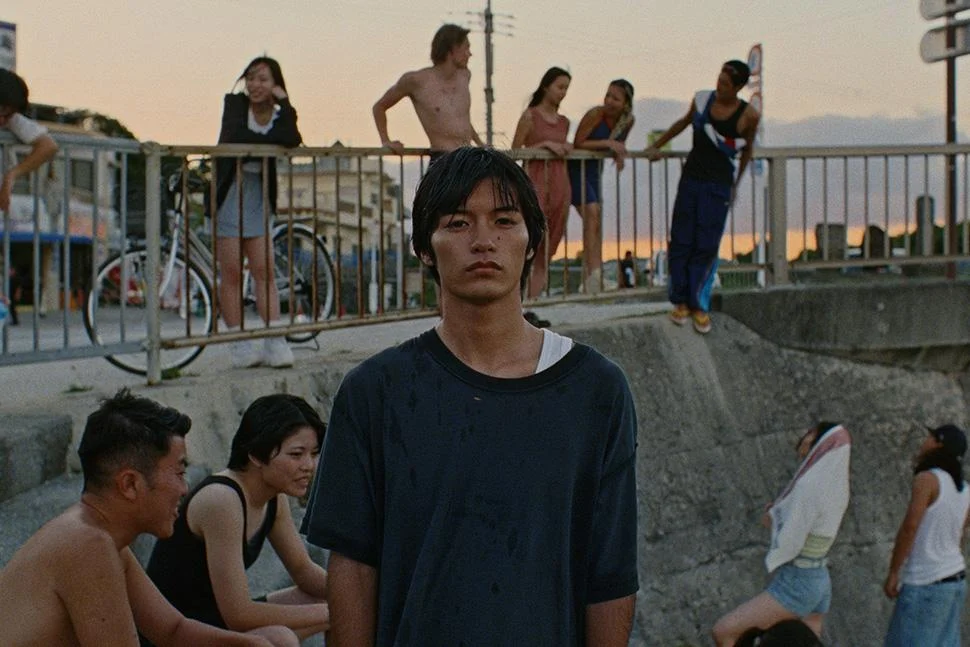
Set against the lush, politically charged backdrop of Okinawa—an island off the coast of mainland Japan carrying a heavy historical footprint—The Color of the Sun emerged as one of the most unexpected critical darlings of the Venice Film Festival. Directed by photographer-turned-filmmaker Xavier Tera, the feature won the prestigious FIPRESCI International Critics’ Prize for Best Film in the Orizzonti section.
Though grounded in a specific geographical and cultural setting, the film is a globally resonant coming-of-age story. It reflects both Tera’s complex Québécois upbringing and the decade he has spent living and working in East Asia. The narrative follows Kamei, a young man played by newcomer Naoto Shimajiri, as he navigates his sexuality, identity, and place in a world dominated by the persistent footprint of American military bases and a complicated relationship with mainland Japan.
Produced by Jeremy O. Harris and Josh Godfrey’s newly formed company bb2, alongside Tera’s longtime producing partner Janie Chartier and producer Stella Savino, The Color of the Sun boasts an international pedigree. Cinematography was helmed by industry heavyweight Sayombhu Mukdeeprom—celebrated for his work with Apichatpong Weerasethakul, Luca Guadagnino, and M. Night Shyamalan. While the film has secured distribution in Canada, Italy, and Japan, it currently awaits a U.S. home.
Chronology: From Concept to the Lido
The journey to the Venice Film Festival was anything but straightforward. It began years prior when Xavier Tera, established primarily as a commercial photographer in Japan, crossed paths with Tony-nominated playwright Jeremy O. Harris while shooting a spread for GQ Japan. That initial meeting planted the seeds for a creative partnership that would eventually expand into literary adaptations and independent feature development.
Parallel to this, Tera spent nearly ten years building a life and creative foundation in Japan alongside his business partner and then-partner Janie Chartier. Frustrated by the conventional stories told about Japan, Tera turned his lens toward Okinawa, synthesizing his lifelong preoccupation with identity, minority status, and colonial history into a screenplay.
As development kicked off, the production faced mounting obstacles:
Early Development: Securing financing for a queer, coming-of-age indie film spoken almost entirely in Japanese, directed by a white Canadian, proved a tough pitch for traditional financiers.
Pre-Production Hurdles: The team faced severe budget constraints and the abrupt loss of their local production team right before principal photography began.
The Breakthrough: The recruitment of cinematographer Sayombhu Mukdeeprom elevated the film’s visual language, cementing a shared commitment to 35mm aesthetics and poetic restraint.
The Premiere: Following a grueling physical and emotional production cycle, The Color of the Sun debuted at the Venice Film Festival, capturing the Orizzonti FIPRESCI Prize and securing early distribution deals in Canada, Italy, and Japan.
Supporting Data and Production Insights
The global scale of The Color of the Sun is reflected not only in its themes, but in the multicultural composition of its creative team.
The Cultural Intersection: Okinawa’s Indigenous Ryukyu population was annexed by Japan in the 19th century, remaining culturally distinct. Coupled with the postwar U.S. military presence, the island provided Tera—an outsider with a Québécois background—a unique lens for objectivity. Growing up in a strictly French-speaking household in English-dominated Canada instilled in Tera an early awareness of being historically overlooked and navigating minority identities.
The Visual Language: Master cinematographer Sayombhu Mukdeeprom came to the project while transitioning between high-profile ventures, including a Frank Ocean film and Apichatpong Weerasethakul’s latest project. Operating on a lean budget, the production utilized 35mm film, emphasizing silent, emotive image-making over heavy dialogue.
The Production Apparatus: The film serves as one of the inaugural showcases for bb2, the production shingle launched by Jeremy O. Harris and Josh Godfrey following the conclusion of Harris’s HBO development deal. Furthermore, it marks a foundational milestone for Twin Brains, the Tokyo-based production banner shared by Tera and Chartier.
Official Responses and Perspectives
Speaking with IndieWire in the courtyard of the Residenza d’Epoca Albergo Quattro Fontane in Venice, the filmmakers opened up about the emotional and logistical realities of bringing the film to life.
Xavier Tera reflected on his personal connection to the protagonist, Kamei:
“I grew up in a very strictly French-speaking household in a country where most people speak English… I grew up always questioning this idea of identity and what French represented within North America… I’m definitely depicting a reality for these people that I’ve met in Okinawa in relation with Japan, but also with the American military that is set there. So I feel like I have a form of objectivity being not American, not Japanese and not Okinawan, but still relating to the identity themes.”
Jeremy O. Harris detailed his role as a translator of visionary voices for financiers and audiences alike:
“Most people heard that [Tera] was doing this queer fucking coming-of-age movie where 90 percent of the dialogue is in Japanese, and then it takes place around an American base and they were like, ‘Wait, what?’ Most people would’ve told him, ‘Well, you’re white, you’re Canadian, so it’s basically American. Flip it and make the main character the white boy.’ That would’ve made a much more financially viable movie. But I knew the story he wanted to tell… and so that had to be protected.”
Janie Chartier, Tera’s long-term producing partner, discussed the grit required to cross the finish line:
“We had so many challenges on this shoot, from a tiny budget to losing the head of our local production team right before we started filming. But we are used to having to fight to make our projects the way we want… I think that shared commitment to excellence also helped us land Sayombhu Mukdeeprom.”
Stella Savino, echoing the sentiment of cross-cultural collaboration, noted:
“As a producer, I am deeply committed to debut features, and the coming-of-age genre has always been a core interest of mine. Beyond that, I was highly drawn to the prospect of collaborating with a young female producer who was coming from a completely different background.”
Implications and Future Projects
The success of The Color of the Sun signals a changing tide for international indie cinema, proving that stories rooted in hyper-specific local politics can achieve universal emotional resonance. By rejecting commercial formulas—such as casting bankable Western actors or softening its linguistic barriers—the film has established Tera as a distinct new voice in global cinema and validated bb2’s mandate to protect dangerous, dynamic art.
Looking ahead, the creative collective is wasting no time. Tera is already deep into development on a vastly different sophomore feature set in Tokyo. Described as a raw, high-intensity nightlife thriller akin to Uncut Gems set in Roppongi, the project contemplates a diverse international cast including Nigerian, Russian, and Western actors.
At the same time, Harris and Tera continue to champion literary adaptations, most notably an upcoming screen version of Sayaka Murata’s acclaimed novel Earthlings, a passion project for which Chartier currently holds the rights.
As The Color of the Sun looks toward securing its vital U.S. distribution deal, the film stands as a testament to the power of cross-cultural empathy, rigorous visual storytelling, and the resilience required to bring uncompromised visions to the silver screen.