Beyond the Frame: Deconstructing Meta-Cinema in "Jatuh Cinta Seperti di Film-film"
In the landscape of contemporary Indonesian cinema, few films have managed to interrogate the medium of filmmaking itself with as much tenderness and biting wit as Yandy Laurens’ Jatuh Cinta Seperti di Film-film (2023). Moving beyond the tropes of the romantic comedy genre, the film functions as a sophisticated piece of meta-cinema—a movie about the making of a movie—that challenges both the industry’s commercial demands and the audience’s perception of what constitutes a "romantic" gesture.
The Architecture of Meta-Cinema: A Creative Necessity
To understand the weight of Jatuh Cinta, one must look at the historical lineage of meta-cinema. As noted in William Siska’s Metacinema: A Modern Necessity, self-reflexive storytelling operates through two primary conduits: the creator’s reflection on their medium and the creator’s reflection on their own identity.
Throughout film history, directors have used the "film-within-a-film" device to bridge the gap between fiction and reality. Federico Fellini’s 8½ (1963) remains the gold standard, utilizing surreal imagery to map the neuroses of a director. More recently, Shinichiro Ueda’s One Cut of the Dead (2016) used a structural reset to expose the chaotic mechanics behind a low-budget zombie flick.
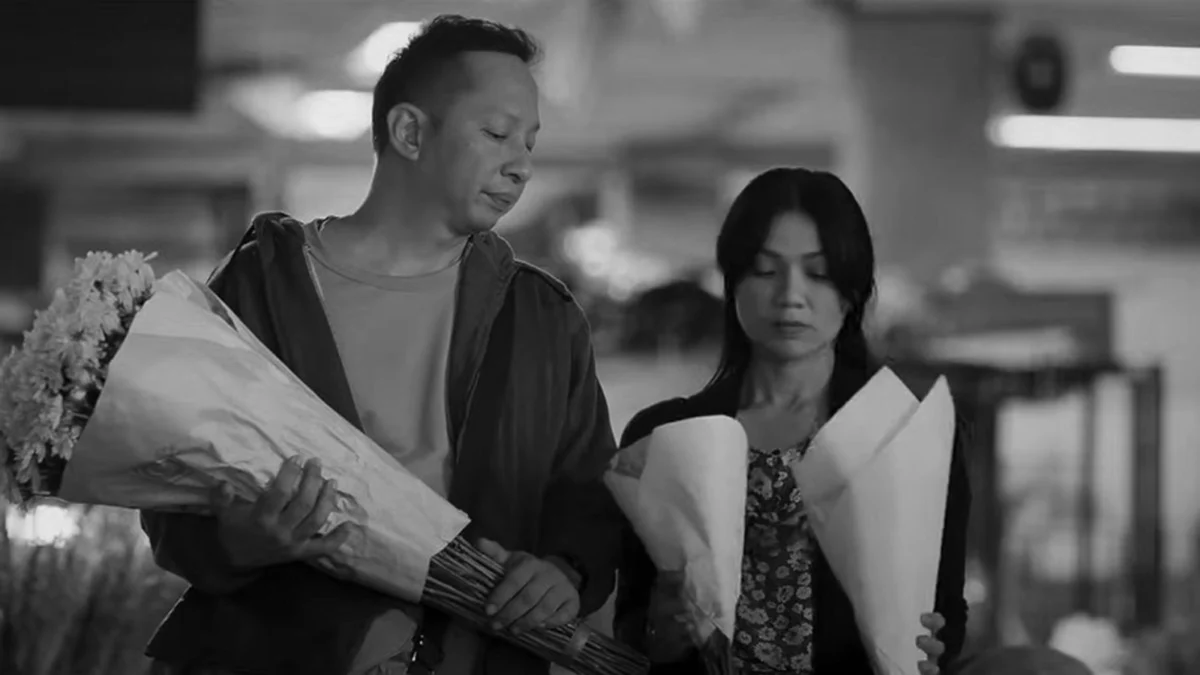
In Jatuh Cinta, Yandy Laurens employs a distinct visual syntax to delineate these layers. The film follows Bagus (Ringgo Agus Rahman), a screenwriter who attempts to win the heart of his grieving friend, Hana (Nirina Zubir), by turning their shared history into a romantic script. The film presents two distinct universes: the "real" world, rendered in vibrant color, and the "film-within-a-film," captured in stark, monochrome black-and-white.
Visual Language as Emotional Narrative
The choice of black-and-white for the inner film is not merely a stylistic flourish; it is a narrative tool. In modern cinema, where color is an accessible luxury, the choice to strip it away serves a specific purpose. It frames Hana’s grief—the primary engine of her character arc—while acting as a visual signifier that the events on screen are being curated, controlled, and potentially exploited by Bagus.
Furthermore, this aesthetic choice serves a practical, cinematic function. By muting the colors of mundane settings—supermarkets, flower shops, and Padang restaurants—the film eliminates visual distraction. The audience is forced to focus entirely on the emotional chemistry and the evolving dynamic between Bagus and Hana, stripping away the "noise" of reality to highlight the intimacy of the dialogue.
Chronology of a Creative Crisis
The narrative trajectory of Jatuh Cinta is one of gradual realization. Initially, Bagus views his screenplay as a grand, romantic gesture. In the tradition of cinema, he believes that immortalizing his feelings for Hana on screen is the ultimate act of love. However, as the production progresses, the "film-within-a-film" encounters the messy, non-linear reality of human relationships.
Supported by a cast of secondary characters—including the skeptical Cheline (Sheila Dara), the thoughtful Dion (Dion Wiyoko), and the grounded Julie (Julie Estelle)—Bagus is forced to confront the ethics of his work. He is compelled to navigate the necessity of consent, empathy, and the realization that his artistic project might be causing more harm than healing.
The climax of this journey arrives when Hana, viewing the footage, confronts Bagus for his lack of consent. The "romance" Bagus intended is shattered, replaced by a raw, uncomfortable truth: not all stories are meant to be told, and certainly not without the participation and blessing of those they depict.
The Critique of the Industry: The "Pak Yoram" Archetype
A pivotal element of the film’s narrative is the role of Pak Yoram, played with cynical brilliance by Alex Abbad. As a producer, Pak Yoram represents the "toxic" side of the industry—a figure who prioritizes market trends and intellectual property (IP) over creative integrity.

Pak Yoram’s insistence that Bagus’s script be transformed into Jatuh Cinta Seperti di Film-film Horor is a searing indictment of the current state of the Indonesian box office. At a time when local theaters are dominated by predictable horror franchises and recycled IP, the film uses its own platform to critique the systemic laziness of the industry.
Implications for Modern Filmmaking
This meta-commentary isn’t just an "insider" joke; it is a wake-up call. By portraying a producer who views art as a mere commodity, Laurens highlights the struggle of filmmakers who wish to explore human, grounded stories in an environment that demands high-concept "gimmicks." The film argues that "mainstream" safety is, in fact, a burden on the evolution of national cinema.
Moreover, the film champions the importance of "self-awareness" among industry professionals. Through characters like Dion and Julie—actors who question the validity of their roles rather than blindly reciting lines—the film suggests that the path toward a more mature industry lies in the hands of those who are willing to push back against dehumanizing production practices.
Redefining Romance: Beyond the Grand Gesture
Perhaps the most significant achievement of Jatuh Cinta is its subversion of the "Romantic Comedy" genre. Early in the film, Hana critiques La La Land (2016), noting that its central conflict could have been resolved through simple, honest conversation rather than cinematic spectacle. By the end, the film echoes this sentiment: true romance is not found in the "final kiss" or the grand, dramatic gestures favored by popular media.
Romance, in the world of Yandy Laurens, is found in the quiet, mundane acts:
- Open and honest communication.
- The simple act of accompanying a partner while they shop or work.
- The mutual respect for each other’s boundaries and grief.
The film effectively argues that "grand gestures"—often used as a proxy for genuine affection—are frequently just a mask for ego. True intimacy, the film posits, is the ability to be present in the small, unscripted moments of life.
Official Reception and Legacy
Jatuh Cinta Seperti di Film-film has been lauded by critics and audiences alike for its refusal to settle for easy sentimentality. The film’s success lies in its ability to be both a meta-textual analysis of filmmaking and a heartfelt story about two people trying to navigate the complexities of adulthood.
The collaboration between Imajinari, Jagartha, Trinity Entertainment, and Cerita Film has resulted in a project that stands as a beacon for independent-minded creators. It proves that audiences are hungry for stories that respect their intelligence and demand more than just visual spectacle.
Summary of Production Data
- Release Year: 2023
- Director/Writer: Yandy Laurens
- Key Cast: Ringgo Agus Rahman, Nirina Zubir, Alex Abbad, Sheila Dara Aisha, Dion Wiyoko, Julie Estelle
- Genre: Meta-Romance/Drama
- Runtime: 118 Minutes
Conclusion: The Luxury of Self-Awareness
In an era defined by rapid content consumption, Jatuh Cinta Seperti di Film-film serves as a meditative pause. It challenges the viewer to look behind the screen, to question the motives of the storyteller, and to reconsider what we define as "romantic."
While the ideal of a self-aware, ethical film industry remains somewhat utopian, the existence of a film like this offers a flicker of hope. It suggests that even within the machine of commercial cinema, there is space for reflection, critique, and, ultimately, human connection. As the film poignantly illustrates, falling in love—and making movies—is rarely as clean or as dramatic as the films would have us believe. It is, instead, a messy, collaborative, and deeply personal process that is best navigated with honesty, empathy, and the courage to stop, listen, and truly see the person in front of you.