
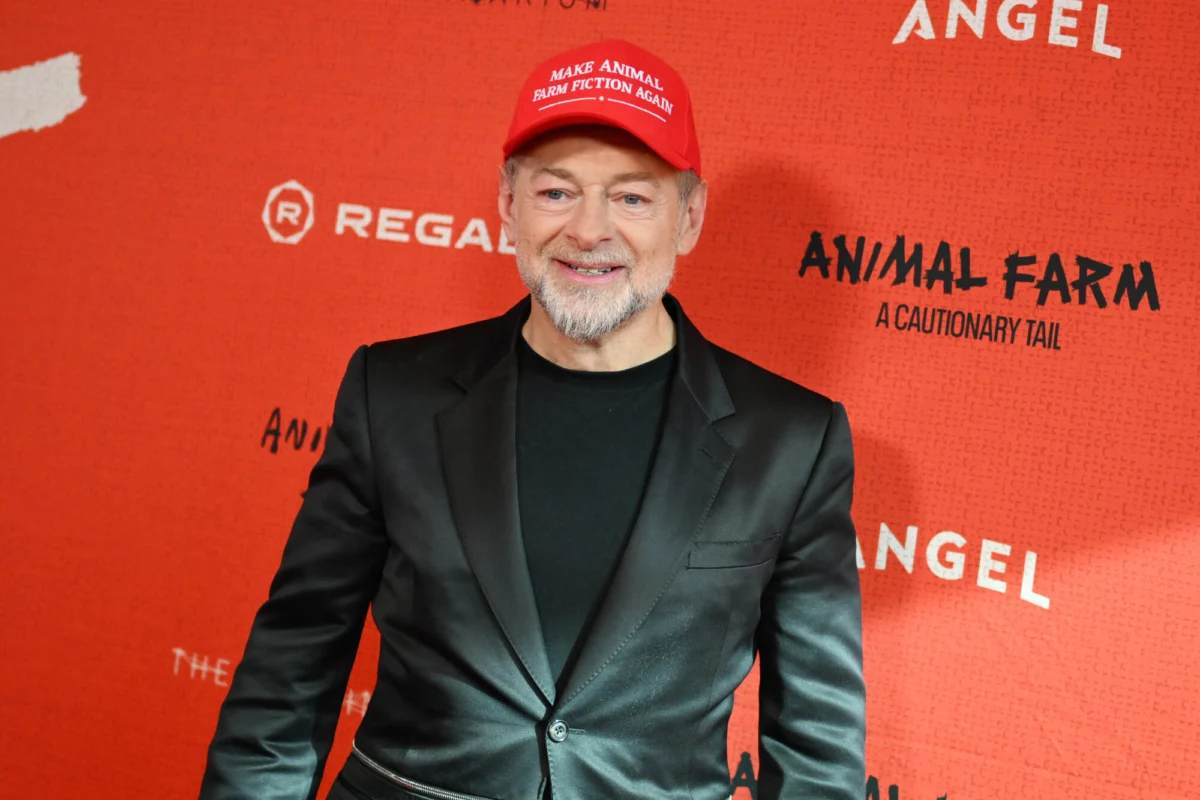
From Rebellion to Reflection: Andy Serkis Reimagines George Orwell’s Animal Farm
George Orwell’s Animal Farm has long stood as a pillar of 20th-century literature—a biting, claustrophobic allegory for the rot of revolutionary idealism and the inevitable slide into the crushing machinery of authoritarianism. For decades, the story of Manor Farm’s uprising has been synonymous with the Soviet Union’s descent into Stalinist tyranny. However, director Andy Serkis, a filmmaker whose career has been defined by pushing the boundaries of performance and technology, has approached the source material with a vision that is as expansive as the barn it is set in.
In his new film, Serkis has transformed the grim, gritty political tract into something altogether different: a vibrant, stylized, and occasionally unconventional spectacle that incorporates elements ranging from rap songs to slapstick humor. It is a bold, controversial, and deeply personal interpretation that prioritizes the emotional life of the animals over the cold, academic precision of the original text.
A New Vision: Breaking the Shackles of Photorealism
When Andy Serkis first embarked on the journey of adapting Animal Farm, the project was conceived as a traditional motion-capture endeavor—a medium in which Serkis is arguably the world’s foremost expert. Given his legendary performances as Gollum in The Lord of the Rings, Caesar in the Planet of the Apes trilogy, and King Kong, there was a natural expectation that his Animal Farm would be a masterclass in hyper-realistic, motion-captured digital creatures.
However, as the production evolved, Serkis encountered a creative wall. He found that the photorealism he had pioneered in other films was, in this instance, a hindrance. The more realistic the animals looked, the more the film’s inherently brutal subject matter—starvation, betrayal, and the physical toll of labor—began to feel oppressive.
"The very early designs for the animal characters were much more unforgiving and brutal," Serkis explained in an interview with IndieWire. "When animals looked like they were starving, you could see their rib cages; the pigs were a lot more gluttonous and just looked meaner. There is a version of that film that could exist, but we wanted to reach out to a younger audience."

This realization led to a pivotal shift in the film’s aesthetic. By pivoting toward animation, Serkis was able to "throw off the shackles" of photorealism. The resulting look is not just a stylistic choice; it is a narrative tool designed to create a "safety margin" for viewers of all ages, allowing them to engage with the heavy themes of the story without being overwhelmed by the visceral, haunting imagery that a live-action or hyper-realistic approach would have necessitated.
The Chronology of an Animated Experiment
The transition from a motion-capture project to a fully animated feature was a complex undertaking that forced Serkis to adopt entirely new workflows. While the film retains the DNA of a performance-driven project, the logistical demands of animation were a far cry from the immediacy of live-action filmmaking.
Phase 1: Conceptualization and Design
The production began with the creation of a world from the ground up. Unlike live-action, where a director arrives on a pre-existing location, Serkis and his team—including the acclaimed set designer Amos Sussigan—had to build every blade of grass and every piece of farm machinery. This foundational period was dedicated to establishing a visual language that could balance the dark, satirical nature of Orwell’s writing with a more accessible, animated aesthetic.
Phase 2: The "Scratch Track" and Voice Acting
Once the visual world began to take shape, the focus shifted to the performances. Serkis utilized a "scratch track" process, recording the voice cast early to guide the animators. The cast, featuring Seth Rogen as the manipulative pig Napoleon and Laverne Cox as the idealistic Snowball, were given an unusual amount of creative freedom.
"If someone gives me the freedom to find a performance, I’ll try lots of different things," Serkis noted. "Standing in front of the mic, not having to reset camera, change lenses, do setups—it’s a great way of working, and it’s a very creative way of working for an actor."

Phase 3: The Long Game of Animation
Unlike live-action, where a scene is "in the can" after a day of shooting, animation is a multi-year process. Serkis describes the challenge of holding the entire film in his mind for extended periods. "Getting to the end of a scene on an animated movie can take years because it goes through so many different hands and skills," he observed. This forced the director to engage deeply with every department, from the layout team to the animators, effectively acting as the central nervous system for a production that was being built piece by piece.
Supporting Data: The Mechanics of the Performance
One of the most striking aspects of Serkis’s Animal Farm is his refusal to abandon the intimacy of live-action performance. Even in animation, Serkis insisted on frequent close-ups, utilizing a performance style that approximates the nuances of motion capture.
The goal was to map the naturalistic acting choices—the subtle twitches, the shift in gaze, the micro-expressions—onto creature-like faces. Serkis wanted the audience to "feel" what the characters were going through during these tight shots without the animators needing to "overperform." By relying on the core tenets of character acting, Serkis ensured that the film felt grounded, even when the visual style remained stylized.
Official Responses and Creative Philosophy
The reception to Serkis’s interpretation has been a topic of significant industry discourse. By incorporating elements like rap songs and humor, the film risks alienating purists who view Animal Farm as a sacred text of political warning. However, Serkis maintains that his approach is rooted in the idea of the "cautionary tale."
He views the film as a story with a "whole heap of innocence around it," which makes the inevitable corruption of the animals all the more tragic. By starting from a place of relative innocence, the audience is more deeply invested in the characters’ fates. When Napoleon begins to co-opt the radical equality preached by Snowball, the betrayal is felt more acutely because the audience has had time to bond with these characters in a way that previous, more cynical adaptations have not permitted.

The Implications: A New Era for Animated Satire
The implications of Serkis’s Animal Farm extend beyond the film itself. The project represents a bridge between two worlds: the high-stakes, performance-heavy world of VFX-driven blockbuster filmmaking and the methodical, world-building nature of feature animation.
Serkis’s experience directing films like Mowgli: Legend of the Jungle and Venom: The Last Dance provided him with the technical foundation to understand the overlap between these processes. However, the true lesson of this project, according to the director, is the freedom that animation provides for character development.
The budget, in many ways, acted as the primary editor. Throughout the animatic and pre-visualization phases, Serkis had to "kill his darlings"—cutting scenes and characters long before they reached the final rendering stage to ensure the film remained cohesive and financially viable. This rigorous process of elimination, while painful, allowed the film to sharpen its focus on the central power struggle between Napoleon and Snowball.
The Verdict on the Revolution
Animal Farm is an experiment in adaptation that dares to be both respectful and subversive. It does not attempt to be a direct translation of the book, but rather a reflection of the themes of power and innocence through the lens of modern digital artistry.
Whether this version will stand the test of time remains to be seen. But for now, Andy Serkis has succeeded in doing the one thing that any adaptation of Orwell should strive for: he has made us look at the barnyard, and the humans running it, with fresh eyes. By stripping away the grey, cold realism of the historical Soviet context and replacing it with a vibrant, character-driven animation, Serkis has created a film that is as much about the process of telling a story as it is about the story itself.

Animal Farm is now playing in theaters, distributed by Angel Studios.