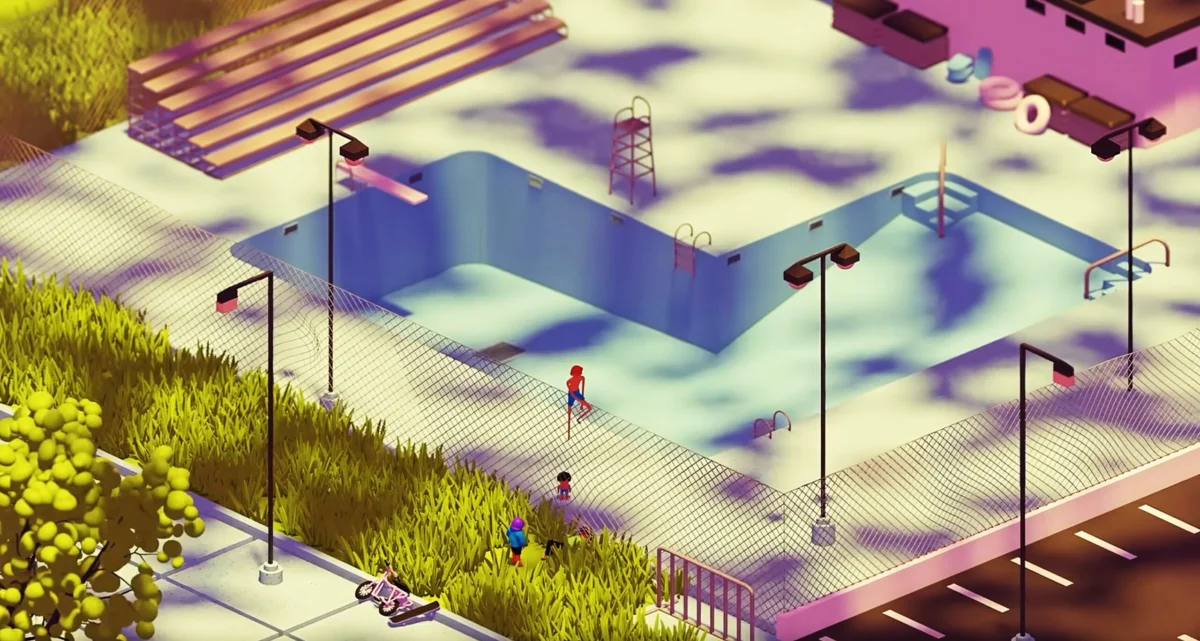
While high-profile triumphs like Gints Zilbalodis’s Academy Award-winning Flow have recently cemented the open-source 3D software Blender as a powerhouse for sweeping, human-free cinematic worlds, a wildly different kind of digital revolution is quietly taking shape at the other end of the aesthetic spectrum. Enter director Julian Glander’s Boys Go to Jupiter, a vaporwave-tinted, poignantly pastel coming-of-age feature that proves independent animation can achieve profound emotional resonance through minimalism, clever constraints, and off-the-shelf software.
Distributed by Cartuna and Irony Point, Boys Go to Jupiter transports audiences to a sun-drenched, slightly grimy, and fundamentally surreal vision of Florida. At once nostalgic and bitingly contemporary, the film captures the unique alienation of modern youth culture against a backdrop of corporate decay, infrastructural absurdity, and technological fatigue.
Main Facts: A Lo-Fi Vaporwave Odyssey
The Creative Force: Written and directed by Julian Glander, a veteran 3D illustrator and animator known for his distinctive pastel aesthetic.
The Software: Built entirely within Blender—the same free-to-download, open-source software responsible for Flow—demonstrating the democratization of feature-length 3D animation.
The Hardware Constraints: The entire feature was crafted by Glander working primarily on a standard, portable MacBook, circumventing the need for high-end rendering farms or massive institutional studios.
The Voice Cast: Features Jack Corbett as Billy 5000, alongside notable turns from Janeane Garofalo and Julio Torres running a surreal orange juice factory.
Release Details:Boys Go to Jupiter hits theaters and digital platforms on Friday, August 8, via Cartuna and Irony Point.
Chronology: From Internet Subcultures to the Silver Screen
Glander’s journey to Boys Go to Jupiter mirrors the broader evolution of digital art over the past two decades.
The Tumblr Golden Age (Early 2010s)
Glander began his artistic career during what he characterizes as the golden age of digital expression on platforms like Tumblr. In this era, the promise of the internet was one of unbridled creative liberation—a decentralized space where anyone with a computer could find an audience and cultivate a unique visual style without institutional gatekeepers.
Decade of 3D Illustration
For the past ten years, Glander honed his signature 3D aesthetic, characterized by candy-colored palettes, geometric character designs, and absurd, whimsical environments. Over time, his visual language evolved in tandem with the capabilities and limitations of Blender running on modest hardware.
Production and Festival Circuit
Facing the economic and logistical realities of independent filmmaking, Glander leaned into stylistic shortcuts that ultimately defined the movie’s identity. By turning technical limitations into creative pillars, he completed the feature film, setting the stage for its distribution rollout through Cartuna and Irony Point.
Supporting Data: The Anatomy of an Indie Animation Breakthrough
To understand the engineering behind Boys Go to Jupiter is to understand the economics of modern independent cinema. Where major studios pump millions of dollars into fluid motion capture, complex camera choreography, and thousands of bespoke character walk cycles, Glander’s production embraced strategic economy.
Zero Walk Cycles: Because animating bipedal characters walking across dynamic environments is notoriously labor-intensive—and disastrous when poorly executed—Glander crafted a world where characters rarely walk. Instead, they remain stationed behind gates, operate behind counters, or, in the case of the protagonist, travel on wheels.
The Swagway Solution: Billy 5000 spends the vast majority of the narrative riding a swagway (hoverboard). While this choice drastically reduced the need for complex walk-cycle animation, it serendipitously reinforced his characterization: an aimless, sleep-deprived teen ghosting through life, trying to stay unnoticed as he hustles for the $5,000 required to buy his independence.
Isometric Perspectives: Much of the film utilizes an isometric viewpoint from a calculated distance. This minimizes the computational and artistic costs associated with complex camera tracking while visually echoing the gamified, alienated digital spaces that consume modern youth.
Official Responses and Insights: Director Julian Glander on Crafting Florida’s Hell
In an exclusive interview, Glander opened up about the cultural philosophy, technological realities, and geographical inspirations driving Boys Go to Jupiter.
Florida as America’s Petri Dish
When asked about the oppressively warm, humid atmosphere of the film, Glander noted that the setting is far from accidental:
"I feel as if we all understand Florida as America’s hell. It’s like the Petri dish where America kind of happens. I kind of think of it as all coming out of Disney World — the invention and the construction of Disney World 75 years ago, the conquering of the swamps, and then the sort of decay of that whole magical fantasy is the world where this movie takes place."
The Radical Promise (and Enshittification) of the Internet
Reflecting on his use of Blender and his early days on the internet, Glander addressed the bittersweet reality of contemporary digital life:
"This is the radical promise of the internet. We love Blender — the software of the year, the hot software of the moment… We’ve almost seen a constriction of it and a re-platforming and a reorganizing of the internet that’s very unsatisfying. I think you’d be very hard-pressed to find someone in 2025 who’s like, ‘I enjoy going online. I like the internet.’ And that wasn’t the case 10 years ago."
The film directly tackles how the tech industry’s pastel fantasies and gamification structures have reshaped human behavior, often demanding total buy-in while isolating individuals from genuine connection.
The iPhone Era of Animation
Drawing parallels between live-action and animated indie filmmaking, Glander believes animation is undergoing a seismic shift similar to when consumer cameras democratized live-action film:
"To me, it feels like we’re at the same moment live-action films had 15 years ago, when all of a sudden everyone had iPhones and everyone started being born with some camera literacy. I think the same thing is happening in animation now. The tools are definitely there — and beyond the tools, the educational resources are there and the communities are there."
Implications: What Boys Go to Jupiter Means for the Future of Indie Film
The release of Boys Go to Jupiter marks a vital milestone in the decentralization of animated storytelling. For decades, feature-length 3D animation was viewed exclusively as the domain of multi-billion-dollar conglomerates like Pixar, Disney, and DreamWorks, requiring massive armies of technicians and years of proprietary pipeline development.
Projects like Flow and Boys Go to Jupiter shatter this paradigm. By demonstrating that an artist can conceptualize, render, and finalize a feature film on a standard laptop using free software, these filmmakers are paving the way for a new wave of auteur-driven, low-budget animated cinema.
Furthermore, the film’s thematic interrogation of internet fatigue, corporate decay, and teenage alienation resonates deeply with a generation exhausted by hyper-connectivity. By transforming logistical limits into expressive narrative devices—such as Billy 5000’s nocturnal, sleep-deprived trudge past towering, dystopian highway billboards—Glander proves that constraints are not barriers to art, but the very crucible in which original artistic voices are forged.
“Boys Go to Jupiter” opens in theaters and on digital platforms on Friday, August 8.