Building a Tomb of Light: Neil Jordan on the Defiant Making of Interview with the Vampire
Main Facts
Thirty years after its theatrical release, Neil Jordan’s 1994 gothic masterwork Interview with the Vampire remains a staggering anomaly in modern cinematic history. Adapted from Anne Rice’s seminal 1976 novel, the film brought a deeply eccentric, psychologically complex, and unapologetically homoerotic narrative straight into the heart of the Hollywood studio system. Boasting an A-list ensemble featuring Tom Cruise, Brad Pitt, Antonio Banderas, and a breakout performance by a young Kirsten Dunst, the film grossed over $223 million worldwide against a $60 million budget.
Yet, the primary legacy of Interview with the Vampire isn’t merely its commercial success or its enduring cultural footprint. Rather, it is the sheer improbability of its existence. Guided by producer David Geffen’s heavy industry leverage and director Neil Jordan’s uncompromising artistic vision, the production managed to smuggle an arthouse sensibility, a deliberate rejection of traditional jump-scare horror, and a tale of dysfunctional, immortal domesticity past the traditional gatekeepers of Warner Bros.
In a retrospective look at the film—pegged to its new 4K UHD home video release from Warner Home Video—Jordan opened up about the high-stakes gamble of mounting a blockbuster that essentially turned the world into a tomb, braved intense fan backlash over casting, and relied on a nocturnal shooting schedule to protect its stylized, hermetic atmosphere.
Chronology: From Studio Friction to Gothic Triumph
To understand how Interview with the Vampire came to fruition with such staggering creative freedom, one must look at the trajectory of Neil Jordan’s career in the late 1980s and early 1990s.
The Late 1980s: Studio Interference
Following early career successes with distinctively atmospheric films like The Company of Wolves (1984) and Mona Lisa (1986), Jordan ventured into Hollywood studio filmmaking with the 1989 comedy-drama We’re No Angels, starring Robert De Niro and Sean Penn. For the Irish auteur, the experience was jarring. Confronted by institutional micromanagement and executive interference far beyond anything he had experienced in independent European cinema, Jordan questioned whether he was fundamentally unsuited for the Hollywood machine.
The Early 1990s: The Crying Game Breakthrough
Jordan retreated to his creative roots, eventually writing and directing The Crying Game (1992). The film became a cultural phenomenon, earning critical adulation, six Academy Award nominations, and an Oscar for Best Original Screenplay. Suddenly, Jordan was one of the most sought-after commodities in the film industry.

Recognizing this newfound leverage, powerhouse producer David Geffen approached Jordan with the rights to Anne Rice’s Interview with the Vampire. Geffen wanted Jordan to helm the adaptation, which had languished in development hell for years under various directors.
Pre-Production and the Casting Storm (1993)
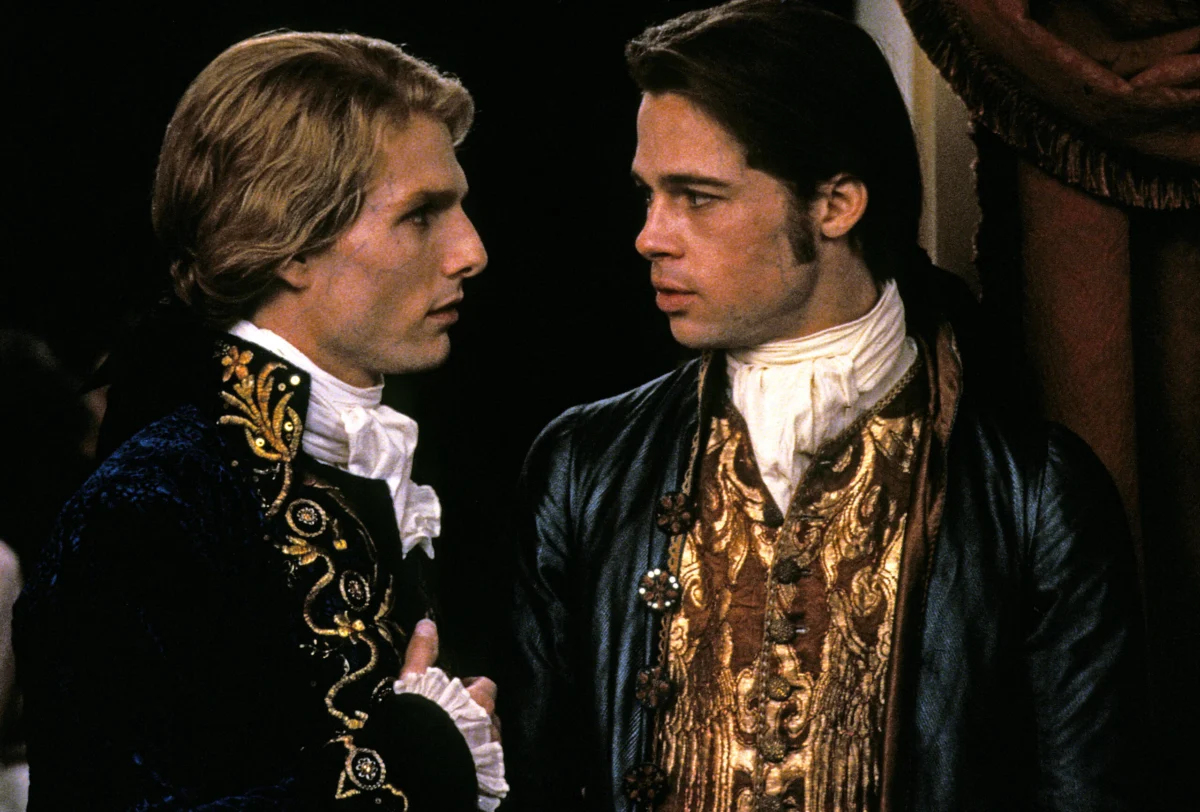
Jordan agreed, but under one strict condition: he demanded complete creative autonomy. Thanks to Geffen’s formidable standing with Warner Bros., the arrangement held. Jordan set to work on casting the immortal bloodsuckers, choosing Tom Cruise as the aristocratic, sadistic vampire Lestat de Lioncourt, and Brad Pitt as his melancholic, reluctant companion, Louis de Pointe du Lac.
The announcement immediately sparked global furor. Anne Rice herself was fiercely vocal in her opposition, publicly criticizing Cruise’s casting in the media and telling fans the choice was "so bizarre it’s almost impossible to imagine." Die-hard literary purists echoed her sentiment, creating an early-internet firestorm of skepticism. Jordan, however, ignored the noise, trusting Cruise’s "eerie sense of control" to ground Lestat’s predatory charisma.
Principal Photography (Late 1993)
Production took place largely on massive, meticulously controlled soundstages rather than on location. To keep aggressive paparazzi—fueled by the anti-Cruise casting frenzy—at bay and to enforce his distinct visual palette, Jordan made the radical decision to shoot almost entirely at night.
Theatrical Release and Redemption (November 1994)
Interview with the Vampire premiered to audiences on November 11, 1994. Any pre-release skepticism instantly evaporated. Upon seeing the completed film, Anne Rice famously reversed her stance, taking out ads in trade publications to praise Cruise’s performance and the film’s faithful translation of her gothic ethos. The film became an instant classic, reshaping how mainstream Hollywood approached horror, aesthetic world-building, and queer subtext.
Supporting Data and Production Mechanics
The visual signature of Interview with the Vampire is inextricably linked to its rigorous technical execution. Working alongside legendary production designer Dante Ferretti and master cinematographer Philippe Rousselot, Jordan established a unified governing philosophy for the film’s look:

"We just wanted to turn the whole world into a tomb."
The Nocturnal Advantage
By electing to shoot exclusively at night, Jordan liberated the production from the unpredictable parameters of natural sunlight. This choice created significant physical strain on the cast and crew, who were forced to live perpetually in the dark, but it granted the director absolute control over the frame. Every ray of light, every shadow, and every nuance of color was meticulously curated. It transformed the period settings of late-18th-century New Orleans, post-revolutionary Paris, and Victorian London into an enclosed, sensual, and suffocatingly beautiful dreamscape.
The Casting of Kirsten Dunst
Perhaps the most delicate production hurdle was casting Claudia, the precocious child-vampire trapped in an eight-year-old’s body for eternity. Recognizing the dangers of thrusting a child actor into the white-hot spotlight of a major Hollywood tentpole, Jordan weighed the risks carefully.
However, during auditions, he recognized a rare, preternatural maturity in an 11-year-old Kirsten Dunst. "It was immediately obvious to me with Kirsten that she was an actress, and that she’d be doing this for the rest of her life," Jordan noted. The gamble paid off exponentially; Dunst delivered a chilling, tragic performance that anchored the psychological weight of the central trio. Years later, Jordan noted striking parallels in Lars von Trier’s casting of Dunst in Melancholia, recognizing the same profound blend of intelligence and underlying melancholy.
Embracing the Homoerotic Subtext
Unlike many studio adaptations that sanded down the edges of edgy source material, Jordan leaned heavily into the intense, codependent, and homoerotic dynamics between the male leads. When asked if the actors—Cruise, Pitt, and Antonio Banderas (as Armand)—exhibited any trepidation regarding the story’s explicit subversion of traditional masculinity and romance, Jordan was blunt:
"They had read the book, and Antonio had worked with Almodóvar and played the object of desire for many lustful men. Brad had played the object of desire for a bunch of lustful women. And Tom is Tom. He exists in his own universe."

Official Responses and Reflections
Reflecting on the film decades later, Neil Jordan remains acutely aware of how unique the cultural and industrial ecosystem of 1994 was. Securing financing and distribution for an expensive, major-studio film with an inherently morbid and non-traditional narrative was a monumental feat.
"The biggest challenge was satisfying the demands of a big studio movie with quite complicated material," Jordan explained. "It’s about a kind of gay relationship where one man creates a child vampire so another man won’t leave him. That’s eccentric shit for a studio, isn’t it?"
Despite the studio’s initial nervousness regarding the lack of conventional scares—such as sudden jump-scares or traditional monster-slaying heroics—the creative team successfully shifted the focus toward psychological horror, emotional isolation, and existential despair. The vampires themselves were the protagonists, a narrative framing that required audiences to empathize with cold-blooded killers rather than root for their destruction.
Implications for Modern Hollywood
The retrospective examination of Interview with the Vampire offers a sharp, cautionary critique of contemporary franchise filmmaking. It is difficult to imagine a major studio today greenlighting a $60 million period piece anchored by complex queer subtext, melancholic pacing, and a complete absence of traditional action beats—let alone entrusting it to an independent-minded auteur willing to shutter daylight production entirely in favor of artistic control.
Today, major intellectual properties are frequently homogenized through committee-driven writing, mandatory four-quadrant appeal, and standardized visual effects pipelines. Jordan’s work stands as a testament to the power of producer-director partnerships that prioritize singular vision over algorithmic safety.
By combining David Geffen’s corporate muscle with Neil Jordan’s European arthouse sensibilities, Interview with the Vampire proved that blockbusters could be luxurious, provocative, and deeply weird. As Warner Home Video introduces the film to a new generation of cinephiles via its pristine 4K UHD release, it serves as a haunting reminder of an era when Hollywood was still willing to let a visionary director build a monumentally beautiful tomb in the dark.