Beyond the Veil of Silence: An Analytical Deep Dive into Kamila Andini’s Before, Now & Then (Nana)
In the landscape of contemporary Indonesian cinema, few filmmakers possess the ethereal, atmospheric precision of Kamila Andini. Known for her ability to manifest internal emotional landscapes into tangible, surreal imagery—such as the grief-stricken, dance-filled voids of Sekala Niskala (The Seen and Unseen) or the memory-laden mirror trees of The Mirror Never Lies—Andini has consistently challenged the boundaries of narrative storytelling. With her 2022 masterpiece, Before, Now & Then (locally titled Nana), she turns her lens toward the subconscious, exploring the trauma, repression, and silent resilience of a woman navigating the turbulent currents of post-independence Indonesia.
The Architecture of the Unspoken: A Narrative Overview
At its core, Nana is a character study of Raden Nana Sunani (played with haunting restraint by Happy Salma). The film is a departure from traditional historical dramas that rely on grand, sweeping depictions of war. Instead, Andini utilizes a unique interplay of "showing" and "telling."
Early in the film, the existential threats faced by Nana and her companion Ningsih (Rieke Dyah Pitaloka) are articulated through dialogue rather than explicit action. The villains—described as "the gang" (gerombolan) rather than the conventional colonial forces of the Dutch or Japanese—remain elusive, existing primarily as shadows in the periphery. This absence of direct confrontation forces the audience to inhabit Nana’s psyche; the terror of the "gang" is only fully realized when Nana visualizes them beheading her father.
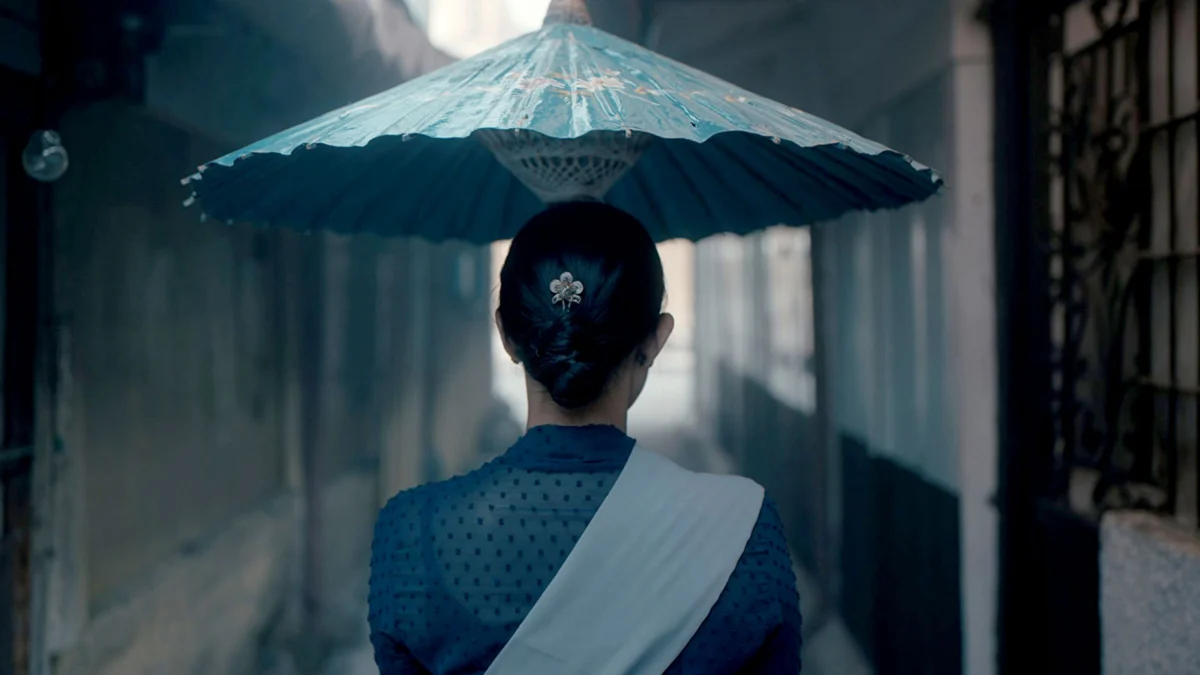
By focusing on the subjective experience, Andini creates a film where the political history of the 1960s serves merely as the backdrop to a deeply personal metamorphosis. Nana’s life is defined by what she loses: her father, her children, and her husband, Icang (Ibnu Jamil). She eventually seeks refuge in a second marriage to Darga (Arswendy Beningswara), a wealthy and respected village leader. To the outside world, she has found stability. Beneath the surface, however, she is a woman carefully curating a life of performance, storing her mounting secrets and emotions behind the rigid structure of her sanggul (traditional bun).
The Surrealist Subconscious: Dreams as a Mental Map
A significant portion of Nana is dedicated to the protagonist’s dream state. In the hands of a lesser director, dream sequences often serve as cheap parlor tricks or narrative misdirection. For Andini, they are vital, structural layers of mental reality.
As the pressures of her domestic life mount—compounded by the arrival of her husband’s mistress, Ino (Laura Basuki)—Nana’s subconscious begins to betray her. Initially, Ino is a nebulous, ill-defined figure, represented in dreams by the cows she sells. As Nana’s relationship with Ino deepens, the imagery sharpens, revealing the raw, uncomfortable truth of her husband’s infidelity.
The dream world in Nana acts as a conduit for suppressed desire and buried resentment. It is here that the film’s "surrealism" finds its justification. These nightmares are not distractions; they are the manifest symptoms of a woman forced into a life of stoic submission, haunted by guilt and the societal demand for perfection.
The Performance of Womanhood: Front Stage vs. Back Stage
The sociological concept of "front stage" and "back stage"—as defined by Erving Goffman—is central to understanding Nana’s domestic existence.
- The Front Stage: This is the public-facing persona. As a wife and mother in a patriarchal society, Nana must appear composed, dutiful, and unflappable.
- The Back Stage: This is where the mask slips. It is in the private moments—the pep talks before a mirror, the meticulous application of makeup, the brief, stolen moments of smoking—that we see the cracks in Nana’s armor.
Interestingly, Ino emerges as a resident of Nana’s "back stage." Their encounters at the vanity table or by the river transcend the traditional, adversarial trope of wife versus mistress. They bond as women, sharing the burden of societal expectations. When Nana is criticized for failing to keep her husband satisfied, it is Ino who offers defense and solidarity. In this shared space, Nana gains a new perspective: life is indeed a stage, but she learns she has the agency to decide which performance to uphold.

The Weight of Motherhood and the Price of Autonomy
The film’s emotional anchor is the recurring theme of separation from one’s children. This narrative thread is drawn from the book Jais Darga Namaku by Ahda Imran, which chronicles the life of Raden Nana Sunani from the perspective of her daughter, Jais.
Throughout the film, Nana is repeatedly stripped of her children, a sacrifice made for her own survival and the safety of her offspring. This trauma is visualized in her dreams, where she wanders in search of children who have vanished. When Nana contemplates leaving Darga to pursue a life with her first husband, Icang, the stakes are not merely romantic—they are existential. To choose her own happiness is to risk further estrangement from her children, a choice that looms large over the film’s climax.
The character of Dais (played by Chempa Puteri as a child and Arawinda Kirana as an adult) serves as the bridge between generations. Dais represents the mystery of the maternal figure: the child who experiences the separation and the adult who eventually questions the motives. The film masterfully uses surreal transitions to show the adult Dais confronting her mother across the boundaries of time, asking, "Why did you leave?"
The film’s answer is never explicitly spoken. Instead, it is whispered in the quiet, atmospheric scenes that define Nana’s long journey toward self-liberation.
Chronology of Production and Reception
- Adaptation: The film is rooted in the life of Raden Nana Sunani, as detailed in the biographical work Jais Darga Namaku.
- Development: Director Kamila Andini spent years refining the visual language of the film, focusing on the historical nuance of the Sundanese culture of the 1960s.
- Global Premiere: Nana made its mark on the international festival circuit, notably premiering at the 72nd Berlin International Film Festival, where it was lauded for its cinematography and performance.
- Awards and Accolades: The film received widespread critical acclaim, with Laura Basuki winning the Silver Bear for Best Supporting Performance at Berlinale, cementing the film’s status as a milestone in Indonesian cinema.
Implications: The Legacy of Silence
The implications of Nana extend far beyond its 103-minute runtime. By centering on the internal world of a woman in the 1960s, Andini highlights the universal struggle for agency within restrictive social structures.
The film suggests that "strength" for a woman of that era was often measured by her ability to endure silence. However, the true power of the film lies in its refusal to romanticize that silence. By the time the credits roll, the audience is left with a profound question: If Dais were to truly understand the weight of the choices her mother made, would she still ask, "Why did you leave?" Or would she look at her mother and ask, "How were you strong enough to survive?"
In Before, Now & Then, Kamila Andini has created a poignant meditation on the ghosts we carry and the courage it takes to eventually lay them to rest. It is a film that demands to be felt rather than just watched, proving that the most powerful stories are often the ones told in the quiet, trembling spaces between heartbeats.
Technical Specifications
- Before, Now & Then (Nana)
- Year: 2022
- Runtime: 103 minutes
- Director: Kamila Andini
- Screenplay: Kamila Andini, Ahda Imran
- Production: Fourcolours Films, Titimangsa Foundation
- Country: Indonesia
- Cast: Happy Salma, Laura Basuki, Arswendy Bening Swara, Ibnu Jamil, Arawinda Kirana, Rieke Dyah Pitaloka, Chempa Puteri