Diplomatic High Stakes: Trump Envoys Kushner and Witkoff Arrive in Kyiv for Peace Negotiations
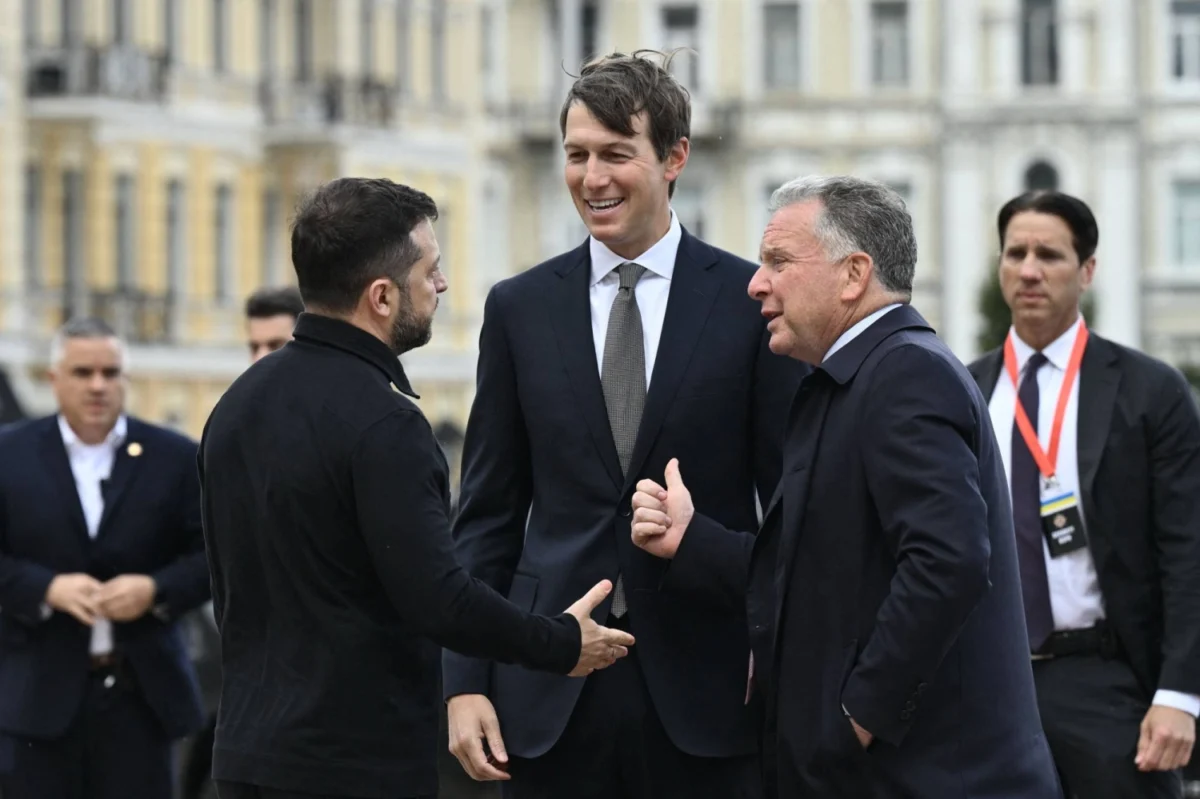
KYIV — The arrival of U.S. Special Envoys Jared Kushner and Steve Witkoff in the Ukrainian capital on Sunday marked a significant, albeit fraught, escalation in Washington’s attempts to find a diplomatic resolution to the four-and-a-half-year-old conflict. As the envoys stepped off the train in Kyiv, the atmosphere was thick with both the solemnity of the ongoing war and a palpable sense of skepticism regarding whether the Trump administration’s unorthodox approach can yield a lasting peace.
The meeting, held at the historic St. Sophia’s Cathedral—a site representing the resilience of Ukrainian identity—served as a symbolic backdrop for a delegation hand-picked by President Donald Trump to navigate the most complex geopolitical crisis of the decade.
The Mission: A New Framework for Peace?
The delegation, led by Jared Kushner, a central architect of the Abraham Accords during the first Trump administration, and Steve Witkoff, a prominent real estate investor and close advisor to the president, represents a departure from traditional state department-led diplomacy. Their mandate, according to sources close to the White House, is to bypass standard bureaucratic channels to seek a "rapid and durable" settlement.
President Volodymyr Zelenskyy, who hosted the envoys in a meeting that included representatives from the United Kingdom, Germany, and France, expressed cautious optimism. "There will be an opportunity for extensive discussion," Zelenskyy told reporters following the initial greeting. "I thank President Trump for allowing them to come."
However, the presence of the envoys has ignited intense debate among policy analysts and international observers. Critics point to the lack of traditional diplomatic experience in the delegation, while proponents argue that the protracted nature of the war—which has exhausted military stockpiles and seen massive loss of life—requires a fresh, non-traditional approach.
Chronology: Four and a Half Years of Attrition
To understand the weight of this weekend’s meeting, one must look back at the trajectory of the invasion, which began in early 2022 and has since evolved into a grueling war of attrition.
- February 2022: Russian forces launch a full-scale invasion of Ukraine, targeting major cities and sparking a massive humanitarian crisis.
- Late 2022 – 2023: Ukraine mounts a fierce resistance, reclaiming significant territory in the Kharkiv and Kherson regions with the support of a massive international coalition.
- 2024: The conflict settles into a stalemate. Both sides suffer immense casualties, and the front lines become increasingly fortified, resembling the trench warfare of the early 20th century.
- Early 2025: Political exhaustion begins to manifest in Western capitals. Discussions regarding "fatigue" and the sustainability of long-term financial aid become central to European and American political discourse.
- September 2026: The Trump administration pivots to a more direct intervention strategy, dispatching Kushner and Witkoff to Kyiv to initiate high-level talks.
The war has claimed hundreds of thousands of lives, displaced millions, and decimated Ukraine’s industrial and energy infrastructure. The economic burden on the global community has been equally staggering, with energy prices fluctuating wildly and supply chains facing persistent disruption.
Supporting Data: The Cost of the Conflict
The urgency behind the Kushner-Witkoff mission is underscored by the grim data emerging from the front lines and the domestic front in both Russia and Ukraine.
Recent intelligence reports suggest that the Russian military has undergone significant restructuring to compensate for early losses, while Ukraine remains heavily dependent on external financing to keep its government and military operational. According to the World Bank and the Ukrainian government, the total cost of reconstruction is estimated to exceed $750 billion, a figure that continues to rise as the bombardment of civilian infrastructure persists.
Furthermore, the "war fatigue" index in Europe has spiked. Public opinion polls across key NATO nations show a declining appetite for the indefinite provision of high-end weaponry, particularly as domestic economic pressures—ranging from inflation to energy transition costs—dominate the political agenda. The U.S. envoys are tasked with balancing these domestic political realities with the stated goal of ensuring a "sovereign and secure" Ukraine.
Official Responses and Diplomatic Friction
The reaction to the visit has been a study in contrasts. In Kyiv, government officials are walking a tightrope, expressing gratitude for American involvement while carefully maintaining their commitment to the "Peace Formula" originally proposed by Zelenskyy.

"We welcome the dialogue, but the parameters of our territorial integrity are non-negotiable," one senior Ukrainian official noted on condition of anonymity.
In Moscow, the Kremlin has remained predictably cautious, if not dismissive. Russian state media framed the visit as an attempt by Washington to "impose a dictated peace" that ignores the "geopolitical realities" on the ground. President Vladimir Putin has previously signaled that any negotiations must reflect the current front lines—a demand that Ukraine and its Western allies have historically rejected.
The inclusion of British, German, and French officials in Sunday’s talks suggests that the United States is attempting to create a "contact group" to present a unified front. By involving these European powers, the Trump administration may be seeking to distribute the diplomatic burden—and potential blame—should the negotiations falter.
The Implications: What Happens Next?
The mission of Kushner and Witkoff is fraught with risks. If they succeed in securing even a temporary ceasefire, it would be a landmark achievement for the Trump administration, potentially reshaping the global security architecture. However, if the talks collapse, it could expose deep divisions within the Western coalition.
1. The Territorial Dilemma
The primary hurdle remains the status of the occupied territories. For Kyiv, the objective is the restoration of its 1991 borders. For Moscow, the annexation of the Donbas and Crimea is presented as a "done deal." Any diplomatic breakthrough will likely require a creative, perhaps unprecedented, status for these regions—possibly involving international administration, demilitarized zones, or long-term lease agreements.
2. The Security Guarantee
Beyond territory, the question of Ukraine’s future security is paramount. Whether the envoys discuss a pathway to NATO membership or a "bilateral security guarantee" modeled after the U.S.-Israel relationship remains the subject of intense speculation. A security guarantee that lacks the teeth of Article 5 (NATO’s collective defense clause) may be viewed by Kyiv as insufficient to deter future aggression.
3. Domestic U.S. Politics
The involvement of Jared Kushner—a figure deeply linked to the Trump family—ensures that these negotiations will be viewed through the lens of American domestic politics. Supporters view it as a bold, pragmatic use of a trusted intermediary; detractors worry that the lack of institutional oversight could lead to concessions that undermine U.S. and NATO credibility for years to come.
Conclusion
As the sun set over the golden domes of St. Sophia’s Cathedral on Sunday, the contrast between the historic weight of the venue and the uncertainty of the mission was striking. The war in Ukraine has entered a phase where traditional battlefield victories are increasingly difficult to achieve, shifting the focus toward the diplomatic arena.
Whether the Kushner-Witkoff mission is the beginning of a genuine peace process or merely a high-profile diplomatic exercise remains to be seen. What is clear, however, is that the eyes of the world are now firmly fixed on this new, unpredictable channel of communication. The stakes could not be higher: the future of European security, the stability of the global order, and, most importantly, the survival of a nation that has spent nearly five years defending its right to exist.
As the envoys prepare for their next round of meetings, the international community waits to see if these hand-picked negotiators can achieve what thousands of diplomats, soldiers, and world leaders have struggled to do: turn the tide from war toward a lasting, if imperfect, peace.