From Demonology to Stardom: How ‘KPop: Demon Hunters’ Redefines Animated Spectacle
For first-time director Maggie Kang, the journey to KPop: Demon Hunters—now streaming on Netflix—was not merely a career milestone; it was the realization of a twenty-year creative obsession. Having previously served as Head of Story on The Lego Ninjago Movie, Kang brought a veteran’s structural precision to her directorial debut, yet her vision for this film was deeply personal. What began as a scholarly interest in Korean folklore and the aesthetic potential of demonology eventually morphed into a high-octane, neon-drenched collision between the world of supernatural combat and the global phenomenon of K-pop.
The result is a groundbreaking hybrid that manages to balance the high-stakes intensity of an action-fantasy epic with the emotional, character-driven beats of a classic K-drama. Produced in collaboration with Sony Pictures Animation, the film stands as a testament to the versatility of modern CG, pushing the boundaries of what audiences expect from animated musicals.
The Narrative Foundation: A Double Life of Rhythm and Ruin
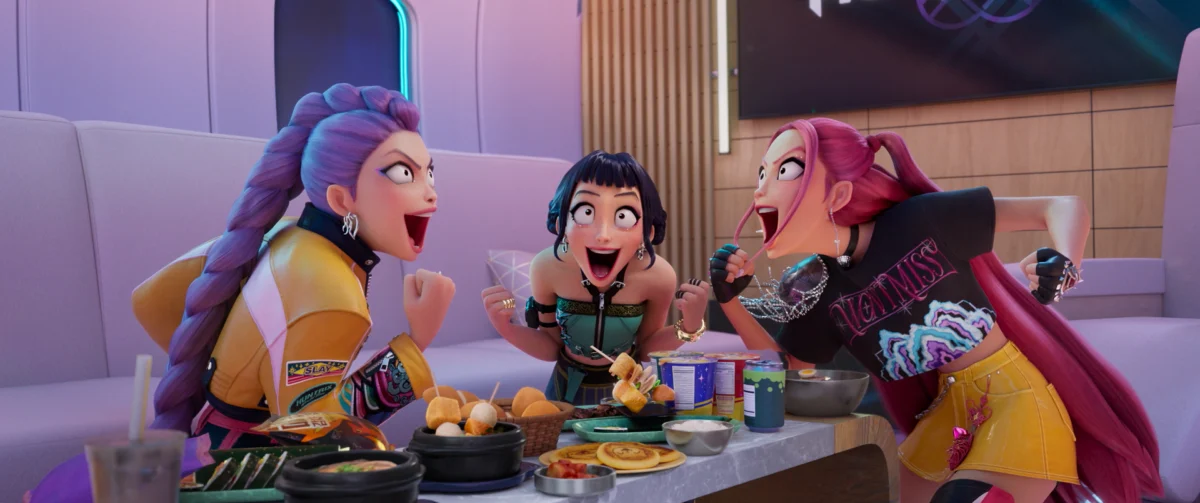
At the heart of KPop: Demon Hunters is the fictional girl group Huntrix, a powerhouse trio consisting of Rumi (voiced by Arden Cho), Mira (May Hong), and Zoey (Ji-young Yoo). By day, they are global icons, filling stadiums and dominating the charts. By night, they are elite, sword-wielding guardians tasked with protecting the human world from an encroaching supernatural menace.
The central conflict ignites when they face the fiery, malevolent Gwi-Ma, portrayed with menacing gravitas by Byung-hun Lee. However, the stakes are raised when a rival boy band, the Saja Boys—led by the mysterious and charismatic Jinu (Ahn Hyo-seop)—emerges on the scene. The narrative twist, which reveals the Saja Boys to be demons in disguise, provides the film with its most compelling K-drama elements. It forces the protagonist, Rumi, to grapple with a complex connection to Jinu, effectively exploring themes of dual identity, the "dark side" of fame, and the inherent loneliness of holding a secret that defines your entire existence.

A Two-Decade Evolution of Vision
Director Maggie Kang’s path to this project was fueled by a desire to see more nuanced representations of women in the superhero genre. "I was drawn to demonology and thought that it would be very visually impactful to feature in mainstream media," Kang explained in an interview with IndieWire. "And so that naturally led to demon hunters and a group of really badass superhero women. I felt like I wasn’t seeing women who were too relatable for me in this superhero market that is so saturated."
Kang’s goal was to strip away the hyper-polished veneer often applied to female protagonists in action films. She wanted characters who were "funny and goofy," characters who were unafraid to look "stupid or ugly" while gorging themselves on snacks in the quiet, mundane moments between world-saving battles.
Interestingly, the K-pop element was a late addition to the script. The team realized that for the girls to operate as demon hunters in a modern setting, they needed a legitimate public cover. K-pop, with its inherent requirement for spectacle, global scale, and rigorous performance standards, provided the perfect narrative vessel. It allowed the film to transition seamlessly from musical numbers to high-stakes combat, effectively serving as both a stylistic choice and a practical plot device.
The Technical Marvel: Bridging 3D and 2D Aesthetics
To bring this world to life, the production turned to Sony Pictures Imageworks—the same studio responsible for the revolutionary visual language of the Spider-Verse franchise. Under the guidance of co-director Chris Appelhans (Wish Dragon), the film adopted a unique visual language that merges the dimensionality of 3D computer animation with the expressive, "goofy" aesthetic of traditional 2D anime.

"You want to find some unique visual elements for your film that are unique to animation, and you need to let the film help tell you what those are," Appelhans noted. The team intentionally avoided the "momentary illustration" look, opting instead for a "claymation-inspired" approach that keeps characters feeling grounded and tactile, even during high-velocity action sequences.
This aesthetic choice was critical for capturing the extreme, often hyper-ridiculous facial expressions characteristic of K-dramas. By embracing this approach, the team successfully created a film that doesn’t just mimic 2D shorthand but utilizes a full, three-dimensional range of motion to heighten the emotional stakes of the story.
The Challenge of the Musical Action Sequence
One of the most significant logistical hurdles during production was the integration of musical numbers with action choreography. Because the animation had to be meticulously timed to the soundtrack, the production team often had to wait for the final songs to be completed before finalizing the animation.
To circumvent this, the team relied on extensive storyboarding and "pre-vis" work, cutting to the tempos of early demo tracks. The film features three standout musical set-pieces: "Golden," "What It Sounds Like," and the lead single, "Takedown." The latter, performed by members of the real-world K-pop juggernaut TWICE (Jeongyeon, Jihyo, and Chaeyoung), became the anchor for the film’s high-energy climax.

The "plane fight" sequence serves as a masterclass in this integration. Influenced by the rhythmic editing of Edgar Wright’s Baby Driver, the sequence sees the Huntrix trading blows with demons in perfect sync with the beat of a rap track. As Kang noted, "As soon as the music kicks in, we change lighting, all these other things happen. We just wanted the girls to have fun and kick butt to the beat."
Complexity and Technical Innovation: The "Zombie Train"
The film’s most technically demanding sequence is the "train fight," which features a massive, flowing horde of zombie-like demons. Managing such a high volume of characters required significant innovation from the animation team.
Appelhans revealed that the team utilized "simple volumes" during the prototyping phase to map out the movement of the masses, which were later "decorated" with the intricate, multi-layered designs of the individual demon models. This allowed the directors to maintain the illusion of overwhelming speed and scale while keeping the audience oriented within the chaotic environment of the moving train.
Implications for the Future of Animation
The success of KPop: Demon Hunters suggests a shift in the animation landscape. By treating the musical performance not as a break from the narrative, but as a critical component of the story’s action, Kang and her team have demonstrated that genre-mashing is a viable, and indeed, highly effective way to reach modern audiences.

Furthermore, the film’s willingness to experiment with "happy accidents"—a rarity in the highly planned world of animation—sets a new precedent. By filming "coverage" and exploring sequences in a way that mirrors live-action filmmaking, the team discovered moments of authentic chemistry between characters that might have been lost in a more rigid, traditional production pipeline.
A Cultural Landmark
As KPop: Demon Hunters finds its audience on Netflix, it serves as more than just an entertaining romp. It is a bridge between the vibrant, high-energy world of Korean pop culture and the global language of animation. By centering the story on the complex, messy, and deeply human experiences of its three leads, Maggie Kang has delivered a film that feels both hyper-modern and deeply traditional in its heart.
For the animation industry, the film stands as a bold assertion that the future lies in the synthesis of styles, the courage to blend genres, and the unwavering commitment to character depth. Whether one is a die-hard K-pop fan or a devotee of high-concept animation, KPop: Demon Hunters offers a spectacle that is as emotionally resonant as it is viscerally exciting.