[Editor’s Note: This article contains major spoilers for Disney and Pixar’s “Elio.”]
Original animated feature films face an uphill battle at the global box office. In an era dominated by established intellectual properties, sequels, and cinematic universes, breaking out an unfamiliar concept requires a delicate alchemy of bold visuals and resonant storytelling. Under the creative leadership of Pixar Chief Creative Officer Pete Docter, the studio’s recent slate has leaned heavily into deeply personal narratives. Yet, even within Pixar’s hallowed halls, getting these unique visions across the finish line is rarely a smooth process.
No project in recent memory exemplifies this high-stakes creative wrestling match quite like Elio. The sci-fi comedy-adventure, which follows an imaginative young boy swept up in an intergalactic misunderstanding, underwent a massive structural and directional overhaul before finally crystallizing into its theatrical form.
Through a combination of leadership shifts, late-stage script rewrites, and a steadfast dedication to grounding cosmic chaos in genuine emotional isolation, Pixar’s creative team managed to rescue a troubled production—transforming a standard alien abduction tale into a poignant exploration of belonging.
The Chronology of a Creative Course Correction
The journey of Elio to the big screen was defined by pivots, departures, and a collaborative tag-team effort among some of the studio’s brightest minds.
Initially, the project was spearheaded solely by first-time feature director Adrian Molina, who previously co-directed the acclaimed 2017 hit Coco. However, as the immense pressures of crafting an original animated tentpole mounted, the production necessitated a strategic course correction. Molina ultimately stepped down from his solo director’s chair to rejoin Lee Unkrich as a co-director on the upcoming Coco 2.
Recognizing the need for a visionary to cross the finish line with Molina’s pet project intact, the studio tapped Coco story artist Madeline Sharafian to step up. Sharafian, celebrated for her knack for incisive character introductions and emotional sincerity, didn’t just inherit the film; she fought for its soul. She was soon joined by Turning Red director Domee Shi, who bonded with Sharafian during her stint as a story artist on the film. Together with Molina, Sharafian and Shi forged a directorial trio supported by producer Mary Alice Drumm.
This creative leadership shift was catalyzed by a piece of vital internal critique. Sparked by a rallying cry from WALL-E director Andrew Stanton—who famously challenged the crew to “make me care”—the team realized that Elio’s motivations needed to transcend a simple, quirky sci-fi premise. They needed to anchor the story in a profound emotional truth.
Main Facts: Elevating the Stakes and Grounding the Sci-Fi
The early iterations of Elio featured a more traditional setup: a young boy gets accidentally abducted by aliens, leading to standard fish-out-of-water comedy beats. Under the guidance of Sharafian, Shi, and Drumm, the narrative was overhauled to deepen the emotional stakes from frame one.
1. From Parents to a Stressed Aunt
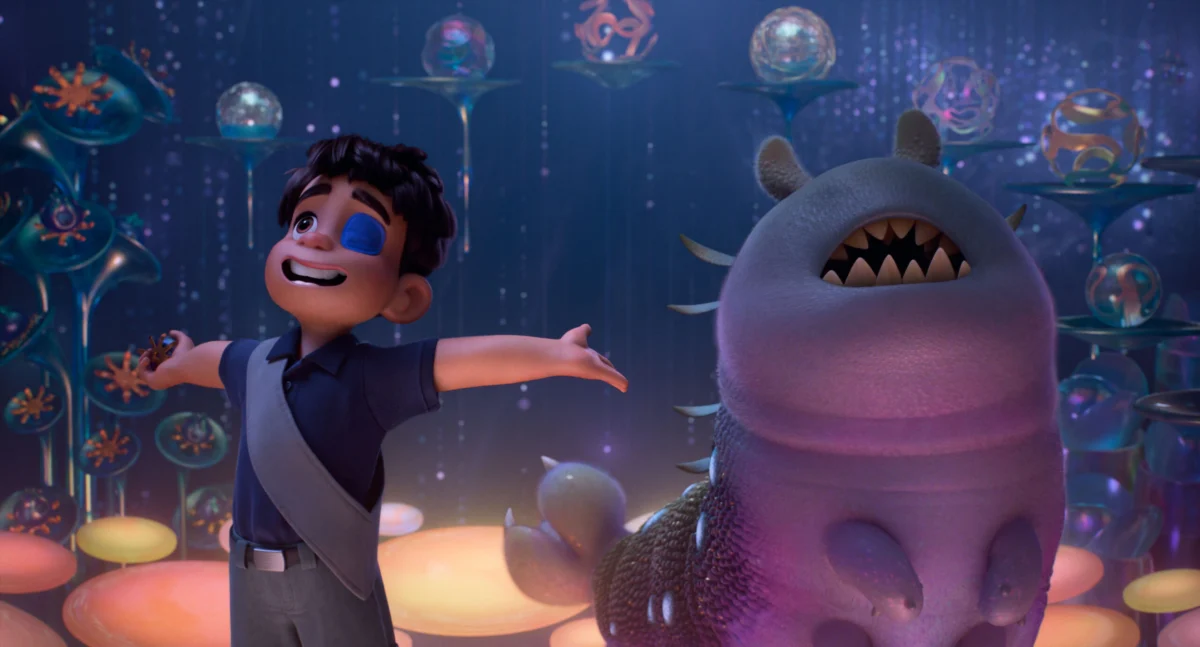
In the revised narrative, Elio (voiced by Yonas Kibreab) is rendered entirely an orphan, having lost his parents prior to the events of the film. His mother figure was replaced by his stressed-out, overworked aunt, Olga (originally slated to be voiced by America Ferrera, before Oscar winner Zoe Saldaña stepped into the role).
This heavy narrative choice instantly defines Elio’s desperate sense of isolation. Space ceases to be a mere playground for sci-fi tropes; it becomes a beacon of hope—a desperate psychological escape hatch for a boy who feels invisible on an isolated Air Force base.
2. Subverting the Abduction
Rather than showing the traumatic moment of parental loss, the filmmakers smartly anchor Elio’s obsession with space to a quiet, wondrous moment at a museum exhibit. Lying down while Kate Mulgrew’s voice washes over him as he listens to NASA’s Voyager Golden Record, Elio falls in love with the cosmos.
This sets up a brilliant, darkly comedic montage set to the Talking Heads’ “Once in a Lifetime.” Wearing a colander on his head, ignoring his peers, and clashing with Aunt Olga, Elio actively pleads to be abducted. When the tractor beam finally lifts him up to the heavenly, bureaucratic Communiverse interplanetary space station—subverting the terrified "No thanks" reaction seen in early teaser trailers—the audience is fully onboard with his eccentric mission.
Supporting Data and Creative Choices
The collaborative environment at Pixar relies heavily on the "Brain Trust," a sounding board of directors and storytellers who offer rigorous notes. During these sessions, Sharafian frequently found herself defending core thematic choices that some executives initially questioned.
"I remember being in some of those later meetings with Adrian fighting for some of the scenes in the movie," Sharafian recalled in an interview. "One was that early scene where Elio watched the Golden Record Voyager leave Earth, and there were some voices in the room that didn’t think it was necessary. I could see Adrian’s face sort of stricken, and I was like, ‘No, you have to ease the audience into the movie. This is thematically relevant, it’s about Elio connecting with that [NASA] satellite in space.’"
Producer Mary Alice Drumm noted that the creative team’s personal backgrounds heavily mirrored Elio’s plight:
"With Adrian, he had grown up as an artsy kid. His dad was a military dentist, and he would talk about being this kid that didn’t fit in and feeling lonely. And I think Maddie and Domee both have that similar story and overlap a lot. They’re like a Venn Diagram of taste… The more we started talking to the crew about it, they really grabbed onto that idea. It really galvanized us. It became our North Star—a weird boy who learns to connect with aliens in outer space."
Redefining the Antagonists
The script adjustments also extended to the film’s alien hierarchy. In earlier drafts, Elio bonded directly with Lord Grigon (voiced by Brad Garrett), a fierce alien warlord ruling the planet Hylurg. However, the writers realized that the emotional resonance landed much harder when Elio bonded instead with Grigon’s worm-like son, Glordon (Remy Edgerly).
Initially appearing terrifying in a parody of Ridley Scott’s Alien, Glordon turns out to be just as lost and lonely as Elio. Lord Grigon was subsequently rewritten into an aggressive, armored obstacle from the very beginning. His emotionally distant relationship with Glordon serves as a direct mirror to Olga and Elio’s dynamic on Earth. A late-stage rewrite by screenwriter Julia Cho ultimately crafted the tender, tear-jerking father-son reconciliation that anchors the film’s climax.
Official Responses and Behind-the-Scenes Insights
The filmmakers were unabashed about expanding Pixar’s emotional palette to include genres typically foreign to the studio, such as sci-fi horror and thriller elements.
"We were leaning into our love of sci-fi and horror, and it felt like a fun opportunity as well," Domee Shi explained. "Pixar movies make you laugh or they make you cry, but I feel like movies can make you thrilled or on the edge of your seat, or gasping, surprised, and I love getting those reactions out of audiences, too."
This philosophy bled into the film’s subplot involving Elio’s ever-pleasing clone, who temporarily replaces him on Earth. The uncanny valley creepiness of the clone introduces a layer of dark comedy that forces Aunt Olga to realize the substitute is a fake.
This realization pays off in a stunning emotional beat on a beach, where Olga reunites with the real Elio. The scene hinges on the removal of Elio’s eye patch—an injury sustained from a scuffle with an Earth bully named Caleb (Jake Getman). While the patch initially made Elio feel "othered" on Earth, space turned it into a badge of honor, making him feel like a dashing space pirate.
Sharafian elaborated on the evolution of this crucial payoff:
"There were multiple spots where we thought, maybe they can take the eye patch off here, maybe there. We had it more as a joke. But what we realized was this moment of reuniting needed to be reworked because it wasn’t emotional enough… Having Olga peel off that eye patch, and finally, they’re seeing each other for the first time, and she realizes she knows him, and he finally feels wanted. It was such a delightful payoff."
Implications for Pixar’s Future
The tumultuous development and ultimate reinvention of Elio carry significant implications for Walt Disney Animation and Pixar moving forward.
The Cost of Originality:Elio highlights the sheer difficulty of launching original IP in a risk-averse theatrical marketplace. Audiences no longer flock to animation purely on brand recognition; films must offer distinct visual identities and visceral emotional hooks to cut through the noise.
Collaborative Stewardship: By allowing directors like Adrian Molina to transition back to established hits while empowering artists like Madeline Sharafian and Domee Shi to reshape a faltering project, Pixar has demonstrated a willingness to prioritize the health of the film over rigid auteur ego.
Genre Fluidity: The successful infusion of sci-fi action, horror subversion, and high-stakes emotional drama proves that Pixar’s signature formula can stretch beyond cozy family dynamics into genre-bending territory without losing its soul.
Ultimately, Elio stands as a testament to the messy, collaborative, and often miraculous reality of modern animation production. By leaning into universal themes of loneliness, isolation, and the desperate search to be understood, Pixar turned a chaotic cosmic misadventure into a deeply human journey.