‘KPop Demon Hunters’ Built a Soundtrack to Slay Global Pop Charts
Main Facts: A Global Cultural Juggernaut
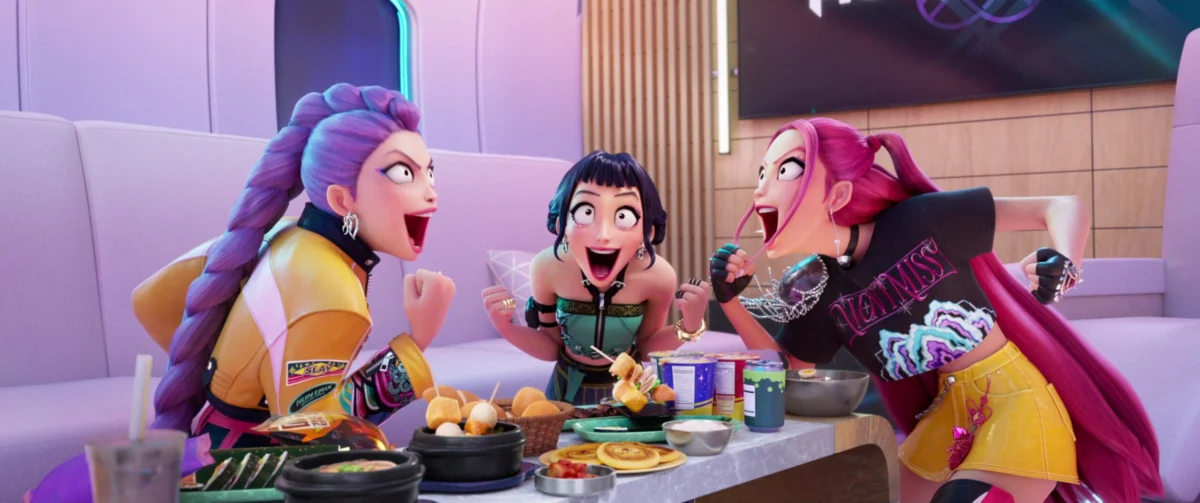
Since premiering on Netflix on June 20, the animated musical feature KPop Demon Hunters has transcended traditional media boundaries, evolving from a streaming anomaly into an international multi-platform powerhouse. Directed by Maggie Kang and Chris Appelhans, the film follows the high-stakes double life of Huntr/x—a fictional K-pop powerhouse trio comprised of Rumi (voiced by Arden Cho), Mira (voiced by May Hong), and Zoey (voiced by Ji-young Yoo). By day, they dominate the global pop charts; by night, they serve as elite demon hunters tasked with protecting humanity from supernatural threats.
The narrative reaches a fever pitch when a charming, rival boy band known as the Saja Boys bursts onto the scene, only to be unmasked as demons in disguise. With the fate of the world resting on their shoulders, Huntr/x must use their musical prowess and combat skills to vanquish the threat.
However, the film’s conquest has not been limited to the screen. KPop Demon Hunters has effectively conquered the real-world music industry, breaking historical streaming records, dominating global airwaves, and reshaping how Hollywood approaches animated movie soundtracks. Backed by executive music producer Ian Eisendrath and an elite team of top-tier K-pop songwriters—including South Korea’s renowned Black Label, Jenna Andrews, Lindgren, and EJAE—the film’s music is functioning not merely as a narrative device, but as an authentic, chart-topping commercial enterprise.
Chronology: From Concept to Global Domination
The journey of KPop Demon Hunters from an ambitious animation concept to a worldwide cultural phenomenon spans years of meticulous planning, cross-cultural collaboration, and iterative creative processes.

Pre-Production and Collaborative Genesis (2023–2024)
Co-directors Maggie Kang and Chris Appelhans, alongside producer Michelle Wong, spent a full year collaborating with executive music producer Ian Eisendrath before a single line of dialogue or lyric was finalized. Unlike traditional animated musicals where songs are retrofitted to serve immediate plot points, the team established a unique directive: the soundtrack had to function first and foremost as a collection of authentic, high-caliber K-pop hits.
Production logistics involved assembling a cross-continental "songwriting camp." Writers from Los Angeles and Seoul—including Stephen Kirk, Mark Sonnenblick, and EJAE—participated in a massive cross-pollination effort. Crucially, the production team chose to construct full, standalone album versions of every track before slicing and dicing them to fit the film’s narrative structure.
The Iterative Crucible (Late 2024)
Song development proved to be an intense, highly collaborative crucible. For the film’s centerpiece anthem, "Golden," the creative team cycled through five different writers and seven distinct musical iterations over several months. The final version—co-written by EJAE Kim and Mark Sonnenblick with production by the Black Label—was recorded as late as December, an exceptionally tight timeline for a major animated feature. Similarly, novelty tracks like "Soda Pop," performed by the villainous Saja Boys, required multiple revisions to balance bubblegum-pop appeal with dark, double-entendre lyricism hinting at the characters’ true demonic nature.
Summer 2025 Release and Chart Revival (June–July 2025)
- June 20, 2025: KPop Demon Hunters officially premieres worldwide on Netflix, instantly capturing audience attention and securing a spot in the Netflix Global Top 10.
- Early July 2025: The film momentarily slips to #2 on the platform’s English charts following the debut of Charlize Theron’s action sequel The Old Guard 2.
- Week Ending July 13, 2025: Powered by strong word-of-mouth and viral social media traction, KPop Demon Hunters reclaims the #1 spot on Netflix’s Global Top 10 (English) with a staggering 40,400,000 hours viewed, marking its fourth consecutive week in the upper echelon of streaming metrics.
Supporting Data: Breaking Records on the Charts
The metrics behind KPop Demon Hunters demonstrate an unprecedented crossover success that blurs the lines between animated cinema and the real-world music industry.

- Streaming Longevity: According to Netflix viewing data for the week ending July 13, the film accumulated 40,400,000 hours viewed, spending four consecutive weeks in the Global Top 10 (English) and recapturing the #1 position.
- Global Billboard Dominance: The film’s breakout single, "Golden," currently sits at #1 on both the Billboard Global 200 and the Billboard Global Excluding U.S. charts. Netflix has confirmed plans to officially submit the track for major awards consideration.
- Soundtrack Performance: The official KPop Demon Hunters movie soundtrack has climbed to #2 on the Billboard Global 200 chart, competing directly against major mainstream pop releases.
- Spotify History: The Saja Boys’ track "Your Idol" recently surged to the #1 spot on the US Spotify chart, officially crowning them as the highest-charting K-pop group in Spotify history—a milestone that notably eclipses previous streaming milestones set by global superstars BTS.
- Creative Output: Throughout the production cycle, the music team considered over 30 original songs across seven designated musical spots within the film, rigorously testing multiple versions to achieve cultural and narrative resonance.
Official Responses: Insights from Executive Music Producer Ian Eisendrath
In an exclusive interview with IndieWire, executive music producer Ian Eisendrath opened up about the philosophy, challenges, and surreal triumphs of crafting the film’s auditory landscape.
Reflecting on the initial goals for the project, Eisendrath noted the ambition behind the soundtrack:
"The directive was very much ‘We want to create a soundtrack of real K-pop hits.’ That was the goal. This is not one of those films where it’s like, ‘Let’s hire some people to write in the style of it.’ This soundtrack needs to land and exist as a K-pop album, but also work within the film and cover the narrative territory it needs to cover and fit in the mouths of each of the characters, which is not something that K-pop traditionally does."
Addressing the unique songwriting process—which mirrored the famous collaborative camps of the South Korean music industry—Eisendrath highlighted the benefits of artistic cross-pollination:

"It was beneficial in many ways. One, it is how pop music is made, and usually it is a group of artists that get thrown into a camp together, and they come out the other end with something cool. Having a group of people and figuring out what their strengths were and who they would partner best with was a real bonus for the project."
Eisendrath also detailed the grueling yet rewarding creative journey behind the chart-topping global smash "Golden":
"Ironically, ‘Golden’ was the one that had the most iterations. We had 5 different writers on it and seven different songs by the time we were done. It took a long time. It’s an interesting ask because it had to be very much life imitating art, and something that would top the charts… It was a dream team, and it was the last thing we recorded as late as December of this last year, which is very, very late for animation. It’s gratifying that that’s the one."
When asked about the cultural validation of seeing global fans—and even real-world K-pop royalty like BTS—engage with the music, Eisendrath expressed profound awe:

"Yeah, it’s crazy. It’s super exciting and validating because we were trying to create something that the Korean culture would feel like was created by them, and also that they loved, so to see that, I don’t think there’s any greater sort of reward from doing this project. Also, this project is Maggie Kang’s. This is so deeply from her brain and heart."
Regarding the growing public appetite for a follow-up, Eisendrath didn’t hesitate to share his personal aspirations:
"I would love it. It would be a dream. I could do this forever."
Implications: A New Blueprint for Animated Musicals
The runaway success of KPop Demon Hunters carries significant implications for the future of Hollywood animation, streaming economics, and transmedia pop culture integration.

1. Redefining the Animated Soundtrack Model
Historically, animated musical features rely on traditional theatrical composers to write character-driven numbers that advance the plot at the expense of contemporary radio viability. KPop Demon Hunters has shattered this paradigm by proving that an animated film can yield legitimate, chart-topping pop singles that dominate Spotify and Billboard independently of the film itself. By treating the music pipeline like a real-world K-pop agency comeback—utilizing collaborative writing camps and South Korean production houses—Netflix has unlocked a lucrative secondary revenue stream in music streaming and licensing.
2. Cultural Authenticity as a Commercial Driver
The film’s triumph underscores the commercial viability and critical necessity of cultural authenticity. Helmed by co-director Maggie Kang—whose lifelong passion for K-pop infused the project with genuine appreciation—the film avoided the trap of producing a generalized, Westernized caricature of the genre. Consequently, the project earned the embrace of both the global K-pop fandom and Korean cultural tastemakers, culminating in organic viral marketing, fan cover videos, and even casual shout-outs from real-world K-pop icons like BTS.
3. Awards Season Momentum and Franchise Potential
With Netflix officially backing "Golden" for major awards consideration, KPop Demon Hunters is poised to make significant noise during the upcoming awards season, potentially bridging the gap between mainstream pop music accolades and traditional animation achievements. Furthermore, with the soundtrack dominating global charts and streaming numbers holding steady through four consecutive weeks, discussions regarding a potential sequel (K-pop Demon Hunters 2) appear not only commercially viable, but practically inevitable.
As streaming platforms continue to search for intellectual properties capable of breaking through an increasingly crowded digital landscape, KPop Demon Hunters has established a gold standard: marry high-concept genre storytelling with uncompromising, world-class pop production, and let the culture take care of the rest.