Behind the Scenes of KPop: How Maggie Kang and Chris Appelhans Blended Glitz, Beats, and Supernatural Warfare
Main Facts
The Netflix and Sony Pictures Animation feature KPop: Demon Hunters represents a groundbreaking cultural and creative milestone. Directed by first-time feature filmmaker Maggie Kang—whose previous credits include serving as head of story on The Lego Ninjago Movie—alongside co-director Chris Appelhans (Wish Dragon), the film merges the high-energy spectacle of the global music phenomenon with high-stakes fantasy action.
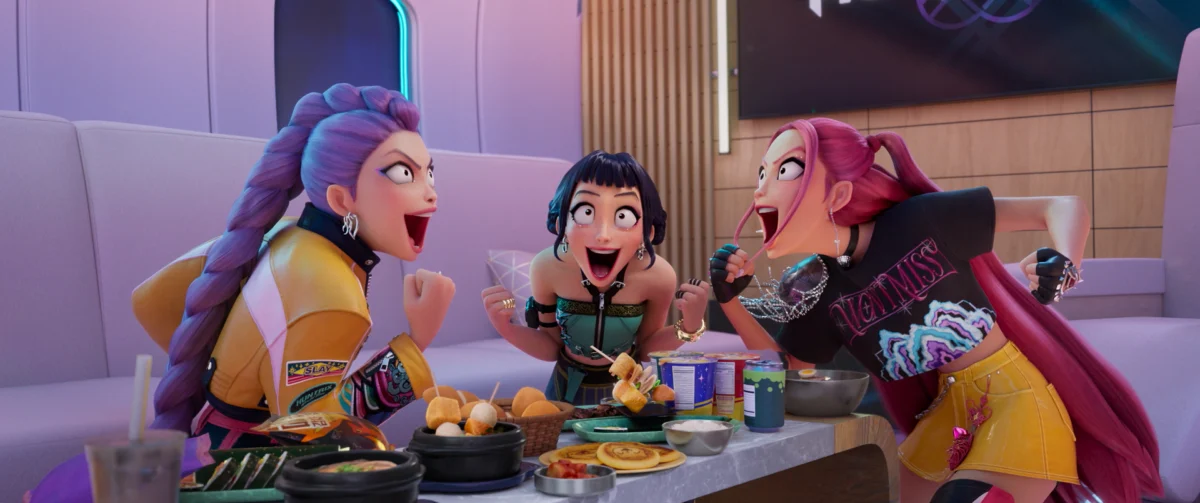
At its core, the movie follows "Huntrix," a globally dominant K-pop girl group whose members lead secretive double lives as elite demon hunters. The group comprises Rumi (voiced by Arden Cho), Mira (May Hong), and Zoey (Ji-young Yoo). Together, they must protect their massive fandom from the fiery, underworld-ruling supernatural entity Gwi-Ma (Byung-hun Lee). The narrative thickens when the Huntrix find themselves threatened by a breakout rival act: the Saja Boys, an irresistibly charming boy band whose members are actually undercover demons led by the enigmatic Jinu (Ahn Hyo-seop).
The project brings together an all-star creative and technical pipeline. Visually, the film utilizes anime-influenced computer-generated imagery executed by Sony Pictures Imageworks—the studio renowned for its revolutionary work on the Spider-Verse franchise. Musically, the movie features blockbuster tracks such as "Golden," "What It Sounds Like," and the lead single "Takedown," which was performed by Jeongyeon, Jihyo, and Chaeyoung of the real-world K-pop powerhouse TWICE.

Chronology
The genesis of KPop: Demon Hunters spans two decades, born from Maggie Kang’s long-standing desire to bring authentic Korean cultural elements into mainstream Western animation.
- The Two-Decade Evolution: Kang’s initial inspiration centered on traditional Korean demonology, which she recognized as visually rich and underrepresented in Western media. Over time, the concept evolved from a straightforward supernatural thriller into an action-comedy musical.
- Structuring the Narrative: Interestingly, the K-pop element was one of the final pieces folded into the story design. Because demon hunting traditionally requires secrecy, Kang realized the protagonists needed a plausible public facade. A massive pop group provided the ideal cover, simultaneously injecting high spectacle, musical scaling, and commercial viability into the pitch.
- Production and Pipeline Challenges: Once Sony Pictures Imageworks boarded the project, the directors faced major technical and artistic hurdles. Animators had to wait for core musical tracks to be finalized before locking down visual choreography. Consequently, sequences were storyboarded dynamically to match specific tempos.
- Sequencing the Action: Action pieces were meticulously paced. The frantic plane fight sequence—stylistically likened to Edgar Wright’s Baby Driver—was among the last to be animated. Meanwhile, the sprawling train battle against a horde of zombie-like entities tested the technical limits of crowd rendering.
- Release: Following years of development, KPop: Demon Hunters has officially debuted on Netflix, capturing global audiences.
Supporting Data
The production of KPop: Demon Hunters relied heavily on innovative technical pipelines and unique artistic choices to bridge the gap between 3D animation and 2D aesthetic sensibilities.
- Studio Collaboration: The film is a major co-production between streaming giant Netflix and Sony Pictures Animation, leveraging the technical prowess of Sony Pictures Imageworks.
- Vocal Talent and Soundtracks: The cast features prominent Korean-American and international talent, including Arden Cho, May Hong, Ji-young Yoo, Byung-hun Lee, and Ahn Hyo-seop. The soundtrack features high-profile collaborations, anchored by TWICE members Jeongyeon, Jihyo, and Chaeyoung performing the lead single "Takedown."
- Visual Styling: Instead of opting for traditional ultra-realistic 3D rendering, the directors chose a dimensional, claymation-inspired approach. This allowed characters to transition seamlessly between high-glam pop star aesthetics and hyper-exaggerated, comedic facial expressions reminiscent of classic anime.
- Complex Scene Rendering: The train sequence required animators to prototype massive crowds using simple volume blocks before populating the space with hundreds of uniquely rendered zombie demons, creating a dizzying illusion of speed at thousands of miles per hour.
Official Responses
The creative team behind KPop: Demon Hunters has spoken candidly about the inspirations and philosophical choices that shaped the film’s unique identity.

Reflecting on her motivations, director Maggie Kang explained her desire to subvert conventional superhero tropes. "I was drawn to demonology and thought that [it] would be very visually impactful to feature in mainstream media," Kang told IndieWire. "And so that naturally led to demon hunters and a group of really badass superhero women. I felt like I wasn’t seeing women who were too relatable for me in this superhero market that is so saturated."
Kang emphasized that she wanted the protagonists to possess genuine flaws, humor, and vulnerability—characters who are unafraid to look "stupid and ugly" while gorging on snacks before a massive concert or a grueling battle.
Co-director Chris Appelhans noted how these character choices directly influenced the film’s visual language. "You wanna find some unique visual elements for your film that are unique to animation, and you need to let the film help tell you what those are," Appelhans told IndieWire. "And so this idea that Maggie had, representing women with more range, was really helpful in pulling from this wonderful language of goofy, cheapie aesthetic that some anime do."

Discussing the experimental nature of the production, Appelhans noted the unusual workflow required for the musical numbers. Unlike standard animated films, the team shot extensive live-action-style coverage to capture "happy accidents." "You have to draw it all first and plan it out, so it was a mind bender," Appelhans admitted. "But it was exciting to do a sequence that’s about building a song, telling a story, and also cutting on beats and having action and dialogue happen."
Implications
KPop: Demon Hunters arrives at a pivotal juncture in the animation and entertainment industries, carrying significant cultural and commercial implications.
- Representation and Cultural Authenticity: By rooting a major Western-produced animated feature deeply in Korean folklore and contemporary pop culture, the film proves that culturally specific narratives can achieve broad, mainstream global appeal without diluting their roots.
- Evolution of the Musical Animation Genre: Following in the footsteps of modern visually stylized hits, the film demonstrates how synchronization between musical tempo and action choreography can elevate animated storytelling. The integration of real K-pop superstars (like TWICE) blurs the line between commercial music releases and cinematic tie-ins.
- Redefining Female Superheroes: The deliberate push for multidimensional, humorous, and imperfect female protagonists offers a refreshing antidote to the overly polished superhero archetypes that have dominated box offices for the past two decades.
- Technological Benchmarks for Sony Pictures Imageworks: Building upon the visual breakthroughs of the Spider-Verse series, the film pushes the envelope on how CG pipelines can successfully emulate 2D, anime-influenced stylization while handling complex, high-velocity action sequences and massive crowd simulations.