The Architecture of Silence: An Analytical Deep Dive into Kamila Andini’s ‘Before, Now & Then (Nana)’
Kamila Andini has long established herself as a filmmaker who masterfully translates the abstract language of human emotion into tangible, often surreal, visual grammar. In her past works—the grief-stricken choreography of Sekala Niskala (The Seen and Unseen) or the poignant, installation-like mirror trees in The Mirror Never Lies—Andini demonstrated an uncanny ability to externalize the internal. With her 2022 masterpiece Before, Now & Then (Nana), she takes this aesthetic prowess to its most natural habitat: the fluid, unsparing landscape of dreams.
The film is not merely a period piece set against the turbulent backdrop of post-independence Indonesia and the political fragility of the 1960s. It is a psychological portrait of Raden Nana Sunani (Happy Salma), a woman whose existence is defined by the heavy, invisible weight of secrets. By prioritizing the subjective experience of its protagonist over historical exposition, Nana invites audiences into a sensory exploration of trauma, resilience, and the quiet rebellion of the female spirit.
The Chronology of Trauma: A Life Defined by Loss
The narrative arc of Nana is punctuated by historical displacement, yet it remains stubbornly intimate. The film opens in the immediate aftermath of Indonesia’s struggle for independence. Nana and her companion, Ningsih (Rieke Dyah Pitaloka), are refugees of a different kind—fleeing not from the formal armies of the Dutch or the Japanese, but from the encroaching, nameless "gerombolan" (militia groups).
Andini’s directorial choice to keep these threats largely verbal is a stroke of brilliance. The horror is never fully staged for the viewer; instead, it is internalized. When Nana imagines the militia beheading her father, the violence is a projection of her own terror, not a spectacle for the audience. This narrative economy serves a specific purpose: it highlights that for Nana, the political is profoundly personal.
As the story progresses, the losses mount. Nana loses her father, her children, and her husband, Icang (Ibnu Jamil), to the chaos of the era. She eventually finds sanctuary in a marriage of convenience with Darga (Arswendy Beningswara), a wealthy and respected local leader (lurah). To the outside world, Nana has achieved stability. To herself, she has merely moved into a new, more gilded cage—one that demands she suppress her identity, swallow her grief, and curate a flawless performance of domestic perfection.
Dreams as the Unfiltered Language of the Soul
In Nana, the subconscious acts as a vital narrative conduit. While the waking world forces Nana to adhere to strict societal scripts, her dreams offer an unvarnished window into her psyche.
The Symbolic Power of the Dreamscape
Dreams in this film are not tricks or plot devices meant to confuse the viewer; they are legitimate mental layers. When Nana dreams of the past, she sees Icang; when she encounters the presence of Ino (Laura Basuki), Darga’s mistress, she begins to manifest in these visions as well. Initially, Ino is obscured, represented merely by the livestock she trades, reflecting Nana’s subconscious reluctance to acknowledge her husband’s infidelity. As the two women grow closer, the dream-image of Ino sharpens, eventually appearing in the bed next to Darga.
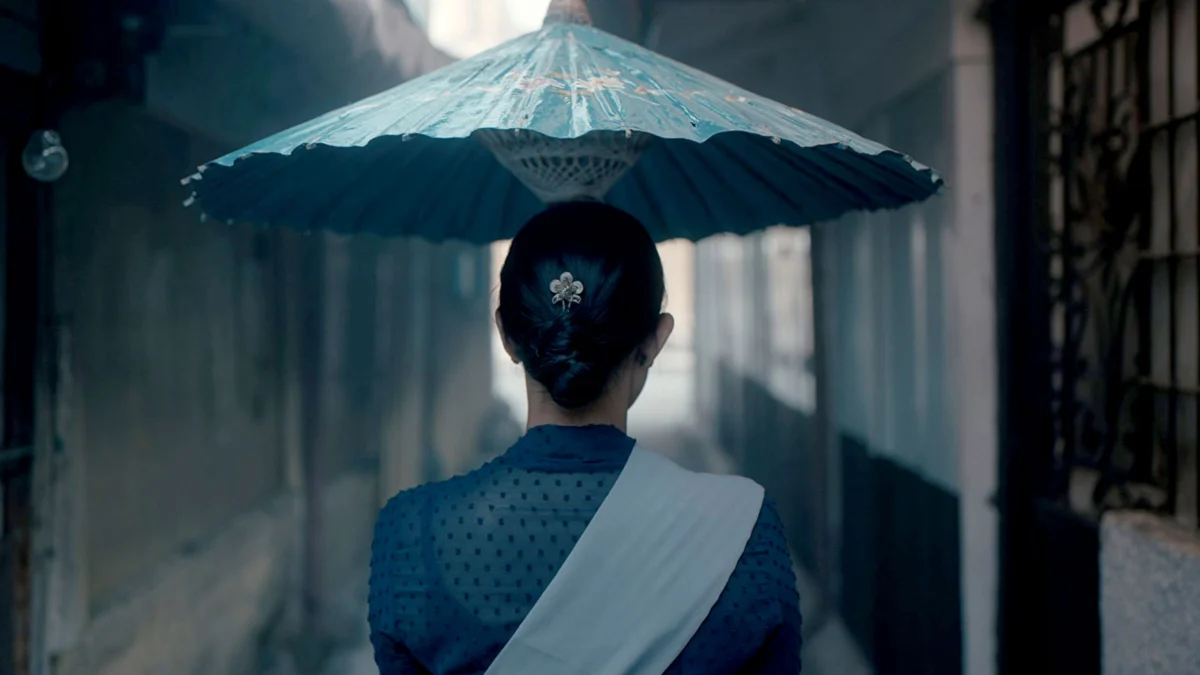
This transformation illustrates a key theme: the "sanggul" (traditional bun) that Nana wears serves as a metaphor for the societal constraints placed upon women. It is a structure meant to keep everything in place, yet it fails to contain the internal rupture caused by suppressed desire and betrayal.
Front Stage vs. Back Stage: The Sociology of Suppression
Sociologist Erving Goffman’s theory of "front stage" and "back stage" performance is essential to understanding the film’s domestic dynamics.
The Performative Wife
In the front stage—the public sphere and the main rooms of her home—Nana must perform as the perfect wife and mother. The expectations of her social class demand it. She meticulously prepares for these performances in the back stage: the private spaces of her vanity table, the bathroom, or the quiet corners where she smokes to steady her nerves.
The introduction of Ino into this narrative is transformative. Ino does not merely exist as an antagonist; she enters the back stage of Nana’s life. They share intimate moments at the vanity, by the river, and in private conversations where they are not "the wife" or "the mistress," but simply women sharing the burden of their circumstances. Ino becomes a source of empowerment, defending Nana against societal critiques and helping her realize that while the world is a stage, she possesses the agency to decide which role she plays.

Implications: The Multi-Generational Perspective
The film, adapted from a chapter in the book Jais Darga Namaku by Ahda Imran, provides a unique look at Nana through the eyes of her daughter, Jais. This shift in perspective is crucial, as the film interrogates the long-term impact of a woman’s departure on her children.
The Questioning of Dais
The character of Dais, played by Chempa Puteri (as a child) and Arawinda Kirana (as an adult), serves as the bridge between generations. While the child Dais experiences the confusion of her mother’s shifting loyalties, the adult Dais represents the interrogation of history. The surreal juxtaposition of the two Dais characters on screen suggests that the trauma of the past is never truly resolved; it is inherited and re-examined.
The film features three pivotal moments of whispering between women. The contents of these whispers are never explicitly revealed, but they serve as the "why" behind Nana’s eventual choices. When the adult Dais asks, "Mami, why did you leave?", there is no spoken answer. Yet, the audience understands. Nana’s journey is one of survival, and her decision to reclaim her life is not an act of selfishness, but an assertion of humanity in a world that demanded her total erasure.
Supporting Data and Production Context
Before, Now & Then (Nana) is a testament to the collaborative spirit of contemporary Indonesian cinema. Produced by Fourcolours Films and the Titimangsa Foundation, the film reflects a growing trend in Southeast Asian cinema to reclaim personal histories from the margins.
Technical Specifications:
- Director: Kamila Andini
- Writers: Kamila Andini, Ahda Imran
- Runtime: 103 minutes
- Key Cast: Happy Salma (Nana), Laura Basuki (Ino), Arswendy Bening Swara (Darga), Ibnu Jamil (Icang), Arawinda Kirana (Dais)
The film’s visual language is heavily influenced by the restraint and color palettes often associated with auteurs like Wong Kar-wai, particularly in its handling of unrequited longing and the weight of "what-ifs." The recurring musical score acts as a heartbeat, keeping time with Nana’s suppressed emotions and the subtle shifts in her environment.
Official and Critical Reception
Upon its release, the film garnered significant acclaim for its atmospheric depth and the raw, understated performances of its leads. Critics particularly praised the chemistry between Happy Salma and Laura Basuki, noting that their interactions redefined the standard tropes of the "other woman" narrative.
The film’s producers have noted that the goal was never to recreate the 1960s with encyclopedic precision, but to capture the feeling of living in a time where the ground was constantly shifting beneath one’s feet. By focusing on the female experience during this period, Andini fills a critical gap in historical cinema, shifting the focus from the macro-politics of the state to the micro-politics of the household.
Conclusion: The Strength to Survive
Ultimately, Before, Now & Then (Nana) is a profound meditation on the cost of silence. Nana is not a tragic heroine, but a survivor who navigates the constraints of her era with quiet, calculated dignity. As the film concludes, the question posed by her daughter shifts from an accusatory "Why did you leave?" to an implied, unspoken inquiry: "How were you strong enough to endure?"
Kamila Andini has succeeded in creating a film that is as visually arresting as it is emotionally resonant. By elevating the mundane—the act of combing hair, the smoking of a cigarette, the whispers in a dark room—into a cinematic experience, Nana asserts that the most powerful stories are often those told in the silence between breaths. It remains a vital piece of modern Indonesian cinema, reminding us that history is not just made in parliaments or on battlefields, but in the private, internal revolutions of the human heart.