The Meta-Cinematic Mirror: Deconstructing Romance and Industry in "Jatuh Cinta Seperti di Film-film"
In the landscape of contemporary Indonesian cinema, few films have managed to bridge the gap between technical experimentation and emotional intimacy as effectively as Yandy Laurens’ Jatuh Cinta Seperti di Film-film (2023). By positioning the act of filmmaking at the heart of its narrative, the film transcends the tropes of a standard romantic comedy, inviting the audience into a sophisticated meditation on the ethics of storytelling, the nature of consent, and the state of the domestic film industry.
The Architecture of a Meta-Narrative
A film about the process of filmmaking often risks becoming a self-indulgent "behind-the-scenes" documentary. To avoid this, creators must employ a strong narrative thread that elevates the meta-layer beyond mere technical curiosity. Historically, legends like Federico Fellini achieved this in 8½ (1963) by externalizing the director’s existential dread through surrealist vignettes. Others, such as Shinichiro Ueda in the cult hit One Cut of the Dead (2016), utilized structural ingenuity, shifting the perspective backward to recontextualize the entire viewing experience.
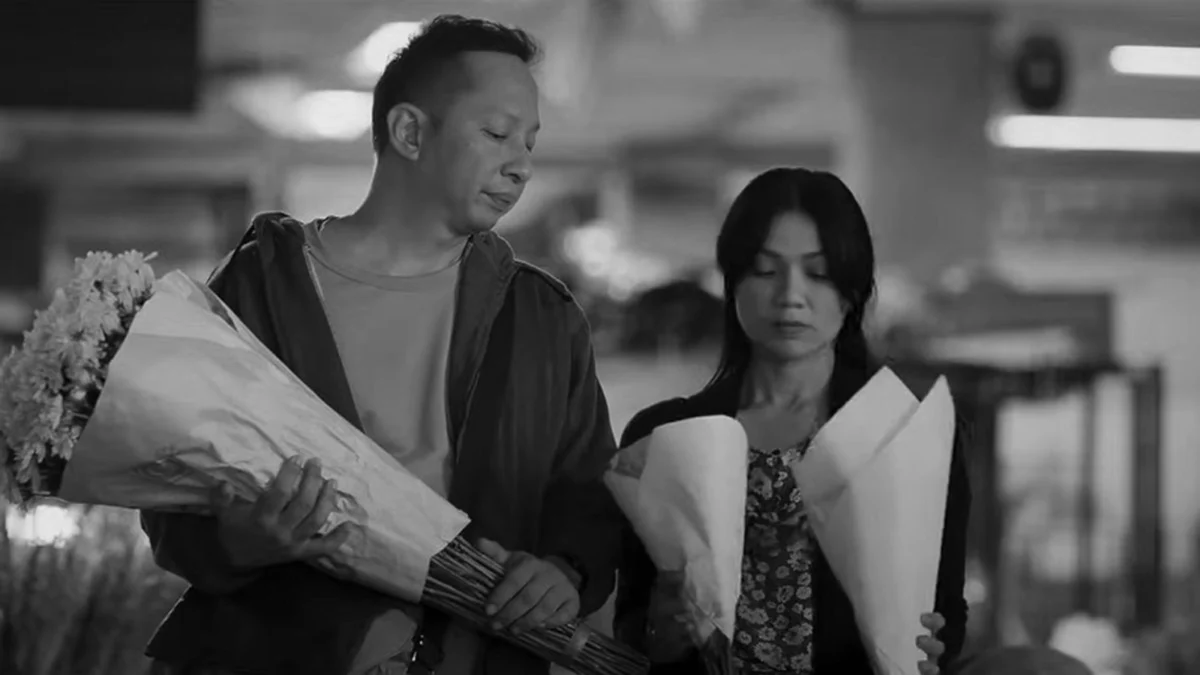
In Jatuh Cinta Seperti di Film-film, Yandy Laurens adopts a distinct aesthetic strategy: the binary of color and monochrome. The film follows Bagus (Ringgo Agus Rahman), a screenwriter attempting to process his feelings for Hana (Nirina Zubir) by writing a screenplay based on their evolving relationship. The film operates across two planes of existence: the "real" world, captured in vibrant color, and the "film-within-a-film," presented in stark black-and-white.
This choice is not merely stylistic; it is functional. The monochromatic palette serves as a visual manifestation of Hana’s grief—her mourning of her late husband—while simultaneously acting as a narrative signifier that distinguishes the fiction being written from the reality being lived. In an era where color is the standard, this aesthetic decision strips away the visual "noise" of everyday life—the clutter of a supermarket or the palette of a Padang restaurant—forcing the audience to focus exclusively on the raw, unadorned interaction between the two protagonists.
Chronology of a Creative Process
The narrative arc of Jatuh Cinta begins as a romantic gesture. Bagus, driven by a desire to reach out to a grieving Hana, decides to write a film that captures their connection. However, the process quickly spirals into a reflection on the ethics of creative ownership.
As the project progresses, Bagus is forced to step back. With the help of his peers—Cheline (Sheila Dara), Dion (Dion Wiyoko), and Julie (Julie Estelle)—he begins to view his script through a more critical lens. He is forced to confront the necessity of consent: is it acceptable to turn someone else’s trauma into a romantic narrative without their permission? This realization transforms the film from a simple love story into a cautionary tale about the exploitation of personal narrative for artistic gain.
By the final act, the film-within-a-film—which once promised a grand, cinematic "final kiss"—is deconstructed by the characters themselves. Hana, reflecting on the tropes of modern cinema, criticizes the artificiality of romantic clichés, noting that the "grand gestures" seen in films like La La Land often ignore the importance of real, mundane communication.
Supporting Data: Romanticism and the Modern Relationship
The film relies on the concept of "metacinema"—a term explored by William Siska in Metacinema: A Modern Necessity. Siska argues that self-aware writing functions through two primary mechanisms: the creator reflecting on their medium, and the creator reflecting on themselves.
Jatuh Cinta succeeds by challenging the audience’s perception of "romance." In the digital age, romanticism has often been equated with grand, performative gestures. Jatuh Cinta suggests that true intimacy is found in the quiet, unglamorous moments: the ability to listen, the willingness to share space, and the honesty of transparent communication.

Data regarding audience reception and critical acclaim for the film suggests that this shift in perspective resonated deeply with the Indonesian public. The film moves away from the "territorial" or "grandiose" romantic tropes that dominate local teen dramas, favoring a mature dialogue that acknowledges the complexity of love in one’s thirties and forties.
Industrial Implications: The "Pak Yoram" Archetype
Perhaps the most biting aspect of Jatuh Cinta is its critique of the film industry itself. Through the character of Pak Yoram (Alex Abbad), the film provides a sharp, satirical look at the "toxic producer" archetype. Pak Yoram represents the institutionalized aversion to risk, prioritizing intellectual property (IP) based on popular soap operas over original, exploratory screenplays.
The tension between Bagus’s artistic integrity and Pak Yoram’s corporate mandate to turn the script into a generic horror film—Jatuh Cinta Seperti di Film-film Horor—serves as a meta-commentary on the current state of the Indonesian box office, which is heavily saturated with horror titles and IP adaptations.
This critique is not delivered via academic essays or social media discourse, but through the medium itself. By embedding these industrial pressures into the plot, Laurens highlights the struggle of the independent filmmaker:
- The Pressure for Gimmicks: Producers demand high-concept hooks that prioritize marketability over emotional honesty.
- The Devaluation of Labor: Tight, unreasonable deadlines strip the creative process of the necessary time for empathy and development.
- The Erosion of Agency: When producers treat actors as mere vessels for tropes rather than collaborators, the resulting work loses its human core.
Official Responses and Cultural Impact
The film’s reception has been overwhelmingly positive, with critics praising the performances of Ringgo Agus Rahman and Nirina Zubir for their ability to navigate the meta-textual requirements of their roles. The chemistry between the cast members, particularly the supporting turns by Dion Wiyoko and Julie Estelle, adds a layer of depth to the production, as their characters openly challenge the script they are meant to perform.
Industry experts have noted that the film serves as a "call to awareness" for practitioners. It posits that for a film to be a true instrument of empathy, it must respect its subjects. When a film exploits its characters for profit without their consent, it fails as a work of art.
Conclusion: The Luxury of Awareness
Jatuh Cinta Seperti di Film-film stands as a testament to the power of self-reflective storytelling. It does not merely tell a story; it asks us to consider how stories are made and at what cost. In an industry often accused of creative stagnation, the film offers a refreshing, albeit utopic, vision of what happens when creators choose to be "mawas" (aware/mindful).
While it may be optimistic to hope that the industry will pivot away from the "Pak Yoram" style of production, the success of Jatuh Cinta provides a blueprint for change. It suggests that there is a hunger for narratives that prioritize human connection over algorithmic predictability. For those working within the creative arts, the film serves as a gentle but firm reminder: falling in love is messy, complicated, and rarely cinematic in the way we expect—and that is exactly what makes it worth telling.
Production Details
- Jatuh Cinta Seperti di Film-film
- Release Year: 2023
- Duration: 118 minutes
- Director/Writer: Yandy Laurens
- Production Houses: Imajinari, Jagartha, Trinity Entertainment, Cerita Film
- Cast: Ringgo Agus Rahman, Nirina Zubir, Alex Abbad, Sheila Dara Aisha, Dion Wiyoko, Julie Estelle