When four-time Academy Award nominee Saoirse Ronan signed on to star in director Jonatan Etzler’s English-language feature debut, Bad Apples, she knew she was walking into uncharted territory. Based on Rasmus Andersson’s 2020 debut novel, De Oönskade, the film is a pitch-black comedy that blends heavy real-world societal critiques with a deeply zippy, absurd sense of humor.
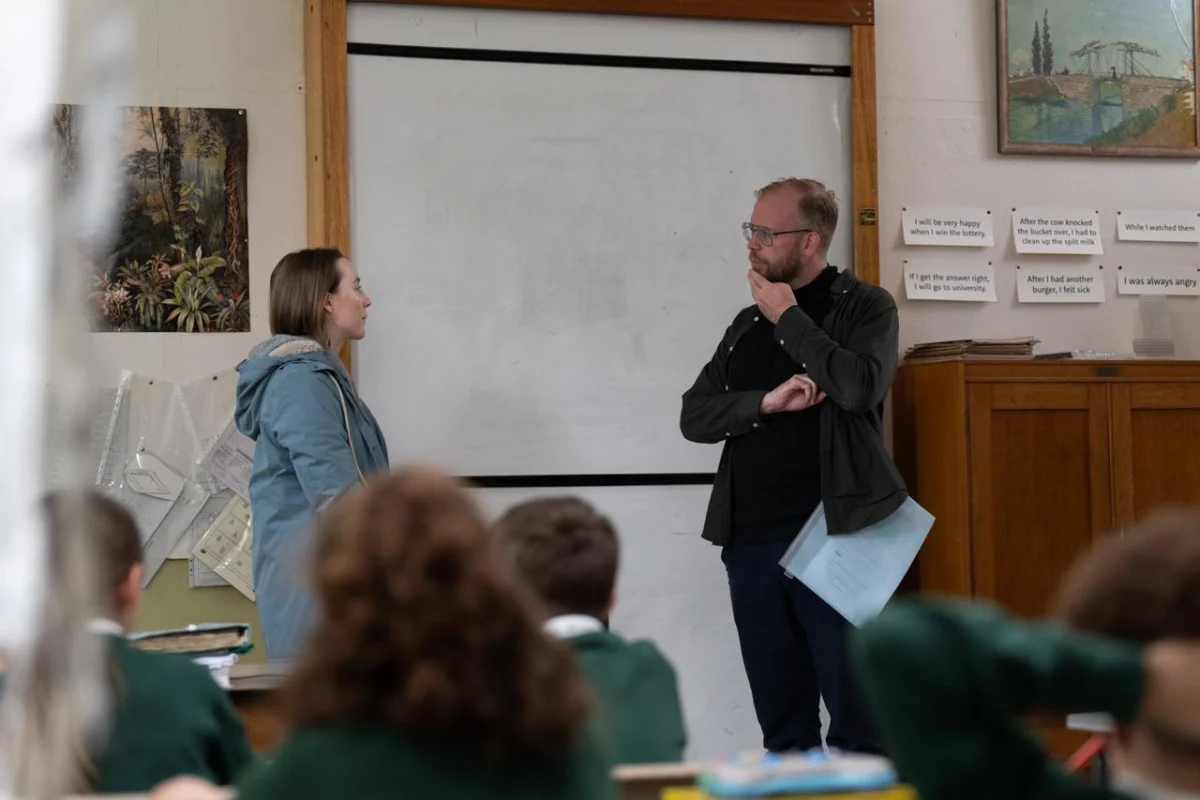
Ronan stars as Maria, a beleaguered primary school teacher whose mounting professional frustrations peak when she encounters Danny—a foul-mouthed, violently disruptive student played by newcomer Eddie Waller. Danny doesn’t just torment Maria; he upends her entire classroom. Driven to her absolute limit, Maria takes a drastic, highly unorthodox step: she locks Danny in her basement. What follows is a wildly unpredictable, darkly funny spiral that forces audiences to question their own capacity for empathy and moral compromise.
The film world-premiered at the Toronto International Film Festival (TIFF) before receiving a theatrical release in the U.S. and UK via Republic Pictures. It features a stellar supporting youth cast alongside Ronan, including Nia Brown and Mylee Soverall, with casting overseen by legendary director Fiona Weir.
Chronology
The journey of Bad Apples from Scandinavian page to international screen unfolded over several years, defined by serendipitous casting choices and sharp script development:
2020: Author Rasmus Andersson publishes his debut novel, De Oönskade, exploring the loss of control inherent in the teaching profession—a theme that deeply resonated with Swedish director Jonatan Etzler, a former teacher himself.
October 2023: Saoirse Ronan officially signs on to the project. Producer Oskar Pimlott recalls that Ronan’s agent responded almost immediately after reading the script, making Ronan the very first and only major actor approached for the role of Maria.
Pre-Production: Screenwriter Jess O’Kane—who, serendipitously, also worked as a teacher—comes aboard to inject a distinctively British comedic voice into the adaptation. Meanwhile, Etzler searches extensively for the film’s antagonist, auditioning roughly 2,000 children before discovering Eddie Waller in the north of England.
September 5, 2025:Bad Apples holds its high-profile world premiere at the Toronto International Film Festival, generating immediate critical buzz for its provocative narrative and Ronan’s underutilized comedic talents.
September 18, 2025: Republic Pictures officially releases Bad Apples in theaters across the United States and the United Kingdom.
Supporting Data and Production Insights
The production of Bad Apples required a delicate balancing act between escalating absurdity and grounding emotional realism. Behind the scenes, the creative team leaned heavily on unconventional inspirations and rigorous casting procedures to bring the chaotic classroom dynamic to life.
The SNL Connection: Director Jonatan Etzler revealed that his decision to cast Ronan was cemented not just by her acclaimed dramatic work, but by a 2017 Saturday Night Live (SNL) hosting stint where she played a stern yet hilarious flight attendant. Etzler recognized in that sketch the exact blend of authoritative presence and sharp comic timing needed for Maria.
The Search for Danny: Finding the right actor to play the disruptive student Danny was cited by Etzler as the production’s biggest casting hurdle. Out of approximately 2,000 young hopefuls, Eddie Waller was chosen for his ability to convey a simmering, authentic anger beneath the surface.
A Masterclass in Youth Casting: Veteran casting director Fiona Weir (Harry Potter, Fantastic Beasts) assembled a diverse classroom ensemble. Producer Oskar Pimlott noted that the first table read left the director, star, and cinematographer looking "bedraggled" and wondering how they would manage the energetic young cast—though the children ultimately proved to be exceptionally diligent and hard-working.
Official Responses and Creative Perspectives
The filmmakers and cast have spoken extensively about the unique challenges and thematic depth of Bad Apples, emphasizing that the project’s success hinged entirely on making Maria’s irrational choices feel strangely justified.
Director Jonatan Etzler on the Core Illusion:
"One of the most important things was making the very core of the film very believable so that we really follow Saoirse’s character all along and we understand everything that she’s doing. When you have that, you can start surrounding it with increasingly more absurd layers… And if we can sort of follow her here, then when she’s locked him in the basement, we’re going to look at ourselves and be like, ‘Oh, what am I sympathizing with now?’"
Saoirse Ronan on Finding the Humor in the Uncomfortable:
"I’d never read anything quite like that, I’d never gotten the chance to play a character that would allow me to find myself in such insane situations, and it was still so hilariously funny. I responded to the material… because that’s my sense of humor as well. It was sort of a marriage between her brilliant, dark comic writing, my taste in comedy anyway, and then Jonatan’s style as a filmmaker."
Producer Oskar Pimlott on Ronan’s Appeal:
"There were so many reasons why she was at the top of our list, but I think one of them was that we hadn’t seen her do this character before, a kind of good-person-doing-bad-things [role]. You can’t help but empathize with Saoirse Ronan, there’s not a single person out there that doesn’t like her."
Implications and Cultural Impact
Bad Apples arrives at a unique cultural crossroads, using dark comedy to interrogate modern anxieties about institutional failure, non-conformity, and human nature.
By centering a narrative around a protagonist who steps far outside moral boundaries—yet retains the audience’s profound sympathy—the film challenges the polished, curated facades society projects (such as those on Instagram) in favor of something much more raw, awkward, and twisted.
Furthermore, the film marks a pivotal moment in Saoirse Ronan’s two-decade career. Coming off a string of intense dramatic roles (including wartime drama Blitz and addiction story The Outrun), Ronan views Bad Apples as part of a conscious effort to protect her relationship with acting. By embracing projects that feel loose, playful, and unorthodox, she seeks to avoid creative burnout and maintain the childlike purity that first drew her to the craft.
Ultimately, Bad Apples stands out as a rare cinematic experiment: a philosophical comedy that refuses to lecture its audience, choosing instead to make them laugh through their discomfort and re-examine the hidden, unruly edges of human behavior.