From Childhood Nightmares to Small-Screen Dread: Nick Antosca Reimagines ‘Cape Fear’
The journey of Nick Antosca’s creative life began not in a writer’s room, but in the dim light of his parents’ living room, where a young boy caught a glimpse of a black-and-white figure stalking a child down a hallway. That fleeting, terrifying encounter with J. Lee Thompson’s 1962 thriller Cape Fear planted a seed of obsession that would eventually bloom into one of the most anticipated television events of 2026.
Now, decades later, Antosca has returned to the source material—having also been shaped by Martin Scorsese’s visceral 1991 remake—to craft a new, ten-hour iteration of the story for Apple TV+. This modern Cape Fear is not merely a retread of familiar beats; it is an ambitious expansion, trading the “blunt force trauma” of the films for a slow-burning, hallucinatory experience of ambient dread designed for a world obsessed with misinformation, AI, and digital uncertainty.
The Genesis of an Obsession: A Legacy of Fear
For Antosca, the appeal of Cape Fear has always been its ability to function like a nightmare. As he explained during an upcoming episode of the Filmmaker Toolkit podcast, the original films served as a masterclass in tension. The premise is elemental: a sadistic stalker—Max Cady—emerges from prison to terrorize the lawyer, Sam Bowden, who he believes wronged him.
“My parents were watching a black and white movie where a little kid was being chased down a hallway,” Antosca recalled. “I asked what was happening, and they explained the concept of stalking to me. It was very frightening.”
That fear evolved into a professional philosophy. Whether working on Hannibal or his own projects, Antosca has consistently sought to capture that same “nightmare logic.” While the original film and the Scorsese remake functioned as tight, aggressive thrillers, Antosca’s series seeks to stretch that anxiety over a much longer canvas. “The movies are blunt force trauma,” he noted. “Cady is just a machine coming for them. He’s going to bludgeon this family to death. In a show, you have the luxury—and the challenge—of sustaining that energy for ten hours.”

Chronology: Three Decades of Cinematic Stalking
The evolution of the Cape Fear narrative serves as a reflection of the shifting anxieties of American culture:
- 1962 (J. Lee Thompson): Starring Robert Mitchum as the menacing Cady and Gregory Peck as the righteous attorney, the original film was a tense, morality-driven procedural. It defined the “stalker” trope for a generation, grounding its horror in the vulnerability of the suburban home.
- 1991 (Martin Scorsese): Nearly 30 years later, Scorsese brought a darker, more cynical edge to the story. With Robert De Niro’s transformative performance as Cady and Nick Nolte as the morally compromised Sam Bowden, the film questioned the sanctity of the “good guy” lawyer, introducing a level of violence and psychological complexity that raised the stakes significantly.
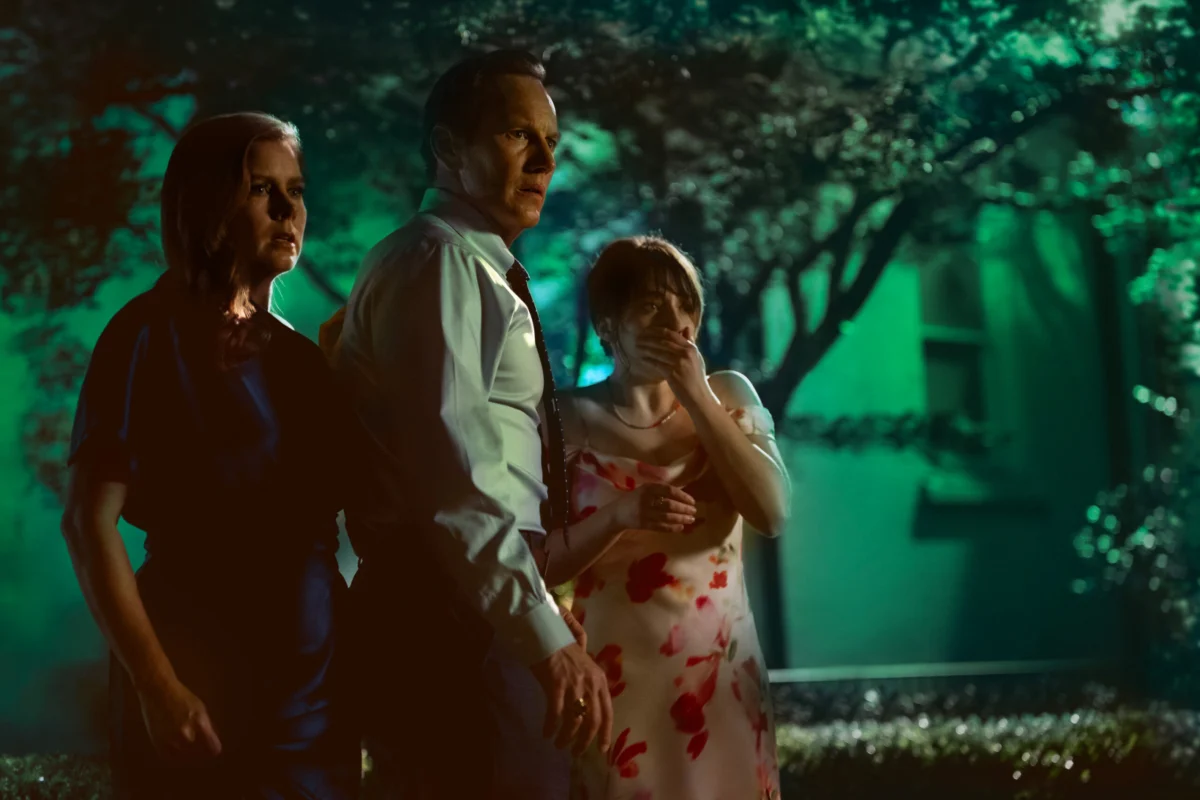
- 2026 (Nick Antosca): Moving the story to the digital age, Antosca’s series introduces a new layer of ambiguity. By casting Patrick Wilson and Amy Adams as the Bowdens, the show explores how modern technology—AI, social media, and the rapid spread of disinformation—can fracture a family’s sense of reality.
Reinterpreting the Material: The Ethics of Adaptation
One of the central questions facing any modern adaptation is how to avoid the trap of “just doing it again with cell phones.” Antosca is acutely aware of the pitfalls of remaking IP (Intellectual Property). His approach, which he describes as “respectfully unfaithful,” is rooted in the lessons he learned while working on the writing staffs of Teen Wolf and, most significantly, Hannibal.
“Silence of the Lambs is perfect,” Antosca said of Bryan Fuller’s approach to the Hannibal franchise. “But I watched Bryan Fuller make it his own and do a really strange, surprising art project on network TV. That was very formative for me in terms of how to do idiosyncratic, personal things using IP.”
For the new Cape Fear, Antosca decided that the only way to honor the source material was to fundamentally alter the moral landscape. In his version, Sam and Anna Bowden are not merely innocent victims; their own culpability in Cady’s past imprisonment is brought into sharper, more uncomfortable focus. Furthermore, the show intentionally leaves the audience guessing: Did Cady actually commit the crime for which he served time, or is he a victim of a system that lied to him?
The Modern Landscape of Uncertainty
The most significant departure from the 1991 film is the shift in focus from physical threat to psychological gaslighting. Antosca notes that in 2026, the greatest fear is no longer just the man standing outside your window—it is the fear that you cannot trust your own eyes or the information on your screens.

“Each Cape Fear says something very different about the society it was made in,” Antosca observed. By weaving in themes of AI and the erosion of truth, the show mirrors the collective anxiety of a society that feels increasingly untethered from reality. The “hallucinatory unease” that critics have noted in the series’ cinematography is a direct effort to manifest that internal chaos into a visual language.
Supporting Data: The Power of the Performance
A major pillar of the show’s success is the casting of Javier Bardem as Max Cady. While Mitchum and De Niro provided iconic interpretations of the character, Bardem brings a contemporary weight to the role that aligns with the series’ more cerebral, terrifying tone.
The production design and cinematography, led by Eben Bolter, have been lauded for their “acid-trip” aesthetic, particularly in the show’s sixth episode. This stylistic choice is not merely decorative; it is a narrative tool used to signal the breakdown of the Bowden family unit. Antosca has often stated that the “fragmentation of the family” is the scariest part of the Cape Fear story, and the series leans into this by forcing the audience to sit with the characters as they turn on one another under the pressure of Cady’s psychological siege.
Implications for the Future of IP Television
The success of Antosca’s Cape Fear suggests a new model for the future of prestige television. Rather than competing with the iconic films that came before, the show seeks to function as a companion piece—an expansion that utilizes the depth of a 10-hour runtime to explore psychological corners the films didn’t have the time to reach.
By blending the “appetites of the marketplace” with a deeply personal, idiosyncratic vision, Antosca has demonstrated that IP can be used as a canvas for high-art horror. The series forces the viewer to confront the same feelings that scared a young Antosca in the 1980s, but it updates the trauma for a generation that lives in a state of constant, ambient, and digital dread.

Final Reflections
As the industry continues to mine existing libraries for content, Antosca’s work serves as a gold standard for how to handle legacy material with both reverence and, more importantly, audacity. He hasn’t just remade a thriller; he has created a mirror for contemporary society.
“I made the Cape Fear that I wanted to see in 2026,” Antosca concluded. “If the movies are acute fear, the show is ambient dread and uncertainty. I wanted to feel that and play with that for a long time.”
The series is currently available for streaming on Apple TV+, and for those who wish to delve deeper into the creative process behind this reimagining, the upcoming Filmmaker Toolkit episode will offer further insight into how Antosca translated those childhood nightmares into a modern television milestone. In an era where remakes are often dismissed as cynical cash-grabs, Cape Fear stands as a testament to the idea that with the right creative vision, even the most well-trodden stories can still hold the power to surprise, unsettle, and profoundly move an audience.