Striking a Chord and Slaying Monsters: How Netflix and Sony’s ‘KPop: Demon Hunters’ Reimagines Animated Action
Main Facts
The intersection of global pop culture phenomena and high-octane supernatural action has yielded one of the most visually distinctive animated features in recent memory. KPop: Demon Hunters, a collaborative venture between Netflix and Sony Pictures Animation, represents a milestone for first-time director Maggie Kang. Best known for her work as head of story on The Lego Ninjago Movie, Kang has finally brought a 20-year personal ambition to the screen: an animated film deeply rooted in Korean culture.
What began as a stylistic exploration of traditional demonology eventually blossomed into an explosive genre-mashup that pairs the glittering, high-stakes world of K-pop with martial arts fantasy. Co-directed by Chris Appelhans (Wish Dragon) and utilizing the advanced, anime-influenced CGI capabilities of Sony Pictures Imageworks—the studio behind the revolutionary Spider-Verse franchise—the film has officially landed on Netflix.
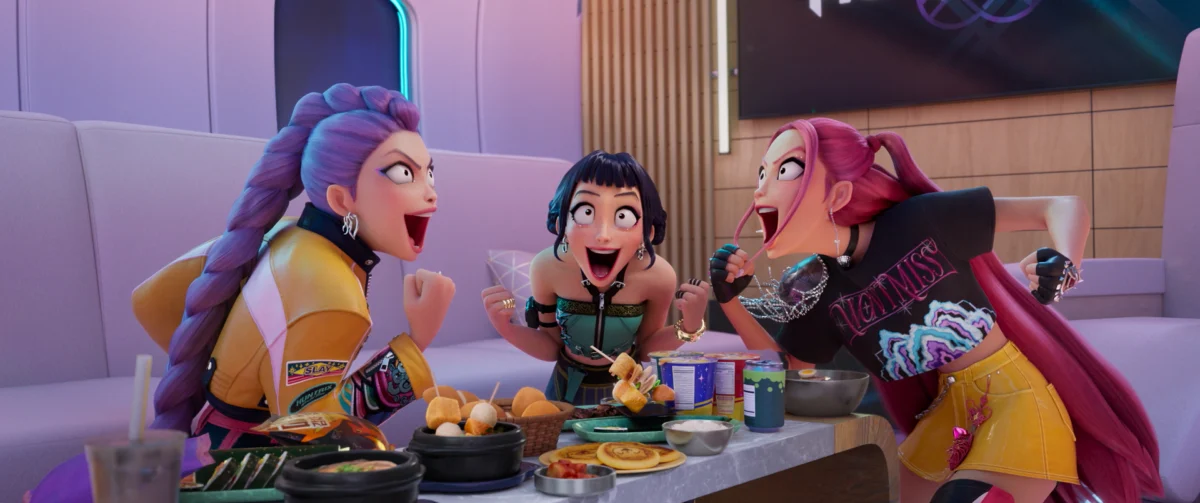
At the heart of the narrative is the superstar girl group Huntrix. Composed of members Rumi (voiced by Arden Cho), Mira (voiced by May Hong), and Zoey (voiced by Ji-young Yoo), the trio leads a high-stress dual existence: selling out massive international stadiums by night while secretly acting as a frontline defense against supernatural threats. Their primary adversary is the fiery, malevolent spirit Gwi-Ma (Byung-hun Lee), who controls an army of traditional and mythological demons, including goblins, zombies, shapeshifters, and robed messengers of death.

Complicating matters are the Saja Boys, an irresistibly charming rival boy band led by the enigmatic Jinu (Ahn Hyo-seop). Unbeknownst to their legions of screaming fans, the Saja Boys are actually secret demons in disguise. The dynamic is further complicated by a dramatic, K-drama-worthy romantic twist connecting Jinu and Rumi, allowing the film to playfully tackle mature themes of dual identities, hidden facades, and confronting one’s inner darkness.
The soundtrack serves as the film’s driving pulse, featuring standout tracks such as “Golden,” “What It Sounds Like,” and the aggressive, empowering breakup anthem “Takedown.” The latter serves as the film’s lead single and boasts vocals performed by Jeongyeon, Jihyo, and Chaeyoung of the global K-pop powerhouse TWICE.
Chronology of Development: From Concept to Screen
The journey to bring KPop: Demon Hunters to life was decades in the making, marked by iterative creative breakthroughs and structural evolution.

Phase 1: The Seeds of Inspiration
For Maggie Kang, the concept originated roughly two decades ago as a desire to place Korean culture and folklore into the center of mainstream Western animation. Initially, Kang was drawn heavily to traditional demonology, recognizing its vast potential for striking visual storytelling. However, simply populating a fantasy world with monsters felt incomplete. This realization naturally birthed the concept of demon hunters—specifically, a group of powerful superhero women.
Phase 2: Folding in the Music
Interestingly, the defining musical element of the film was introduced relatively late in the creative process. Because demon hunting in the film’s lore must be conducted covertly, the protagonists required a believable, high-profile public facade. K-pop emerged as the definitive choice. It was authentically Korean, provided an inherent sense of spectacle and scale, instantly converted the project into a musical, and acted as an attractive high-concept pitch for studio executives.
Phase 3: Technical Prototyping and Animation
Once the script and musical integration were locked, Sony Pictures Imageworks faced monumental technical challenges. Because the music was central to the pacing, the animation team had to build complex storyboards synchronized to the exact tempos of unreleased songs.

Production workflows frequently bucked traditional animation norms. Mimicking live-action filmmaking, the directors shot extensive coverage and lined up various angles to unearth "happy accidents"—a rarity in computer animation, where scenes are typically meticulously planned and drawn out frame-by-frame beforehand. Major set-pieces, including a frantic airplane battle and a sprawling zombie train sequence, were among the final segments to be animated, requiring painstaking prototyping and physics simulations to pull off seamlessly.
Supporting Data and Production Details
Bringing the world of KPop: Demon Hunters to life required bridging diverse artistic mediums, blending 3D computer graphics with 2D aesthetic sensibilities, and drawing from multiple branches of Asian entertainment media.
- Production Studios: Netflix Animation and Sony Pictures Animation.
- Animation Services: Sony Pictures Imageworks (leveraging techniques pioneered during the Spider-Verse films).
- Key Creative Personnel:
- Maggie Kang (Director, former head of story on The Lego Ninjago Movie)
- Chris Appelhans (Co-Director, director of Wish Dragon)
- Voice Cast:
- Arden Cho as Rumi
- May Hong as Mira
- Ji-young Yoo as Zoey
- Byung-hun Lee as Gwi-Ma
- Ahn Hyo-seop as Jinu
- Soundtrack Highlights:
- “Golden”
- “What It Sounds Like”
- “Takedown” (Lead single performed by TWICE members Jeongyeon, Jihyo, and Chaeyoung)
- Visual Inspirations: K-dramas (for emotional melodrama and comedy), K-pop music videos (for concert lighting and choreography), editorial fashion photography, and the "goofy, cheapie aesthetic" found in select anime styles.
Official Responses and Creative Vision
The creative team behind KPop: Demon Hunters has been vocal about their desire to subvert traditional tropes in both superhero cinema and mainstream animation.

Director Maggie Kang explained that her frustration with the current landscape of media inspired the portrayal of the Huntrix. "I felt like I wasn’t seeing women who were too relatable for me in this superhero market that is so saturated," Kang noted in an interview with IndieWire. Instead of pristine, unflawed heroines, Kang wanted characters who were "funny and goofy and unafraid to look stupid and ugly, gorging themselves on snacks before a concert or a fight."
Co-director Chris Appelhans elaborated on how the film’s distinctive visual style was forged through trial and error. "You wanna find some unique visual elements for your film that are unique to animation, and you need to let the film help tell you what those are," Appelhans stated.
Addressing the technical challenges of blending high-fashion aesthetics with exaggerated comedic expressions, Appelhans noted that the team intentionally pivoted away from strict realism. "To work in 3D, it didn’t need to feel like a momentary illustration, but more of a claymation approach… As soon as we committed to that, it felt okay to those kinds of boundaries. We’re not trying to do 2D shorthand; we’re trying to keep it all feeling dimensional, whatever the characters do."

Discussing specific action sequences, Kang highlighted the musical choreography of the opening fight scene set aboard a frantic airplane. "I think we always talked about it being kind of like Baby Driver, with the fight punches on the beat," she explained. "As soon as the music kicks in, we change lighting, all these other things happen. We just wanted the girls to have fun and kick butt to the beat."
Implications for the Animation Industry
The release of KPop: Demon Hunters carries significant weight for the future of cross-cultural storytelling and stylistic innovation within major Hollywood animation studios.
- Validation of Hybrid Aesthetics: By successfully combining the dimensional capabilities of 3D computer animation with the expressive framing, vibrant color palettes, and stylistic shorthand of anime and K-dramas, the film pushes forward a visual movement that began in earnest with films like Spider-Man: Into the Spider-Verse. It proves that mainstream audiences embrace hyper-stylized, non-traditional character models.
- The Power of Cross-Media Synergy: The direct integration of top-tier K-pop talent—such as members of TWICE—into the core musical identity of the film marks a sophisticated evolution in promotional and artistic synergy. It bridges the gap between Hollywood animation blocks and the billion-dollar global music industry, setting a new benchmark for how animated musicals can capture organic pop-cultural enthusiasm.
- Redefining Female Hero Tropes: By prioritizing flawed, humorous, and deeply relatable female protagonists who balance high-fashion glamour with messy, grounded humanity, the film challenges the sanitization often found in female superhero narratives. This shift signals a broader industry appetite for multifaceted female characters who do not have to sacrifice their vulnerabilities to be powerful.
KPop: Demon Hunters is now streaming worldwide on Netflix.