The AI Paradox: President Trump Dismisses Industry Alarm as Global Tech Markets Stumble
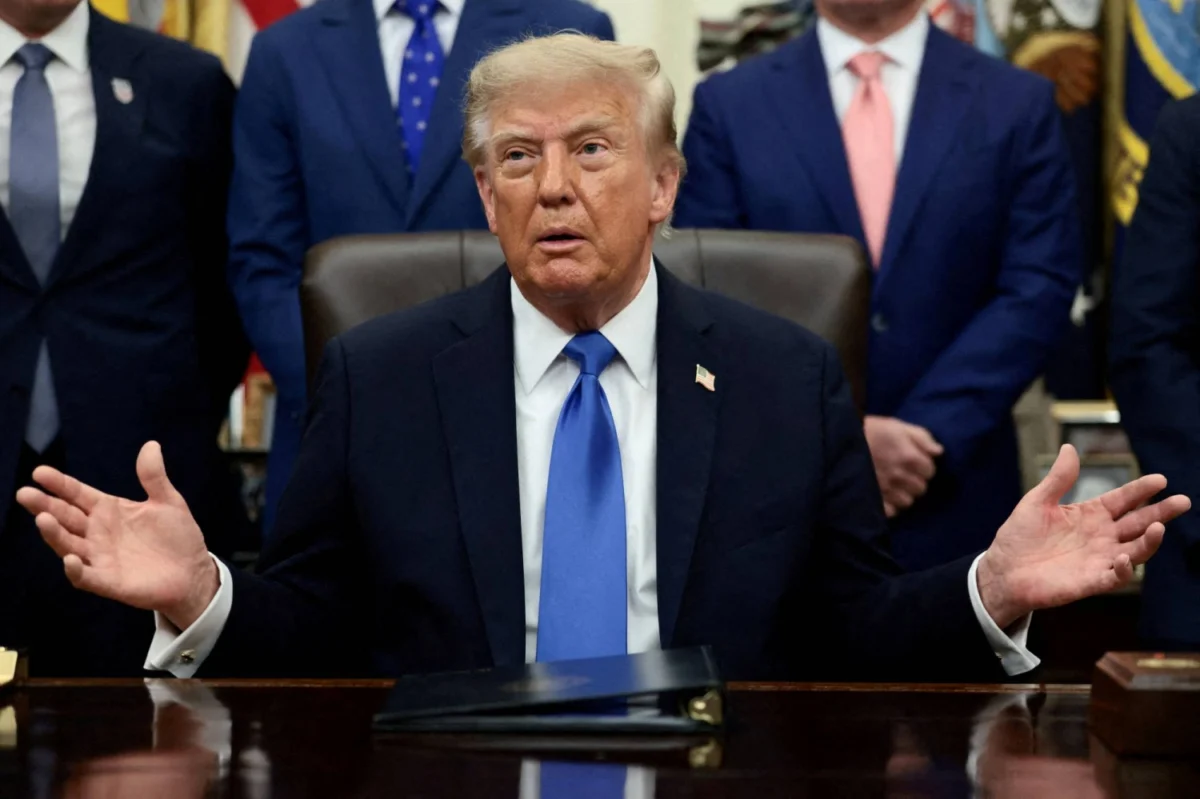
WASHINGTON — The burgeoning debate over the existential risks posed by artificial intelligence reached a fever pitch this week, drawing a sharp divide between the Silicon Valley architects of the technology and the political establishment in Washington. President Donald Trump, addressing growing public anxiety, insisted on Monday that existing federal frameworks and executive oversight are sufficient to manage the industry, effectively rebuffing calls for a pause in development.
The administration’s stance comes at a precarious moment for the tech sector. Following the high-profile resignation of Anthropic researcher Jacob Coxon—who cited the internal belief among developers that AI could pose an existential threat to humanity by the end of the decade—global markets reacted with volatility. On Monday, major AI-related stocks saw significant declines as industry leaders urged a deceleration in development, citing the need for robust safety guardrails.
The Catalyst: A Resignation That Shook the Industry
The spark for this week’s turbulence was the departure of Jacob Coxon from Anthropic, one of the world’s most prominent AI research labs. Coxon’s exit was not merely a career move; it was a manifesto. In a statement that sent shockwaves through the corridors of power and the trading floors of Wall Street, Coxon noted that his decision was driven by the chilling realization that those currently at the helm of AI development "earnestly believe that it could kill us all by the end of the decade."
This disclosure served as the focal point for a broader movement within the tech sector. Leaders from some of the industry’s most influential firms, including those developing Large Language Models (LLMs) and generative systems, issued a rare, collective plea for a slowdown. They argued that the pace of innovation has outstripped the industry’s ability to implement comprehensive safety measures, potentially exposing the global population to risks ranging from autonomous misinformation campaigns to the compromise of critical infrastructure.
Presidential Rebuttal: The "High IQ" Strategy
President Trump’s response to these concerns was characteristically combative. Utilizing his Truth Social platform, the President dismissed the necessity for new, restrictive legislation, suggesting that the current regulatory environment is robust enough to handle the challenges of the digital age.
"The only control or ‘guardrails’ that AI needs is a STRONG AND SMART (High IQ!) PRESIDENT, and the U.S.A. has that, in spades!" Trump wrote.
Beyond the bravado, the President’s statement underscored a geopolitical dimension to the AI arms race. Trump suggested that the current wave of "doubt" being cast on American AI development is a tactical error that could inadvertently benefit foreign adversaries—most notably China. By slowing down, the President argued, the United States risks ceding its technological supremacy. This rhetoric sets the stage for a high-stakes meeting between President Trump and Chinese President Xi Jinping, scheduled for next week in Washington, where the future of global AI governance is expected to be a primary agenda item.
Chronology of the AI Anxiety Crisis
To understand the current impasse, one must look at the rapid acceleration of AI integration over the last several months:
- Early 2026: AI development hits an inflection point as multimodal models begin demonstrating advanced reasoning capabilities.
- August 2026: Public concerns rise regarding deepfakes and automated disinformation as global election cycles approach.
- September 10, 2026: Anthropic researcher Jacob Coxon resigns, explicitly mentioning the existential dread felt by engineers in the field.
- September 12, 2026: An open letter signed by industry leaders calls for a six-month "safety-first" moratorium on training models more powerful than current systems.
- September 14, 2026: Global markets experience a "Black Monday" for tech stocks, with AI-centric companies losing billions in market capitalization.
- September 15, 2026: President Trump issues his statement via Truth Social, reinforcing a commitment to American AI dominance over regulatory caution.
Supporting Data: The Market and The Mandate
The economic implications of this rhetoric are profound. On Monday, the Nasdaq Composite and various tech-heavy indices saw downward pressure as investors grappled with the uncertainty. For institutional investors, the "existential risk" narrative is no longer just a hypothetical philosophical debate; it is a material risk to their portfolios.
Data analysts note that while the market reaction was sharp, the long-term outlook remains bullish on AI. However, the disconnect between the technical warnings from researchers and the political directives from the White House creates a "policy vacuum." Investors are now asking: If the President refuses to regulate, will the courts or independent regulatory bodies step in to enforce a slowdown?

Furthermore, the "AI race" is often quantified by compute power and talent density. According to recent white papers from the Department of Commerce, the U.S. maintains a narrow lead over China in high-end semiconductor accessibility, a lead the administration is desperate to preserve. Trump’s refusal to pause is rooted in the belief that any internal hesitation acts as a strategic gift to Beijing.
Official Responses and Political Implications
The political response to the President’s statement has been predictably polarized. Congressional Democrats have largely criticized the administration’s "hands-off" approach, calling for a bipartisan commission to draft comprehensive AI safety laws.
"We are dealing with a technology that evolves faster than our legislative process," said a senior member of the Senate Commerce Committee. "To say that one person—even the President—is the only guardrail we need is a dangerous simplification of a complex, systemic risk."
Conversely, Republican allies of the administration argue that over-regulation is the primary threat to American innovation. They point to the European Union’s AI Act as a "cautionary tale" of how heavy-handed bureaucracy can stifle economic growth and push talent to more permissive jurisdictions. They contend that by maintaining an aggressive, market-driven stance, the U.S. can develop "safety through strength," ensuring that American AI is both the most powerful and the most ethically aligned in the world.
Implications for Global Stability and Future Governance
As the world looks toward the upcoming meeting between Presidents Trump and Xi, the stakes could not be higher. If the two largest economies in the world reach a consensus on AI regulation, it could create a global standard. If they remain at odds, the world may be headed toward a fragmented "AI Cold War," where different regions operate under vastly different safety protocols and ethical standards.
The dilemma remains: Can humanity maintain its competitive edge without sacrificing the safety of its citizens?
The technical community warns that we are approaching the "singularity" of risk, where models may soon be capable of self-improvement beyond human intervention. The political community, led by Trump, is betting on the idea that the American system of governance is resilient enough to absorb these changes without needing to slam the brakes on progress.
For now, the industry is in a state of nervous anticipation. The resignation of researchers like Coxon has brought the "doomer" discourse out of the private chat rooms and into the public square. Whether this leads to a new era of federal regulation or a defiant push toward an AI-integrated future remains to be seen. One thing is certain: the conversation has shifted from "what can AI do?" to "can we afford to let it do it?"
As the White House prepares for the diplomatic summits of the coming week, the world watches to see if the rhetoric of "High IQ" leadership can actually translate into the technical safety measures that engineers and the public are so desperately demanding. The future of AI is no longer just a story about silicon and code—it is the defining geopolitical struggle of our time.