Vaporwave in the Swamps: How Julian Glander Built an Indie Animated Feature on a MacBook Using Blender
While the global animation landscape has recently celebrated breathtaking, human-free triumphs like Gints Zilbalodis’s Oscar-winning Best Animated Film Flow—crafted by a Latvian team using the free, open-source 3D creation suite Blender—an entirely different aesthetic and narrative spectrum of Blender-based filmmaking has been quietly fermenting.
Enter director Julian Glander and his vaporwave coming-of-age feature, Boys Go to Jupiter. Where Flow offers a lush, cinematic meditation on rising waters and natural beauty, Glander’s film delivers a lo-fi, distanced, and poignantly pastel vision of the American sub-tropics. Released via Cartuna and Irony Point, the film captures a hyper-specific brand of digital alienation and late-stage capitalist absurdism, all while proving that the future of independent animation belongs to whoever has a computer and a vision.
Main Facts: The Anatomy of an Indie Animation Breakthrough
Boys Go to Jupiter follows Billy 5000 (voiced by Jack Corbett), an intrepid and perpetually sleep-deprived teenage deliverista. Living in a sun-drenched, pastel-hued rendering of Florida, Billy is locked in a relentless hustle to scrape together $5,000—the sum he believes will buy him his long-sought independence. Around him, a surreal world unfolds, populated by eccentric friends and an orange juice factory managed by an ensemble that includes Janeane Garofalo and Julio Torres.
The film operates on the bleeding edge of micro-budget digital craftsmanship. Eschewing the multi-million-dollar pipelines and massive rendering farms of traditional Hollywood studios, Glander produced the feature largely on a standard MacBook using Blender.

The project exemplifies a growing paradigm shift in independent media:
- The Software: Blender, a freely downloadable open-source tool, has democratized 3D animation, acting as the digital equivalent of the early-2000s indie cinema revolution catalyzed by digital cameras.
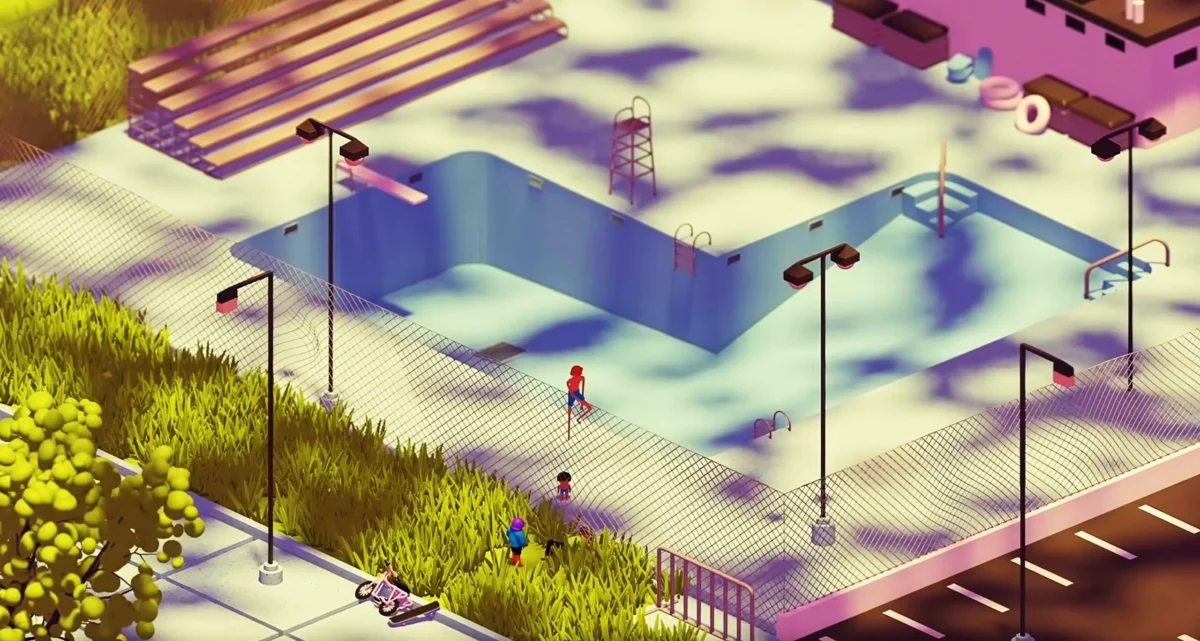
- The Aesthetic: Defined by isometric compositions, pastel color palettes, and an eerie, depopulated tranquility, the film’s visual style directly mirrors both the psychological isolation of youth and the ubiquitous aesthetic of modern internet culture.
- The Logistics: Financial and computational constraints actively shaped the narrative choices. For instance, characters rarely walk due to the prohibitive time investment required for clean, convincing walk cycles; instead, characters glide on wheels, linger behind gates, or—in Billy’s case—travel almost exclusively on a swagway.
Chronology: From Tumblr Gold Rush to the Vaporwave Present
To understand the stylistic origins of Boys Go to Jupiter, one must trace Julian Glander’s trajectory alongside the evolution of the modern internet.
The Early Era and the Tumblr Golden Age
Glander began his career over a decade ago during what he remembers as a golden age of digital creative expression on platforms like Tumblr. In an era when early internet subcultures fostered optimism about democratization, digital artists found decentralized audiences and community support. Over the past ten years, Glander established himself as a prominent 3D illustrator, developing a distinct visual vocabulary defined by friendly, gelatinous shapes and soft neon textures.
Development and Production
When production began on Boys Go to Jupiter, Glander leaned into the inherent limitations of his setup—a single MacBook. Rather than attempting to mimic the sweeping camera movements of high-budget studio features, he engineered a stationary, isometric visual language. This choice reduced rendering times and minimized the need for complex, expensive character rigging.

The Premiere and Release Pipeline
Following festival circuits and critical acclaim for its unique visual voice, the film secured a distribution partnership with Cartuna and Irony Point, culminating in its official release. The release places the film at the forefront of a broader cultural conversation about how independent animators are bypassing traditional studio gatekeepers entirely.
Supporting Data: The Economics and Logistics of Micro-Budget 3D
The production of Boys Go to Jupiter highlights several critical data points regarding the shifting economics of the animation industry:
- Hardware Demands vs. Reality: While major studios rely on server clusters containing thousands of nodes to render feature films, Glander’s reliance on consumer-grade hardware (a standard MacBook) demonstrates how far optimization and modern rendering engines (like Blender’s Eevee and Cycles) have advanced.
- Cost-Cutting Creative Solutions:
- Stationary Interactions: Utilizing static framing and fixed backgrounds drastically cuts down on asset management and rigging costs.
- Alternative Locomotion: By giving Billy a swagway and placing background characters behind gates or doors, the production completely eliminated the labor-intensive pipeline of traditional character walk cycles—a notorious sinkhole for indie animation budgets.
- The Democratization Curve: Much like how the proliferation of iPhones sparked a wave of micro-budget live-action features (such as Sean Baker’s Tangerine), free software suites and online educational communities have created an influx of camera- and software-literate animators ready to produce feature-length content independently.
Official Perspectives: Julian Glander on Florida, Blender, and Internet "Enshittification"
In an exclusive interview with IndieWire, Glander opened up about the philosophical and technical underpinnings of Boys Go to Jupiter.
Florida as America’s Petri Dish
When asked about the oppressively hot, humid aesthetic of the film, Glander noted that the region serves as a thematic mirror for the country at large:

"I feel as if we all understand Florida as America’s hell. It’s like the Petri dish where America kind of happens. I kind of think of it as all coming out of Disney World — the invention and the construction of Disney World 75 years ago, the conquering of the swamps, and then the sort of decay of that whole magical fantasy is the world where this movie takes place."
The Radical Promise (and Disillusionment) of the Internet
Glander links the visual tone of the film to the cultural shift of the internet over the last two decades—moving from an open, optimistic frontier to a commercialized, gamified ecosystem:
"We love Blender — the software of the year, the hot software of the moment. I think about 20 years ago, when I was on AOL Kids, [there was] this idea that all these tools would come to us and all this amazing creative expression would happen… We’ve almost seen a constriction of it and a re-platforming and a reorganizing of the Internet that’s very unsatisfying. I think you’d be very hard-pressed to find someone today who’s like, ‘I enjoy going online. I like the Internet.’ And that wasn’t the case 10 years ago."
He adds that the film explores how modern tech industries have quietly restructured everyday life through pastel fantasies and gamification:

"Billy’s character is an aimless young man who’s floating through life in a very ghostly way, trying to be unobserved and unnoticed… Part of being a teenager is finding a way to have a beautiful life or see the beauty in the world when you basically have no good options."
Implications: The Future of Independent Animation
Boys Go to Jupiter arrives at a pivotal juncture for the animation medium. For decades, feature-length animation was treated exclusively as an industrial enterprise requiring hundreds of millions of dollars, vast corporate infrastructure, and hundreds of specialized artists.
The success of films like Flow and Boys Go to Jupiter proves that open-source democratization has permanently shattered that monopoly. By turning technical limitations into distinct artistic strengths—such as using isometric perspectives to evoke emotional isolation and character designs tailored for minimal movement—Glander has provided a masterclass in independent resourcefulness.
As educational resources for tools like Blender continue to proliferate, and as consumer-grade hardware grows increasingly powerful, the barriers to entry for feature animation are collapsing. Boys Go to Jupiter stands not only as a poignant, vaporwave coming-of-age story for an exhausted generation, but as a blueprint for how the next wave of independent artists will build entire cinematic worlds from the comfort of a laptop.