
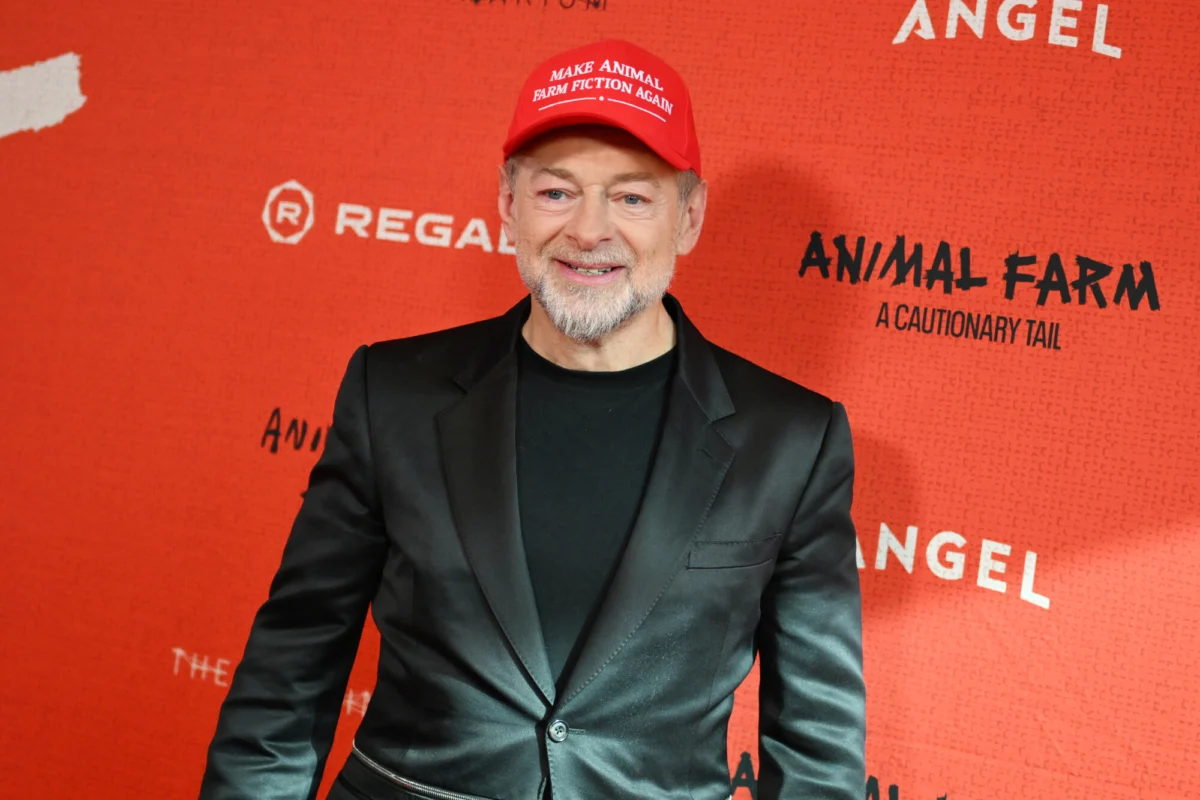
Revolution Reimagined: Inside Andy Serkis’ Bold, Animated Take on ‘Animal Farm’
George Orwell’s Animal Farm has long served as the definitive literary prism through which we view the corruptive nature of power. A biting satire of the Soviet Union’s descent into totalitarianism, the novella is etched into the cultural consciousness as a grim, monochromatic warning about how revolutionary idealism curdles into tyranny. Yet, director Andy Serkis—a filmmaker whose career is built on the intersection of humanity and digital artifice—has approached this classic with a vision that defies its traditional somber reputation.
His new film, released by Angel Studios, is a daring, maximalist departure from the source material’s bleak origins. It is a version of the farm that embraces the absurd, incorporating rap songs and irreverent humor, while simultaneously grappling with the heavy moral weight of betrayal. By pivoting from a planned motion-capture project to a stylized animated feature, Serkis has created an experimental, albeit divisive, interpretation that prioritizes emotional resonance over historical grit.
A Chronology of Creation: From Motion Capture to Animation
The road to Animal Farm was anything but linear. For years, the project was conceptualized as a motion-capture epic, a natural evolution for a director who redefined the medium with his legendary performances as Gollum, Caesar, and King Kong. Serkis initially envisioned a gritty, hyper-realistic depiction of the animal rebellion.
“The very early designs for the animal characters were much more unforgiving and brutal,” Serkis explained in an interview with IndieWire. “When animals looked like they were starving, you could see their rib cages; the pigs were a lot more gluttonous and just looked meaner. There is a version of that film that could exist.”

However, as the production progressed, Serkis faced a fundamental creative crossroads. He realized that a photorealistic approach—one that would capture every sagging muscle and starving rib—risked alienating the very audience he aimed to reach. The project shifted gears, moving away from the shackles of uncanny-valley realism toward the expressive, malleable language of animation. This transition was not merely a budgetary or technical pivot; it was a philosophical one. By shedding the "brutality" of photorealism, Serkis sought to create a "cautionary tale that has a whole heap of innocence around it."
The Mechanics of a Rebellion: Behind the Scenes
The transition to animation required Serkis to expand his skill set far beyond the motion-capture volume. While his experience directing video games and live-action films with heavy VFX—such as Mowgli: Legend of the Jungle and Venom: The Last Dance—provided a foundation in digital performance, animation demanded a different kind of world-building.
World-Building from Scratch
In live-action, a director arrives on a set that exists in physical space. In animation, every blade of grass, every rusted piece of farm machinery, and every shift in lighting must be synthesized. Serkis credits production designer Amos Sussigan of Anaventure for the film’s distinct aesthetic. “You build every blade of grass… the entire world,” Serkis noted. “Working with the layout team and the story team, creating a scratch track, recording the actors—you’re working at a completely different pace.”
The Actor as Animator
One of the film’s most distinct features is its performance style. Serkis implemented a process that approximates the freedom of motion capture, translating naturalistic human impulses onto the faces of creatures. He encouraged his cast—which includes Seth Rogen as the manipulative Napoleon and Laverne Cox as the idealistic Snowball—to explore their characters without the physical constraints of a film set.

“If someone gives me the freedom to find a performance, I’ll try lots of different things,” Serkis said. “Standing in front of the mic, not having to reset cameras, change lenses, or do setups—just being able to go into another round? It’s a great way of working, and it’s a very creative way of working for an actor.”
Supporting Data: The Artistic Gamble
The film’s reliance on "animation as a safety margin" serves a dual purpose. It allows for the depiction of the farm’s collapse—from the hopeful overthrow of Farmer Jones (played by Serkis) to the systemic rot introduced by Napoleon—in a way that is palatable for a wider demographic, yet still retains the core of Orwell’s critique.
By employing a more stylized, animated look, Serkis creates a visual distance that allows the audience to engage with the characters’ trauma without the visceral, often distracting, discomfort of watching realistic animals suffer. This is critical to his goal: ensuring the audience feels the emotional shift when Napoleon begins to co-opt the radical equality preached by Snowball. Through tight, expressive close-ups, Serkis captures the subtle micro-expressions of his characters, ensuring that the humanity of the performance remains intact despite the animated veneer.
Official Responses and Creative Vision
The decision to lean into elements like rap songs and "fart jokes" has drawn scrutiny, with some critics questioning if the tonal shift undermines the gravity of the source material. However, Serkis remains steadfast in his belief that the story needs to be accessible to a younger generation.

The "hollow-boned" nature of the film’s politics, as some critics have described it, is perhaps a reflection of the director’s desire to prioritize the "innocence" of the animals over the cold, hard political theory of the original text. For Serkis, the film is a bridge. He is not trying to replace the 1945 novella; he is trying to create a piece of cinema that operates on a different frequency—one that can sit in the uncomfortable space between a lighthearted romp and a devastating critique of authoritarianism.
The Implications of Modern Animation
The success—or struggle—of this project highlights the changing landscape of modern animation. As studios increasingly look to blend the "naturalistic human acting choices" with the limitless potential of digital worlds, the role of the director becomes more complex.
In live-action, a scene is often "in the can" after a day’s work. In animation, a single scene can pass through dozens of hands over the course of years. The director must act as a guardian of the film’s "DNA," holding the vision together through long cycles of previz, animatics, and final render. Serkis’ admission that "budgetary concerns can kill a scene while it’s still in the animatic stage" highlights the brutal reality of modern filmmaking: even with the freedom of animation, the director is constantly "killing darlings" long before the film reaches the editing room.
Conclusion: A New Lens on the Barnyard
Andy Serkis’ Animal Farm is an audacious experiment. By marrying the technical rigor of his motion-capture background with the artistic freedom of animation, he has crafted a film that feels both deeply familiar and wildly unpredictable. Whether this interpretation succeeds in capturing the nuance of Orwell’s original allegory is a question that will undoubtedly spark debate among film scholars and fans of the book alike.

What is certain, however, is that Serkis has successfully turned the farm into a theater of the absurd, where the lines between power and parody are blurred. It is a film that refuses to sit still, constantly oscillating between its whimsical visual choices and the dark, inevitable outcome of its political narrative. For audiences, the result is a unique, thought-provoking, and ultimately experimental addition to the legacy of George Orwell’s most famous work.
Animal Farm is now in theaters nationwide, distributed by Angel Studios. Whether you go for the animation, the performances, or the bold reimagining of a classic, the film invites you to look at the animals of the farm in a way you never have before.