Echoes of the Unspoken: "Smong Aceh" and the Complexities of Post-Tsunami Resilience Two Decades On
BANDA ACEH, Indonesia – Two decades after the catastrophic Indian Ocean tsunami swept across the western coast of Aceh, leaving an indelible scar on the land and its people, the narrative of recovery remains largely framed by a single, pervasive term: "resilience." This concept of unwavering fortitude has become a cornerstone of post-disaster reconstruction and a keyword in countless development projects. It is within this deeply entrenched discourse that Tonny Trimarsanto’s 2024 documentary, Smong Aceh: Two Decades of Resilience After the Tsunami, emerges, seeking to capture the spirit of a region that has famously risen from the ashes.
However, as the film attempts to navigate the complex terrain of memory, healing, and preparedness, it inadvertently highlights the inherent tension between official narratives of recovery and the intricate, often unspoken, emotional realities of survivors. While lauded for its intent to showcase local wisdom and scientific collaboration in disaster mitigation, the documentary, particularly its longer version intended for Acehnese audiences, grapples with a fundamental ambiguity: it keeps a noticeable distance from the raw grief and unresolved emotions that continue to echo two decades later. This critical distance ultimately raises profound questions about what constitutes true resilience and whether a narrative of strength can truly serve a community still processing an unfathomable loss.
The Documentary’s Dual Lenses: A Tale of Two Audiences
Smong Aceh was produced in two distinct versions, each tailored for a specific audience. A concise 30-minute cut was designed for viewers in Jakarta and Yogyakarta, focusing on a streamlined narrative of disaster mitigation through a collaborative blend of scientific expertise and indigenous knowledge. This version emphasizes the synergy between modern scientific understanding and local wisdom, presenting a clear message of preparedness and successful recovery.
In contrast, a more expansive 70-minute version was crafted for audiences in Aceh. This longer cut delves into the personal journeys of two central figures, Zahrina and Suman, both survivors residing in Banda Aceh and Simeulue, respectively. It aims to explore their individual recollections and experiences of the tsunami. The differing durations and narrative approaches initially suggest a thoughtful consideration of audience needs, acknowledging the varied connections to the disaster. Yet, it is precisely within the extended version, intended for those most intimately affected, that a disquieting hesitation becomes apparent. Far from offering a genuinely reflective and complex space, the film often feels like a narrative that has been pre-directed and constrained, limiting the full emotional expression of its subjects.
Chronology of Catastrophe and Recovery: Framing the Two-Decade Mark
The 2004 Indian Ocean tsunami, triggered by a massive undersea earthquake off the coast of Sumatra, remains one of the deadliest natural disasters in recorded history. On December 26, 2004, waves reaching up to 30 meters high devastated coastal communities across 14 countries, with Aceh bearing the brunt of the impact. Over 170,000 lives were lost in Indonesia alone, primarily in Aceh, and millions more were displaced.
The immediate aftermath saw an unprecedented global humanitarian response. Billions of dollars poured into the region for relief and reconstruction efforts. The focus was on rebuilding infrastructure, housing, and livelihoods, alongside establishing robust disaster preparedness systems. The narrative of "building back better" and "resilience" quickly took hold, becoming the dominant framework for measuring recovery. Over the past two decades, Aceh has indeed witnessed remarkable physical reconstruction and the implementation of various mitigation strategies, including early warning systems and public education campaigns. The 20-year anniversary, therefore, serves as a crucial juncture for reflection – not just on physical recovery, but on the deeper, often invisible processes of emotional and psychological healing. Smong Aceh positions itself within this significant anniversary, aiming to contribute to this reflection, yet its approach to emotional depth raises questions about the completeness of its portrayal of "resilience."
The Unseen Wounds: A Critical Examination of the Documentary’s Approach
The film’s reluctance to fully engage with the raw emotional landscape of its subjects is its most significant shortcoming. The two main characters, Zahrina and Suman, embody this paradox.
Zahrina’s "Emptiness": The Chasm Between Public Narrative and Private Grief
Zahrina, a researcher at the Tsunami and Disaster Mitigation Research Center (TDMRC) at Syiah Kuala University, is introduced as a rational and professional figure. Early in the longer version of the film, she confidently asserts, based on research findings, that Acehnese society has demonstrated greater resilience in post-disaster life compared to Japanese communities. This statement aligns perfectly with the prevailing narrative of Acehnese strength. However, in subsequent scenes within her home and at the Ulee Lheu mass grave, a different confession emerges: she admits to feeling "empty." This profound sense of emptiness defies scientific or technocratic explanation. It signifies not merely an emotional void but a social chasm—a gap between the official, sanctioned narratives of recovery and the deeply personal, often unspoken experiences of loss. The film presents this confession but does not adequately explore its implications, quickly moving past it without allowing Zahrina the space to delve deeper into this complex feeling.
Suman and the Echoes of Smong: A Lost Opportunity for Personal Connection
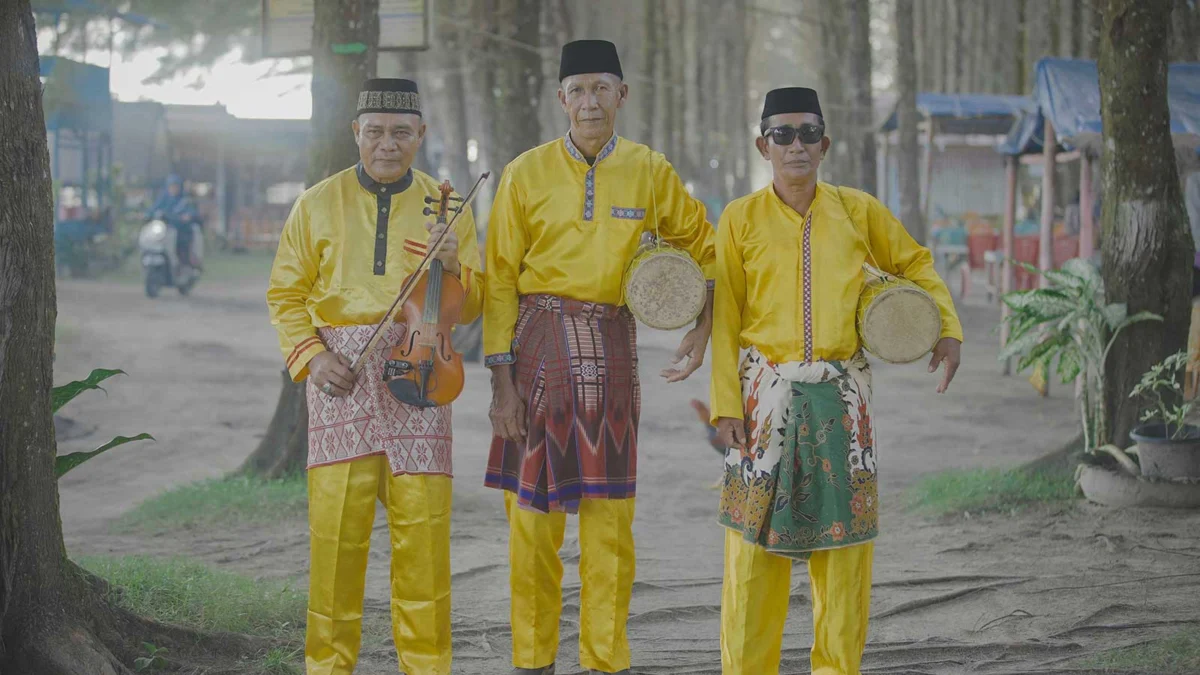
Suman, a traditional artist from Simeulue, experiences a similar narrative constraint. He performs the nandong smong, a traditional oral art form recounting the legend of the smong (tsunami) and its warnings. This local wisdom famously saved thousands on Simeulue during the 2004 event. Yet, the film fails to provide Suman with a platform to narrate his personal experience of the 2004 tsunami. How did it feel when smong, a collective tale passed down through generations, suddenly materialized as a devastating reality? What internal process did he undergo to bridge the gap between folklore and the brutal reality of the disaster? Regrettably, these crucial questions remain unasked and unanswered by the documentary. Suman, like Zahrina, is presented as a survivor, but primarily as a public communicator for mitigation narratives, expected to embody strength and provide information, rather than to express his own raw, lived trauma.
Both Zahrina and Suman occupy an ambiguous position: they are survivors, yet also public figures tasked with communicating messages of mitigation and resilience. They are asked to speak as "those who have survived," but simultaneously required to maintain a certain distance from their own wounds to appear strong and informative. The film, in its attempt to portray a "resilient and cultured society," seems to shy away from the messy, incomplete, and sometimes contradictory nature of post-trauma existence. Even the more emotional visual fragments—footage of muddy waters, ruins, montages resembling ocean waves—shown to audiences at the Banda Aceh Tsunami Museum, lack the full affective context. There is an overarching impression that the film aims to maintain a safe distance, curbing emotional outpouring to adhere strictly to the narrative of a "strong and cultured society."
The "Structure of Feeling" and Unspoken Narratives
To understand the film’s hesitation in capturing the profound collective emotions post-disaster, we can turn to Raymond Williams’ concept of "structure of feeling." Williams used this term to describe the forms of experience, intuitions, and emotions collectively felt within a society, yet not yet fully articulated or explained. This "structure of feeling" exists in everyday life—between insufficient language, oppressive norms, and suppressed emotions. It encompasses not only what is felt but also what cannot be said.
In the Acehnese context, this "structure of feeling" manifests in Zahrina’s confessed emptiness, Suman’s emotional guardedness, and various everyday signals and practices that resist intimacy. These expressions reflect individual and collective attempts to respond to losses from multiple conflicts, epidemics, and disasters, but without a safe public space to truly discuss them freely. Smong Aceh regrettably falls short in its sensitivity to these nuances. It tends to disregard the haphazard, incomplete, and often discordant "structures of feeling" that do not conform to a neatly packaged narrative of resilience. Yet, it is precisely within these ambiguities that the everyday narratives of post-disaster life could find their true depth and honesty.

The Burden of "Ikhlas" and Unresolved Grief
Anthropologist Annemarie Samuels, in her book After the Tsunami: Disaster Narratives and the Remaking of Everyday Life in Aceh, observes that expressions of grief in Aceh are often constrained by religious and social norms. Sadness, at times, is perceived as a sign of weak faith. Consequently, many survivors opt to express their grief through zikir (remembrance of God), kenduri (communal feasts), or pilgrimages to mass graves—methods considered more socially acceptable. However, as Samuels notes, these practices do not necessarily resolve grief. Many survivors continue to live with an unfinished sense of loss, even if they are publicly perceived as having achieved "ikhlas" (sincerity, acceptance). They learn to appear strong, yet carry unhealed wounds.
This narrative of "ikhlas" is intimately intertwined with the concept of resilience. Smong Aceh appears keen to affirm that Acehnese society has recovered. However, by failing to provide space for unresolved feelings, the film inadvertently overlooks the intricate complexities of life after disaster. Unseen grief does not equate to non-existent grief. Zahrina’s expressed emptiness is not a sign of narrative weakness, but rather an indication that the internal healing process is far from complete. It is an invitation to a deeper conversation that should not be prematurely closed off by the narrative of "resilience."
Beyond Individual Strength: Structural Vulnerabilities and the Limits of Resilience Narratives
The dominant narrative of resilience, as presented in the film, also unfortunately closes off space for discussing structural vulnerabilities. An article by Pradiayu FA in Konde highlights how women in disaster situations are often more vulnerable, not only due to geographical conditions but also because of cultural norms. Many women may not know how to swim, cannot leave home without permission from their husbands or parents, or must prioritize the safety of their children. In this context, resilience is not solely an outcome of internal strength but often a form of forced adaptation, presented as a symbol of success. When structural vulnerabilities are unacknowledged, the potential for effective mitigation and truly equitable recovery becomes severely limited.
The film largely presents a familiar narrative: Acehnese society is strong, Acehnese society has recovered, and Acehnese society is ready for the next disaster. But beneath this surface, there is a barely audible doubt. What about those who do not feel recovered? What about those who still experience nightmares, who still feel empty when passing the road to the beach, or who fall silent upon hearing the names of lost relatives? The film had an opportunity to frame these experiences, but it missed it. And in this context, the failure to listen also signifies a failure to nurture and truly heal.
The Reduction of Smong: From Cultural Wisdom to Mitigation Slogan
The smong tradition is rightly celebrated in the film as a local heritage that saved thousands on Simeulue. Yet, it is also reduced to a easily campaigned mitigation slogan. The profound social and emotional depth of the smong stories is diminished. What emerges is a sterilized version, readily consumable by a broad public. There is no space to ask: how were these stories actually passed down, maintained, and personally interpreted? We are not invited to delve into the affective history of smong as an integral part of Simeulue’s community life, a community often marginalized from Aceh’s political bureaucracy.
Smong functions in the film as a bridge between traditional and modern knowledge. But when this bridge is traversed in only one direction—towards a narrative of preparedness—what is neglected is the space for genuine reflection. The meaning of stories like smong lies not only in their functional ability to save lives but also in their power to bind collective memory and forge solidarity. Stories passed down through generations are not just about disaster; they are also about how we mourn and care for those who are lost.
The Missed Opportunity: What a Documentary Could Have Been
This documentary possessed immense potential. It could have opened a vital space for dialogue among survivors, serving as a medium for re-processing shared experiences, and offering a more honest and authentic form of tsunami commemoration. Imagine if Suman had been given the space to recount the details of his experience on December 26, 2004: What was the first sound he heard? What did he think when the earthquake struck and he saw the sea rising? How did he connect the tales he had heard since childhood with the disaster he then lived through? Or, if Zahrina had been allowed to explore her feeling of emptiness more deeply, without needing to rush to any immediate conclusion.
Sadly, this potential is hindered by the imperative to appear "strong" and "resilient." Consequently, the film feels polished, yet too safe. The longer version of Smong Aceh opts to neatly package emotions within a narrative of development and preparedness, rather than allowing ambiguity and vulnerability to surface. When a documentary is positioned primarily as a tool for socialization rather than a space for contemplation, it loses its fundamental function as an intersubjective arena for genuine human experience.
Redefining Resilience: Towards a More Honest Path to Healing
It is time we question whether every disaster narrative must culminate in a message of preparedness. What about unresolved grief? Does it not also require mitigation? A documentary about the tsunami should not merely present technocratic successes but also open a space for indefinable experiences. The emptiness felt by Zahrina is not a narrative weakness, but a signal that something larger and more complex remains truly unaddressed. And it is precisely there that the film should begin its conversation—not end it.
With more than two decades separating us from the event, perhaps it is time to broaden the meaning of "resilience." It should encompass not just recovery and resurgence, but also the courage to acknowledge what remains unfinished. In this context, a film like Smong Aceh could be a crucial space—if it were willing to be a little more honest.
Film Credits:
Smong Aceh | 2024 | Durasi: 30/70 minutes | Director: Tonny Trimarsanto | Production: Christine Hakim Films, Cinesurya Pictures, Rumah Dokumenter, Weber Shandwick Indonesia | Country: Indonesia
This article was written with discussions alongside disaster psychologist Yulia Direzkia and social psychologist Mifta Sugesti.