
The Pastel Nihilism of Florida: How Julian Glander’s ‘Boys Go to Jupiter’ Redefines Indie Animation
The landscape of independent animation is undergoing a seismic shift, fueled not by the cavernous budgets of legacy studios, but by the democratic power of open-source software and a burgeoning spirit of digital rebellion. While the recent Oscar-winning success of Flow proved that Blender—the free, community-driven 3D creation suite—could produce breathtaking, high-fidelity worlds, a new film is pushing that same software toward an entirely different aesthetic frontier.
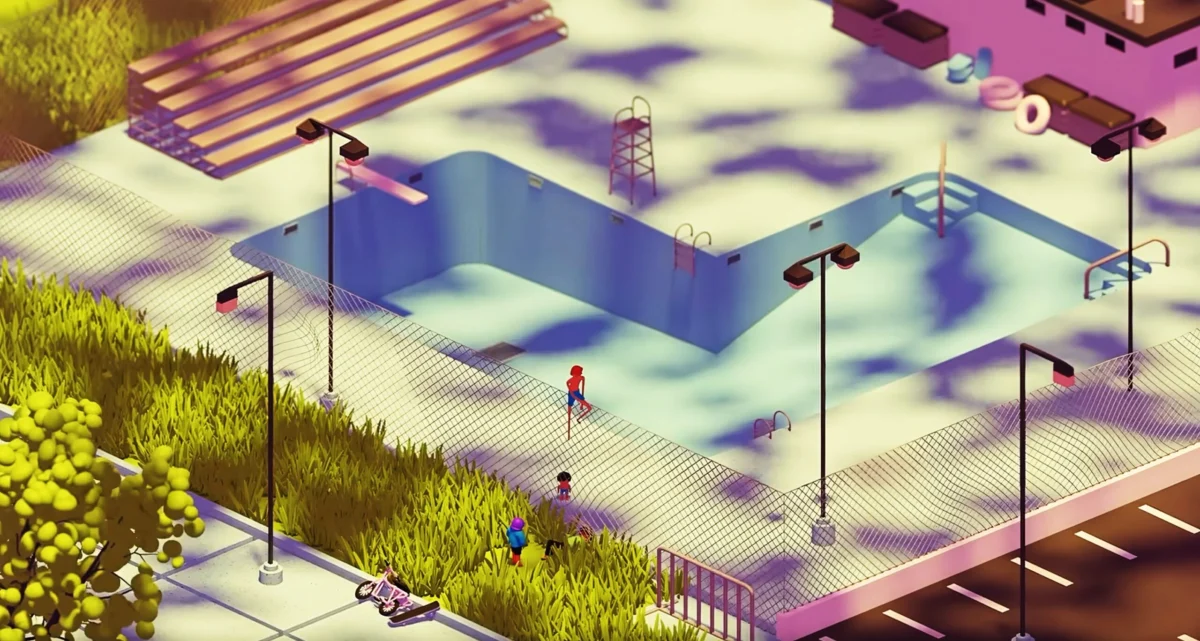
Julian Glander’s Boys Go to Jupiter, a vaporwave-inflected coming-of-age odyssey, stands at the opposite end of the stylistic spectrum from the lush, nature-driven visuals of Flow. Where Flow captures the majesty of a world without humans, Glander captures the claustrophobic, pastel-soaked anxiety of a world defined by them. Set against the backdrop of an absurd, sun-drenched Florida, the film offers a poignant look at modern alienation, delivered through a visual language that is as constrained as it is evocative.
A Petri Dish of American Absurdity
At the center of the narrative is Billy 5000, a perpetually sleep-deprived “deliverista” voiced by Jack Corbett. Billy is on a singular, desperate mission to hustle his way to $5,000, a sum he believes will grant him the autonomy he craves in a society that seems determined to keep him stationary. His journey is punctuated by the bizarre and the miraculous, involving a cast of characters navigating an orange juice factory run by the idiosyncratic duo of Janeane Garofalo and Julio Torres.
For Glander, Florida was the only logical setting for this story. “I feel as if we all understand Florida as America’s hell,” Glander told IndieWire. “It’s the Petri dish where America kind of happens. I think of it as all coming out of Disney World—the invention and the construction of the park 75 years ago, the conquering of the swamps, and then the subsequent decay of that magical fantasy. That is the world where this movie takes place.”

This sense of decay is central to the film’s atmosphere. It is a world of “acid pastels” and humid, oppressive heat that feels instantly recognizable to anyone who has navigated the surreal geography of the American South.
The Technological Pivot: Blender and the DIY Ethos
The production of Boys Go to Jupiter is a testament to the "radical promise of the Internet"—the idea that high-level creative tools should be accessible to everyone, regardless of their financial backing. Glander, who has spent over a decade in 3D illustration, utilized Blender not just for its cost-effectiveness, but for its capacity to empower solo creators working on modest hardware.
“This was made on a regular MacBook,” Glander noted. “That’s the radical promise of the internet. We love Blender—the software of the year, the hot software of the moment.”
However, Glander’s relationship with technology is complicated. He reflects on the "golden age" of the early internet—the era of Tumblr and AOL Kids—and contrasts it with the current state of digital existence. “We’ve almost seen a constriction of it and a re-platforming and a reorganizing of the internet that’s very unsatisfying,” he said. “I think you’d be very hard-pressed to find someone in 2025 who’s like, ‘I enjoy going online. I like the internet.’”

This tension informs the movie’s core message: the way the tech industry has “hoodwinked” a generation through gamification and the promise of pastel-colored fantasies. The film interrogates how these digital structures have reshaped human connection, often without explicit consent.
Navigating Constraints: The Art of Economy
One of the most striking aspects of Boys Go to Jupiter is its visual economy. Because Glander was working with limited resources, he leaned into the constraints of the software and his own hardware, turning potential limitations into stylistic signatures.
The Logic of the Isometric View
The film frequently utilizes an isometric point of view, which provides a distanced, game-like perspective on the characters. While this was a practical choice to minimize the computational load of complex camera movements, it also serves a thematic purpose. It highlights the way the characters are isolated from one another, viewing their world through a screen-like buffer that mirrors the detachment of modern life.
The Physics of the Swagway
Perhaps the most notable creative shortcut in the film is the choice to keep the characters, particularly Billy, on a “swagway” (a hoverboard-like device) for much of the runtime.

“Almost nobody walks in the movie,” Glander explained. “Walk cycles in animation are very time-intensive and when they look wrong, you can really tell. It just shatters everything. So we have characters standing behind gates, characters on wheels a lot, or behind doors.”
This constraint perfectly complements Billy’s character arc. He is a young man floating through life, attempting to remain unobserved, and his reliance on a mechanical device to navigate his environment emphasizes his lack of agency.
The Walk Home: A Structural Turning Point
The film’s most pivotal scene occurs when Billy’s phone and his swagway both die, forcing him to walk home in the dark. This moment of technological failure strips away the digital crutches that have defined his existence, forcing him to confront the scale of his environment.
“I really like that scene because it takes place at night, and so we get to see everything we just saw in a different light, and it’s new again,” said Glander. “Billy has to move through town, and this is the moment where we can show how small he is by putting him up against his actual surroundings.”

In this sequence, the urban landscape of Florida—characterized by massive, impersonal car-centric infrastructure—dwarfs the protagonist. The billboards he passes, offering reminders of the lottery or existential warnings, frame his struggle. It is the end of the “first act” in a musical sense—a moment of stasis before the narrative shifts toward the unknown.
Implications for the Future of Animation
The rise of films like Boys Go to Jupiter and Flow marks a turning point for independent animation. Much like the revolution in live-action filmmaking that occurred 15 years ago when high-quality digital cameras became accessible to the masses, animation is witnessing a democratization of power.
Educational resources, community-led software development, and the ability to distribute work globally have created a new landscape for storytellers. Glander believes we are at a tipping point: “I think the same thing is happening in animation now. The tools are definitely there—and beyond the tools, the educational resources are there and the communities are there.”
The success of these projects suggests that the future of the medium may not belong to the studios with the largest render farms, but to the creators who can best navigate the limitations of their tools to express a unique, resonant vision. By embracing the "gunk" of the digital age, the absurdity of the American landscape, and the constraints of the creative process, Boys Go to Jupiter offers a blueprint for how independent cinema can remain vital and subversive.

Boys Go to Jupiter will be released on Friday, August 8, by Cartuna and Irony Point. As it hits screens, it serves as a timely reminder that while the internet may feel increasingly like an "unsatisfying" place to be, the tools it provides can still be used to craft profound, human stories that demand to be seen.