Beyond the Cut: Navigating the Complexities of Film Censorship in Southeast Asia
When we hear the term "film censorship," our minds often drift to the mundane: the blurred cigarette on a television screen, the abrupt cut in a broadcasted action flick, or the familiar "Self-Censorship" jingles that play before a cinematic screening in Indonesia. These are the normalized experiences of a viewer living under a specific regulatory framework. However, the mechanisms of "penapisan filem" (film censorship) in our neighboring country, Malaysia, reveal a far more intricate and, at times, contentious landscape.
In September 2023, the Freedom Film Network (FFN) hosted a landmark conference in Kuala Lumpur, bringing together filmmakers, activists, and regulators to dissect the state of content control in the digital age. This report explores the nuances of Malaysia’s censorship apparatus, the struggle for artistic autonomy, and the broader regional implications for Southeast Asian cinema.
The Convergence: Freedom Film Network Conference 2023
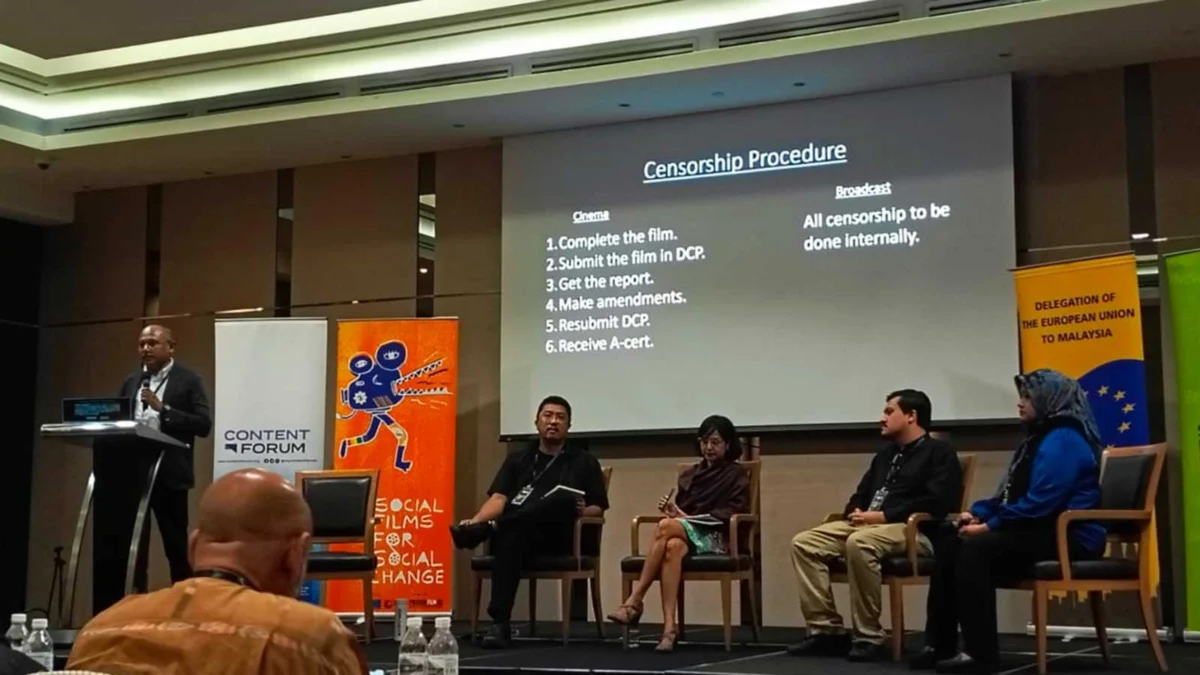
For two decades, the Freedom Film Network has been a vital voice for human rights and artistic expression, primarily through the Freedom Film Festival. However, the inaugural FFN Conference, held on September 7–8, 2023, at the Connexion Conference & Event Centre, marked a shift from celebration to critical inquiry. Titled Content Creation, Choice, and Control in the Digital Age, the event sought to bridge the gap between creative freedom and regulatory oversight.
The conference was a rare convening of stakeholders, including representatives from the Lembaga Penapisan Filem (LPF—the Film Censorship Board), the National Film Development Corporation Malaysia (FINAS), and the Malaysian Communications and Multimedia Commission (MCMC). By placing these state bodies in the same room as independent filmmakers and regional experts, FFN aimed to foster a dialogue that has historically been fraught with tension.
Mediha Mahmood of the Content Forum opened the proceedings with a sobering reflection on the industry’s reality. "In an ideal world, filmmakers would create exactly what they intend, and audiences would consume that vision without mediation," she noted. "But we are not there yet. Reaching a system that is not inherently biased requires time, dedication, and the collective engagement of every stakeholder involved."
Chronology of Control: How Malaysia Censors Its Content
To understand the current malaise, one must first understand the architecture of Malaysian censorship. Unlike the television industry, where broadcasters carry the burden of self-regulation, theatrical film release is a rigid, centralized process.
The Mechanism of LPF
For a film to be screened in a Malaysian cinema, it must be submitted to the LPF in a Digital Cinema Package (DCP) format. The board then assesses the content against specific, though often opaque, guidelines. If the board deems a film—or specific scenes within it—to be potentially harmful to public order, religious harmony, or national security, it can mandate cuts or outright ban the film.
The complexity is deepened by cultural segmentation. Malaysia operates on a nuanced, often controversial, system where films are categorized based on their linguistic and cultural target demographics—Malay, Chinese, or Indian. Films in the Malay language are subjected to additional scrutiny to ensure they adhere to Islamic sensitivities and social norms, creating a tiered reality where "acceptable" content is not a universal standard but a localized negotiation.
The Case of Mentega Terbang
The volatility of this system was best exemplified by the 2023 controversy surrounding the film Mentega Terbang. Released on the streaming platform Viu, the film—which explored themes of death and religious transition—was pulled from the service following a massive public outcry triggered by conservative commentators. The director, Khairi Anwar, faced severe harassment and threats, illustrating the power of "community censorship." In this instance, the state did not need to issue a formal ban; the threat of public mobilization and political pressure proved sufficient to silence the work.
Supporting Data: The Subjectivity of the "Anti-Gangster"
A poignant moment during the conference was the testimony of Syafiq Yusof, a prolific director with over a decade of experience in the Malaysian industry. Syafiq highlighted the disconnect between intent and interpretation, specifically regarding his 2014 action-comedy Abang Long Fadil.
Despite the film being an anti-gangsterism narrative—designed to showcase the unity of villagers against criminal elements—it was subjected to nine separate cuts by the LPF and still slapped with an 18+ classification.

"The tragedy is not the censorship itself, but the lack of clarity," Syafiq argued. "The guidelines are not granular. They are subject to the personal interpretation of the examiners." According to Syafiq, the examiners often focus on aesthetic markers—such as the attire of the characters—rather than the narrative arc. If a character looks like a gangster, the scene is flagged, regardless of the fact that the story ultimately condemns the criminal lifestyle. This "interpretive censorship" turns the LPF examiners into the primary authors of the film, effectively overriding the director’s vision.
Official Responses and the Quest for Transparency
The presence of officials from LPF, FINAS, and MCMC provided a rare window into the rationale behind these policies. Throughout the conference, these agencies defended their roles as necessary safeguards for public morality and national stability. However, they were met with a persistent demand for "procedural transparency."
Filmmakers argued that the current system incentivizes self-censorship. When a director cannot predict what will trigger a cut, they naturally avoid controversial subjects altogether. The officials acknowledged the challenges of the digital age, where the rise of Over-The-Top (OTT) platforms has rendered traditional theatrical censorship models increasingly obsolete. The consensus, if any could be reached, was that the regulatory framework must evolve from a "gatekeeper" model to one that emphasizes media literacy and age-appropriate classification.
Implications: The Role of the Village in the Digital Age
A recurring theme throughout the conference was the protection of minors. The panelists largely agreed that while adults should have the freedom to engage with complex, provocative art, children require a different standard of care.
However, the consensus quickly shifted to the limitations of government intervention. In a digital world, an LPF stamp of approval is insufficient. The burden of protection, the panelists argued, must shift toward a collective, societal approach. As the proverb goes, "It takes a village to raise a child." This implies that schools, parents, and digital platforms must share the responsibility of providing media literacy, allowing children to navigate content safely rather than relying on the state to hide the world from them.
Regional Solidarity: Lessons from Indonesia and Beyond
The FFN Conference was not merely a Malaysian affair. It served as a regional hub for Southeast Asian cinema, featuring experts from Indonesia, the Philippines, Thailand, and Singapore.
Alex Sihar and Tito Imanda from the Indonesian Film Board (BPI) offered a historical perspective, recounting the 15-year struggle of the Masyarakat Film Indonesia (MFI) to dismantle the repressive censorship practices of the Suharto era. Their journey—from underground protest to institutional reform—served as a beacon of hope for their Malaysian counterparts.
Patrick F. Campos of the UP Manila Film Institute emphasized the importance of regional solidarity. While the censorship challenges in the Philippines differ from those in Malaysia, the underlying struggle for artistic freedom is a shared regional narrative. "When we stand together," Campos noted, "we remind the state that these works are not isolated incidents of defiance, but part of a regional conversation about who we are and who we are allowed to be."
Conclusion: The Long Road to Reform
The Freedom Film Network Conference 2023 did not solve the crisis of censorship in Malaysia, nor was it intended to. Instead, it served to expose the fragility of the status quo. By bringing together the regulators, the creators, and the regional observers, the conference challenged the myth that censorship is a static, objective necessity.
As Malaysia continues to navigate the tension between tradition and modernity, the path forward appears to lie in the professionalization of the LPF—moving away from subjective, "interpretive" cuts toward a transparent, guideline-based system. Moreover, the dialogue suggests that for cinema to truly flourish, the focus must shift from "control" to "empowerment."
For the filmmakers in Malaysia, the message of the conference was clear: they are not alone. The regional support from Indonesia, the Philippines, and beyond confirms that the struggle for freedom of expression is a cornerstone of the Southeast Asian cinematic identity. In the end, the most effective "sensor" for a healthy society is not a pair of scissors in a government office, but a well-educated audience capable of engaging with the complexities of the human condition.