
Chart-Topping Magic: Inside the Cultural Phenomenon and Musical Triumph of Netflix’s ‘KPop Demon Hunters’
Main Facts
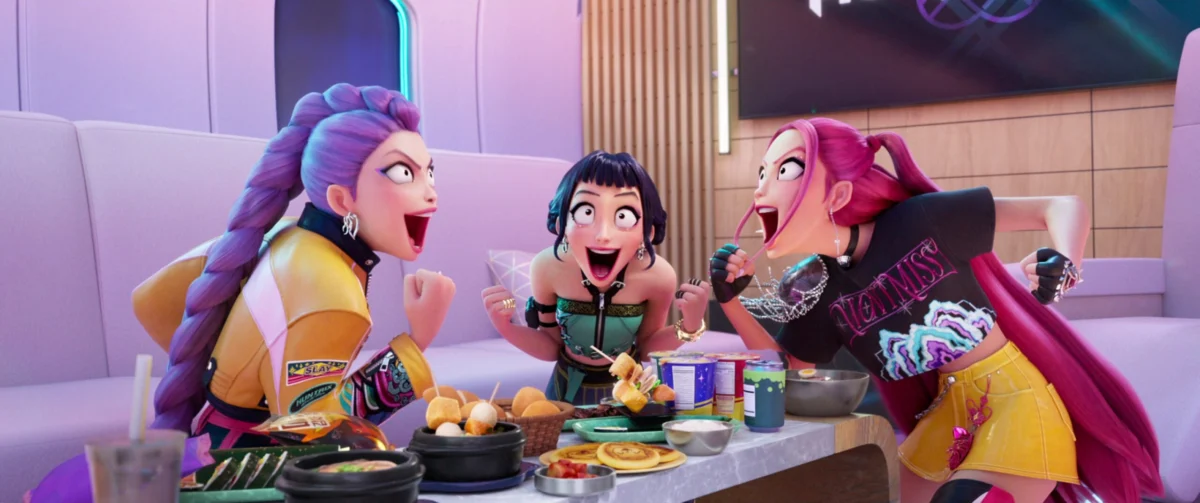
Netflix has struck global gold with its animated musical feature KPop Demon Hunters. Directed by Maggie Kang and Chris Appelhans, the film follows the fictional K-pop girl group Huntr/x—comprising members Rumi (voiced by Arden Cho), Mira (May Hong), and Zoey (Ji-young Yoo)—who balance a chart-topping pop music career with a secret, high-stakes calling as supernatural demon hunters. Complications arise when a rival boy band, the Saja Boys, debut and are revealed to be demons in disguise, leaving the fate of the world in the hands of the female trio.
Since premiering on June 20, the movie has defied expectations by dominating the cultural zeitgeist. According to Netflix’s performance metrics for the week ending July 13, KPop Demon Hunters has spent an impressive four consecutive weeks in the Netflix Global Top 10 (English-language films), raking in 40,400,000 views. After briefly dropping to the #2 spot following the heavy-hitter release of Charlize Theron’s The Old Guard 2, the animated sensation reclaimed the #1 spot.
Beyond its streaming dominance, the film’s soundtrack has transcended the screen to conquer the real-world music charts. The lead single, “Golden,” sits at #1 on both the Billboard Global 200 and the Billboard Global Excl. U.S. charts, and Netflix has confirmed plans to submit the track for awards consideration. Meanwhile, the Saja Boys’ track “Your Idol” has captured the #1 spot on the U.S. Spotify chart, making them the highest-charting K-pop group in Spotify history—a feat that even surpasses global sensations like BTS. Overall, the film’s official soundtrack currently holds the #2 position on the Billboard Global 200.

Chronology: The Making of a Phenomenon
The road to creating KPop Demon Hunters and its record-shattering soundtrack was a meticulous process that required years of planning, writing, and cross-continental collaboration.
Development on the film began years before its summer release. Co-directors Maggie Kang and Chris Appelhans spent a year working closely with producer Michelle Wong and executive music producer Ian Eisendrath just to establish the script, narrative arcs, and the specific emotional beats required for the songs. Unlike many animated musicals that rely on composers to write "in the style of" a specific genre, the creative team established a strict mandate: the music had to function as a legitimate, chart-ready K-pop album while simultaneously driving the narrative forward.
Sony’s music division assembled a formidable writer’s camp of genuine K-pop and pop hitmakers, including talents from South Korea’s renowned Black Label, Stephen Kirk, Jenna Andrews, Lindgren, EJAE, and Mark Sonnenblick. Rather than relying on a single songwriter, the production utilized an ensemble approach mirroring the actual K-pop industry.

Throughout late 2024, the team generated over 30 songs, constructing multiple iterations (sometimes up to seven distinct versions) for each musical placement in the film. The process culminated in late December—an exceptionally late production window for an animated feature—with the final recording of the breakout hit "Golden."
Supporting Data and Music Industry Impact
The crossover success of KPop Demon Hunters into mainstream music charts highlights a seismic shift in how animated media and pop culture interact.
- Streaming Metrics: KPop Demon Hunters accumulated 40,400,000 viewing hours during its fourth week in the Netflix Global Top 10 (English), underlining incredible audience retention and word-of-mouth growth.
- Billboard Dominance: The single "Golden" secured the #1 spot on the Billboard Global 200 and Billboard Global Excl. U.S. charts. The full film soundtrack occupies the #2 position on the Billboard Global 200.
- Spotify History: The Saja Boys’ track “Your Idol” broke streaming barriers by topping the U.S. Spotify chart, officially marking the highest chart placement for a K-pop group in the platform’s history.
- Creative Iteration: Over 30 original tracks were conceptualized and evaluated for the project, with key songs like "Golden" undergoing seven distinct structural and lyrical rewrites before final approval.
Official Responses and Creative Insights
Executive music producer Ian Eisendrath spoke exclusively with IndieWire about the unprecedented creative process behind the film’s musical landscape. Describing the initial directive, Eisendrath noted that the goal was never to fake the genre.

"The directive was very much ‘We want to create a soundtrack of real K-pop hits,’" Eisendrath explained. "This soundtrack needs to land and exist as a K-pop album, but also work within the film and cover the narrative territory it needs to cover and fit in the mouths of each of the characters, which is not something that K-pop traditionally does."
Eisendrath praised the collaborative spirit of the writers’ camp, detailing how songs were constantly refined to fit character arcs. Discussing the creation of the global smash "Golden," he highlighted its complex narrative requirement: "It had to be very much life imitating art, and something that would top the charts… It served the function of what in most film musicals is called the ‘I want song,’ which is where the characters establish the mission that they’re going to be on for the rest of the film."
He also credited co-creator Maggie Kang, whose lifelong passion for K-pop fueled the project’s authenticity. "This project is Maggie Kang’s. This is so deeply from her brain and heart," Eisendrath said. "She loves K-pop, and that was such a driving force of wanting us to make sure we were creating songs that resonated with what she’s been in love with her whole life."

When asked about the viral success of the music—which includes fans posting dance covers online and actual members of BTS lightly riffing on "Soda Pop" during a livestream—Eisendrath expressed disbelief and gratitude: "To see that, I don’t think there’s any greater sort of reward from doing this project."
Implications for the Future of Animation and Franchises
The unprecedented crossover success of KPop Demon Hunters carries significant implications for both Netflix and the broader entertainment industry.
First, it proves that animated musicals can successfully bypass traditional family-film formulas by targeting older, digitally native demographics who consume global pop culture. By treating the film’s music not as an afterthought, but as an authentic commercial product capable of competing with real-world pop acts on Billboard and Spotify, Netflix has unlocked a lucrative cross-promotional pipeline.

Second, the film’s triumph validates the inclusion of culturally specific creative teams. By leaning heavily into authentic K-pop production pipelines—collaborating with Korean labels and genre-specific songwriters—the filmmakers avoided the hollow pastiche that often plagues Western attempts at foreign pop trends. This authenticity has earned the film deep respect within South Korea and among global K-pop fandoms.
Finally, the massive public demand for more content has inevitably sparked discussions about the franchise’s future. When asked if he would return for a potential sequel, Eisendrath’s response was definitive: "I would love it. It would be a dream. I could do this forever."
As Netflix prepares its awards season push—led by the cultural juggernaut that is "Golden"—KPop Demon Hunters has firmly established itself not just as a hit movie, but as a watershed moment where animation and the global music industry successfully merged into one unstoppable force.