From Scraps of Vengeance to Shadow Lord: How Lucasfilm’s Newest Series Reinvents Star Wars’ Most Resilient Villain
Main Facts
Nearly three decades after his menacing, horned visage first graced the silver screen in Star Wars Episode I: The Phantom Menace, Darth Maul is poised to make history once again. Lucasfilm has officially announced Star Wars: Maul — Shadow Lord, a groundbreaking animated series that elevates the iconic Zabrak warrior to a rare echelon in the franchise’s storied legacy. Following Boba Fett, Maul is becoming only the second primary Star Wars villain to headline a dedicated television series.
Set during the precarious dawn of the Galactic Empire, Shadow Lord bridges a crucial narrative gap in the sprawling canon. The series acts as a direct sequel to Maul’s devastating defeat during the Siege of Mandalore in The Clone Wars, and serves as a vital prequel to his criminal empire days in Solo: A Star Wars Story and his final, tragic twilight in Star Wars Rebels.
Unlike the episodic, mission-of-the-week formats that defined earlier animated excursions like The Clone Wars or The Bad Batch, Shadow Lord is built as a tightly wound, fully serialized psychological thriller. Stripped of his power base, his political influence, and his syndicates, a battered Maul finds himself hunted, bitter, and seeking retribution. His crosshairs are locked not only on Darth Sidious—the master who discarded him for a younger apprentice in Anakin Skywalker—but also on the criminal underworld that left him to rot. Complicating his bitter crusade is an unexpected narrative pivot: Maul becomes fascinated by the prospect of taking on his own apprentice, a disillusioned Jedi Padawan named Devon.
Veteran voice actor Sam Witwer, who has breathed chaotic life into the character since 2010, returns to helm the role. Alongside him, a creative team featuring executive producer Athena Yvette Portillo, supervising director Brad Rau, and co-creator/showrunner Matt Michnovetz are steering the project toward a darker, more visually distinct aesthetic that promises to challenge everything fans thought they knew about the dark side of the Force.

Chronology: Tracing Maul’s Unlikely Evolution
To understand the weight of Shadow Lord, one must look back at the improbable trajectory of Darth Maul across the Star Wars timeline.
- 32 BBY (The Phantom Menace): Introduced as a terrifying, silent instrument of Sith wrath, Maul cuts down Qui-Gon Jinn before being sliced in half by Obi-Wan Kenobi and plummeting down a reactor shaft on Naboo. For over a decade, his story was seemingly over, cemented by just 15 minutes of legendary screen time.
- 20 BBY (The Clone Wars): In a move that shocked fans, Maul was resurrected in the animated continuity. Fueled by dark-side-infused madness and cybernetic spider-legs crafted on the junk planet Lotho Minor, he reclaimed his sanity with the help of Mother Talzin, forged a criminal empire alongside his brother Savage Opress, and briefly challenged the rule of Darth Sidious.
- 19 BBY (The Siege of Mandalore & Shadow Lord): Following his capture and subsequent escape during the chaotic twilight of the Clone Wars, Maul loses his throne, his family, and his syndicate allies. Shadow Lord takes place precisely in this volatile window, tracking his desperate maneuvers in the early days of the Galactic Empire.
- Circa 10 BBY (Solo: A Star Wars Story): Maul resurfaces in live-action as the hidden leader of the Crimson Dawn crime syndicate, operating from the shadows of Dathomir.
- 2 BBY (Star Wars Rebels): Driven mad by isolation and an all-consuming obsession with revenge against Obi-Wan Kenobi, an aging Maul tracks his old nemesis to Tatooine, where he meets his final, poignant end in the desert sands.
Supporting Data and Production Insights: Crafting a Painterly Nightmare
The production of Shadow Lord represents a radical departure from Lucasfilm’s traditional animation pipelines. Driven by director of photography Joel Aron—who previously experimented with live-action techniques in The Bad Batch—the creative team sought a grittier, highly tactile aesthetic that separates Shadow Lord from its predecessors.
A Tactile, Hand-Made Visual Language
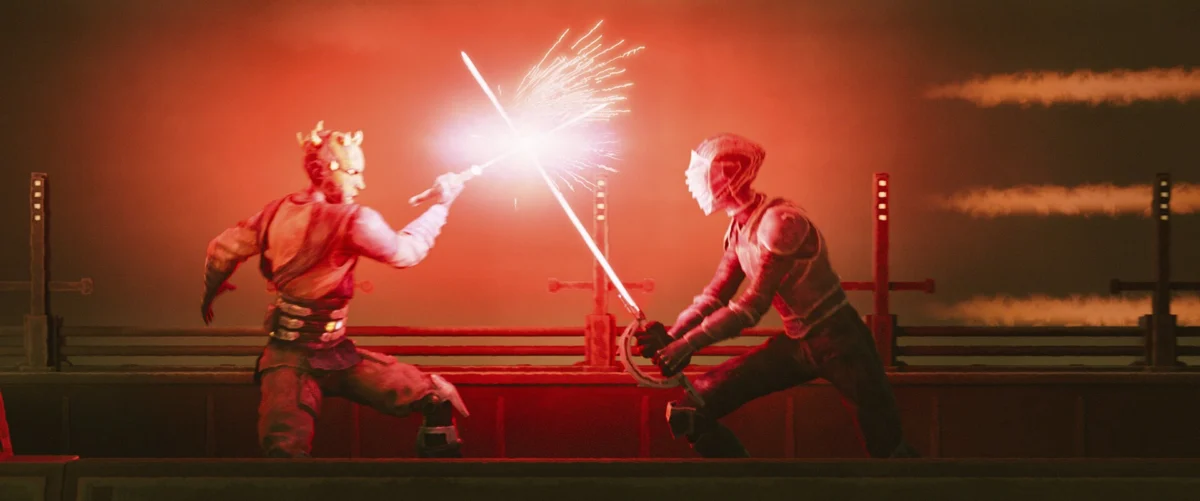
Aron and his visual effects teams leaned heavily into traditional art forms to construct the look of the show. Production utilized oil-on-canvas matte paintings, deliberate paintbrush strokes swept across physical glass panes, and intricate, hand-built practical models for spacecraft rather than relying entirely on digital rendering. This hybrid approach not only expedited the turnaround times for complex backgrounds like Star Destroyers, but it also injected a raw, painterly texture into every frame.
This handcrafted philosophy extends directly to the lightsabers. Instead of the clean, glowing plasma blades typical of the franchise, the lightsabers in Shadow Lord feature visible paintbrush strokes within the core. They appear less like civilized weapons and more like raging, volatile fires tearing through the air and searing flesh.

Sound Design Rooted in Raw Emotion
Sound designer David W. Collins worked closely with the animation team to ensure the audio matched the visual intensity. In a unique twist, Collins incorporated Sam Witwer’s actual, unvarnished screams of anguish and rage directly into the audio profile of the lightsaber swishes. Every clash of blades carries the emotional weight of Maul’s lifelong trauma and unending hatred.
The Serialization Hurdle
Because Shadow Lord eschews standalone adventures in favor of continuous serialization, executive producer Athena Yvette Portillo noted that maintaining visual consistency across the season was a massive logistical hurdle.
"We didn’t want a situation where someone would say episode four looked better than the first," Portillo explained. To solve this, Lucasfilm implemented a unique post-production loop where episodes were not fully locked until the entire season was nearly finalized. "We would constantly go back to earlier episodes and pepper them with what we learn from later episodes. It’s like cooking. You’re taste testing the episodes, then going back in and adding spices to keep it consistent."
Official Responses and Creative Vision
The creative team behind Shadow Lord views the series not merely as a monster-of-the-week action cartoon, but as a deep psychological deconstruction of a character who began his cinematic life as little more than a "cool, devil-looking guy."

"It’s been a real surprise that the character continues to evolve and to grow," Sam Witwer shared in an interview with IndieWire. "The fun of it is reinventing him every time that we bring him out and learning new things about him. I’ve always had a lot of questions about Maul, and now I feel like I finally have the full vision of his arc throughout Star Wars for the first time in my life."
Supervising director Brad Rau highlighted the multifaceted nature of the character, noting his terrifying capacity for manipulation. "He’s a survivor, and dedicated to his causes. He’s also a manipulator, and a very charismatic one at that. He provides a kind of devil on the shoulder of our characters, to tempt them in some ways and reveal some uncomfortable truths in some ways. He’s, in some regards, a relatable character, due to the losses he’s suffered, and the mistakes he keeps repeating."
Meanwhile, co-creator and showrunner Matt Michnovetz discussed how the series handles the looming shadow of the Galactic Empire, especially in the wake of the critically acclaimed, gritty live-action series Andor. Rather than placing the Empire front and center in every scene, Shadow Lord keeps the authoritarian regime at arm’s length.
"We wanted to make it a menacing, strong, external force that would come in at the right time to push the story forward," Michnovetz said, noting that while some characters recognize the Empire as an apocalyptic threat, others are blinded by imperial propaganda promising order and safety.

Implications for the Star Wars Universe
Star Wars: Maul — Shadow Lord arrives at a fascinating crossroads for the franchise, carrying significant thematic and narrative implications.
Redefining the Moral Gray Area
By moving away from traditional, black-and-white morality, Shadow Lord introduces complex dynamics. The series features a rigid detective and a literal-minded droid partner who follow the law blindly, even if it plunges an innocent world into totalitarian darkness. It follows a young Jedi Padawan questioning what it truly means to defend peace in an era of lawlessness. And it positions Maul—a ruthless, bloodthirsty crime lord—as an anti-hero of sorts simply because his warpath happens to intersect with the monolithic evil of the emerging Empire.
The Tragedy of the Mirror Image
Narratively, Maul in Shadow Lord acts as a dark mirror to Ahsoka Tano. Both characters were systematically stripped of their families, indoctrinated into rigid dogmatic orders, and ultimately abandoned by the institutions they served. Yet, while Ahsoka manages to find a path toward healing and altruism, Maul’s inability to let go of his pain seals his tragic fate. Shadow Lord explores the agonizing space where a broken man attempts to fill the void in his soul—not through redemption, but through the dangerous gamble of mentorship and recycled vengeance.
As Lucasfilm continues to expand its animated storytelling into darker, more mature territory, Maul — Shadow Lord proves that even characters cut down in their prime can find new life. As long as there are stories to tell in a galaxy far, far away, Darth Maul will remain in the shadows, waiting for his moment to strike.