Maggie Gyllenhaal Defends Venice Film Festival Jury’s Golden Lion Decision Amid Scrutiny Over Gender Representation
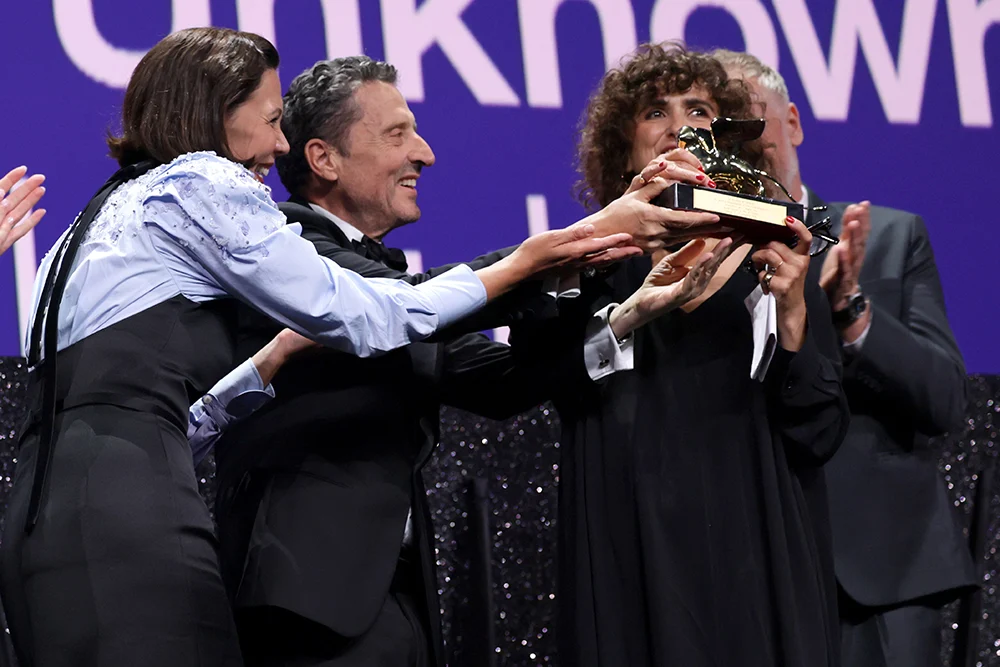
VENICE, Italy — Actor and filmmaker Maggie Gyllenhaal concluded her tenure as the president of the Venice Film Festival main competition jury on Saturday night by awarding the festival’s highest honor, the Golden Lion, to Woman Unknown, directed by May el-Toukhy.
The victory capped off a tense and culturally charged festival cycle that Gyllenhaal herself helped frame on opening night, when she publicly critiqued the glaring lack of female filmmakers in contention for the prize. Yet, despite the historic optics of crowning the only film in the primary competition solely directed by a woman, Gyllenhaal fiercely rejected the notion that the jury’s verdict was a politically motivated gesture rather than an artistic endorsement.
The decision has ignited intense conversations across the international film community regarding gender parity, festival curation, and the fine line between artistic merit and institutional statement-making.
Main Facts
The 2026 Venice Film Festival culminated in a major triumph for Danish-Egyptian filmmaker May el-Toukhy, whose psychological drama Woman Unknown took home the coveted Golden Lion. The victory was bolstered by a Volpi Cup for Best Actress awarded to the film’s lead star, Mathilde Arcel, marking a dual-win sweep for the production.
The path to this moment was defined by a stark numerical reality: out of the numerous features selected for the main competition, Woman Unknown stood alone as the only film solely directed by a woman. The only other competing project involving a female voice was NAZA, a documentary chronicling the ongoing conflict in Gaza, which was co-directed by Rachel Szor and Yuval Abraham. NAZA successfully captured the prestigious Special Jury Prize, earning praise from Gyllenhaal and her fellow jurors for its uncompromising bravery and structural ingenuity.
Despite the heavy socio-political undertones surrounding the festival’s lineup, Gyllenhaal spent much of her post-ceremony press conference pushing back against narratives that reduced the jury’s rigorous deliberative process to mere identity politics. She insisted that Woman Unknown won purely on its cinematic execution—a sentiment complicated by her own early-festival remarks drawing attention to the industry’s systemic gender imbalances.
Chronology of Events
The narrative of the 2026 Venice Film Festival unfolded in distinct, high-stakes phases:
- The Opening Salvo: As the festival commenced, Maggie Gyllenhaal took the stage in her capacity as jury president and did not shy away from controversy. She used her opening remarks to directly call out the festival’s selection committee for the sparse representation of women directors among the Golden Lion contenders, instantly setting a politically charged tone for the fortnight.
- The Fortnight of Screenings: Over the next ten days, critics, audiences, and the international press consumed a diverse slate of global cinema. Discussions consistently circled back to representation, diversity behind the camera, and how the jury—composed of a globally diverse and artistically accomplished panel—would evaluate the competing works.
- Saturday Night’s Awards Ceremony: The festival reached its climax when Gyllenhaal and her jury announced their decisions. Woman Unknown was revealed as the Golden Lion winner, while Mathilde Arcel secured the Volpi Cup for Best Actress. Meanwhile, NAZA was awarded the Special Jury Prize.
- The Post-Ceremony Press Conference: Immediately following the gala, Gyllenhaal faced a barrage of pointed questions from international journalists asking whether the top prize was intended as a corrective statement to her initial critique. Her witty, slightly exasperated, and ultimately deeply sincere responses set the record straight regarding the internal mechanics of the jury room.
Supporting Data and Jury Dynamics
To understand how the decisions were reached, industry observers closely analyzed the composition of the 2026 Venice jury. Gyllenhaal did not operate in a vacuum; she led a diverse and fiercely independent panel of international artists and intellectuals.
The jury included:
- Kaouther Ben Hania: Acclaimed Tunisian director of The Voice of Hind Rajab, whose perspective heavily influenced the jury’s appreciation of structural filmmaking.
- Johnnie To: Legendary Hong Kong action auteur and filmmaking giant.
- Shahrbanoo Sadat: Respected Afghan filmmaker known for her authentic, ground-level storytelling.
- Xavier Giannoli: Noted French director and screenwriter.
- Daniel Blumberg: Accomplished composer behind the musical landscape of The Brutalist.
- Francesco Casetti: U.S.-based Italian film academic and theorist.
This mosaic of global viewpoints ensured that any consensus required intense, multifaceted negotiations. Addressing the double-win for Woman Unknown, Gyllenhaal clarified the strict protocols governing the festival’s awards.
"You’re allowed to give two awards to a Golden Lion winner if the second award you want to give is unanimous," Gyllenhaal explained to the press. "So we unanimously were allowed to award Mathilde [Arcel], who I’d like to say publicly, for all the press, is going to blow our socks off."
Regarding NAZA, Gyllenhaal noted that juror Kaouther Ben Hania helped articulate the film’s brilliant mechanics, comparing its systemic exploration of geopolitical conflict to Jonathan Glazer’s chilling masterpiece, The Zone of Interest.
Official Responses and Gyllenhaal’s Defense
When pressed by reporters on whether awarding the festival’s top prize to the sole solo-directed female-led film was a "political statement," Gyllenhaal initially leaned into dry satire.
"I actually didn’t see Woman Unknown," she deadpanned, before playfully adding, "I just was like, ‘It’s made by a woman and so, Golden Lion!’"
The levity quickly gave way to a more earnest and weary defense of the jury’s autonomy. Gyllenhaal expressed fatigue at having to constantly filter artistic evaluation through the lens of identity politics, while acknowledging the validity of the question itself.
"I will say that, of course, I anticipated that question," Gyllenhaal admitted. "There are many movies that women made that I don’t like and some that I actively, strongly don’t like, just like films made by men. I have one vote just as each member of this jury does, and so all of the decisions that we make are always complicated, always involve a lot of conversation."
Releasing a heavy sigh, she concluded: "I think I’m tired of talking about this same subject over and over. I will continue to do it, but just for a minute, here in this incredible place, I just want to celebrate a beautifully made movie that I felt was like a laser beam just for the well-made movie that it is."
Implications for the Film Industry
The 2026 Venice Film Festival will likely be remembered as a watershed moment for how major European festivals grapple with gender equity in their main competitions.
Gyllenhaal’s tenure highlights a persistent paradox in modern cinema: while female filmmakers continue to deliver world-class, critically acclaimed work, they remain underrepresented in the selection pools of elite autumn festivals. By openly calling out this deficit on day one and subsequently awarding the top prize to a masterclass in filmmaking by May el-Toukhy, Gyllenhaal managed to bridge the gap between systemic critique and artistic celebration.
However, her defensive pushback at the press conference underscores a broader fatigue among female artists who achieve historic milestones. Many creators wish to be judged solely on the caliber of their craft rather than serving as symbols for broader cultural shifts.
As the industry looks ahead to the upcoming awards season, the success of Woman Unknown and NAZA proves that uncompromising vision will always pierce through the noise—even if the road to the podium remains steep, heavily scrutinized, and in urgent need of structural transformation.