The Man Behind the Monster: Carl Toop on Bringing the Xenomorph to Life for ‘Aliens’
When audiences think of James Cameron’s 1986 sci-fi masterpiece Aliens, their minds often drift to the powerhouse performance of Sigourney Weaver’s Ellen Ripley or the frantic, high-octane firepower of the Colonial Marines. Yet, the film’s enduring terror relies heavily on the physical, visceral presence of the Xenomorphs. While the franchise utilized a mix of puppetry and suit performance, there is one individual who stands as the definitive, credited "Alien Warrior" of the film: Carl Toop.
Forty years after Aliens redefined the sci-fi horror genre, Toop—a professional dancer turned monster performer—reflects on his journey from an unlikely audition at Pinewood Studios to becoming an integral part of cinema history.
The Audition: A Trial by Fire
The road to becoming a cinematic icon was anything but planned for Toop. At the time, he was a young dancer working in London’s West End, primarily focused on theatrical productions and wire work. When his agent mentioned an audition for a film called Aliens, Toop didn’t immediately associate it with Ridley Scott’s 1979 predecessor.
"I was a young dancer, I needed the work, and I had to pay the rent," Toop recalls. Upon arriving at Pinewood, he was met with a sea of 200 hopefuls. The casting process was an exercise in chaos and improvisation. Directors didn’t want rigid choreography; they wanted a primal, extraterrestrial movement. "None of us had a clue what we were doing," he explains. "We were just interpreting our idea of how an alien would move… they weren’t suggesting movements to us; it was just putting us in situations."
After surviving four grueling rounds of auditions, the field was narrowed down. Originally, the production intended to hire thirteen performers, but as the budget tightened, the vision shifted. In a turn of events that would alter the course of his career, Toop was the sole performer chosen to serve as the primary Alien Warrior, a testament to his physical agility and ability to adapt to the demanding wire work the role required.
Becoming the Xenomorph: The Art of the Suit
Stepping into the role required more than just movement; it required a physical transformation that pushed the boundaries of practical effects. Toop remembers his initial skepticism upon seeing the costumes—limp Lycra suits adorned with rubber. However, the vision of creature designer Stan Winston soon became clear.
"The head was impressive because it’s over a meter-long and the detail work in it was amazing," says Toop. The process of becoming the Warrior was a collaborative labor of love. Alongside Stan Winston’s team—including Tom Woodruff, Jr.—Toop spent a week refining his movements. They worked to ensure the costume was not only aesthetically terrifying but functional, allowing the performer to breathe and move with predatory grace.
For Toop, the "magic" didn’t happen until the head was finally fitted. It was the catalyst that shifted him from a man in a suit to a nightmare brought to life. Once the suit was on, the environment of the set did the rest.
Life on Set: Working with Icons
Stepping onto the set of Aliens was a formative experience for the young performer. His first day on set was marked by a surreal encounter with his "boy school crush," Sigourney Weaver. "She comes over and says, ‘Hi, I’m Sigourney Weaver. It’s nice to be working with you,’" Toop remembers.
The atmosphere on set was professional yet remarkably human. Despite the high-pressure environment fostered by James Cameron—a director known for demanding perfection—the cast remained grounded. Toop highlights the stark contrast between the terrifying creature he played and the camaraderie he shared with the human actors.
One particularly poignant memory involves the late Bill Paxton. Because the Xenomorph costume was cumbersome and required the wearer to be largely immobile, Toop couldn’t eat or drink for long periods. "Bill Paxton… comes back with a cheese roll," Toop recounts. "He was feeding me because I had my Alien Warrior hands on, so I couldn’t do anything." Such moments of kindness highlight a set where, despite the looming threat of the "monster," the human element was the glue holding the production together.
The Water Hazard: A Near-Miss
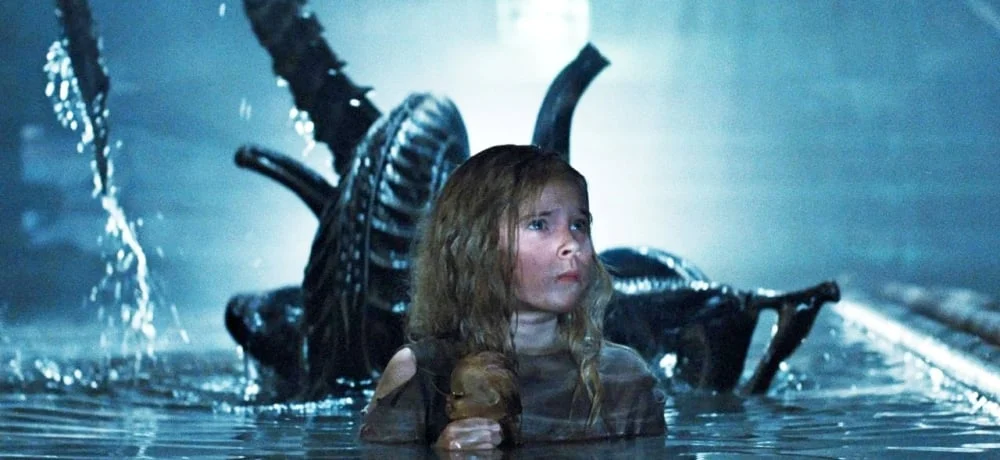
The most iconic sequence involving Toop remains the moment his character emerges from the water to terrorize the young character, Newt (played by Carrie Henn). While it looks seamless on screen, the production was fraught with technical peril.
Toop had to lie horizontally on the bottom of a shallow, two-and-a-half-foot pool, waiting for a signal to emerge. Because the suit was not designed for underwater submersion, the headpiece immediately filled with water. With his arms restricted, Toop found himself unable to rise. "I was just blocked down there," he admits.
It took the crew nearly 40 seconds to realize the performer was in distress. The incident resulted in a quick engineering fix—cutting a side in the helmet to release pressure—but it serves as a stark reminder of the physical dangers inherent in 1980s practical effects. When the scene was finally captured, it became a defining moment of the franchise, perfectly encapsulating the shock and awe that Aliens delivered to global audiences.
Legacy: Why ‘Aliens’ Still Resonates
As Aliens celebrates its 40th anniversary, the industry has shifted toward Computer Generated Imagery (CGI). However, Toop argues that the tactile nature of the 1986 film is precisely why it remains a titan of the genre.
"We didn’t have computers in those days… when I’m getting fire thrown at me, fire’s coming at me," Toop says. He observes that modern audiences, including younger generations who grew up with digital effects, are increasingly appreciative of the "old-school" practical craft. The success of recent entries in the franchise, like Alien: Romulus, proves that there is a hunger for the tangible, physical horror that defined the original films.
The "hive" of the Aliens cast has also evolved into a genuine, long-term friendship. Despite years of distance, reuniting at conventions feels like no time has passed. These events allow Toop to see the impact of his work firsthand, witnessing how the film has touched the lives of fans across three generations.
Implications for Modern Cinema
The career of Carl Toop serves as a case study for the value of the human performer in creature design. In an era where AI and digital avatars threaten to replace physical actors, the nuance of Toop’s movement—the slight head tilt, the predatory stillness, the deliberate, rhythmic breathing—remains difficult to replicate with code.
His story also underscores the unsung labor of the crew. "The people behind-the-scenes, the ones we don’t see; they’re the ones that are doing the crazy work," Toop acknowledges. The lighting technicians, the puppeteers, and the costume maintainers formed a "well-oiled machine" that allowed for the creation of a film that persists in the cultural consciousness decades later.
For those eager to meet the man behind the mask, Toop continues to engage with the fan community at conventions worldwide. His journey from a London dance college to the dark, water-filled sets of a Hollywood blockbuster is a testament to the fact that sometimes the most terrifying monsters are the ones created with the most heart, the most labor, and the most human dedication.
Carl Toop can be followed on Instagram at carltoop.alienwarrior1986.