Beyond the Frame: Deconstructing Meta-Cinema in Yandy Laurens’ Jatuh Cinta Seperti di Film-film
In the landscape of contemporary Indonesian cinema, few films have managed to interrogate the medium of filmmaking itself with as much intimacy and structural audacity as Yandy Laurens’ Jatuh Cinta Seperti di Film-film (2023). While the "film-within-a-film" trope is a well-worn narrative device, Laurens elevates it beyond mere behind-the-scenes documentation, transforming the screen into a mirror that reflects the complexities of human connection, the ethics of storytelling, and the industry’s own systemic fatigue.
The Architecture of Two Worlds: Visual Storytelling
A film about filmmaking requires a strong narrative spine to avoid feeling like a mere "making-of" documentary. Throughout history, masters have tackled this challenge in diverse ways: Federico Fellini’s 8½ (1963) utilized surrealism to manifest a director’s internal anxieties, while Shinichiro Ueda’s One Cut of the Dead (2016) opted for a clever, chronologically inverted meta-structure.
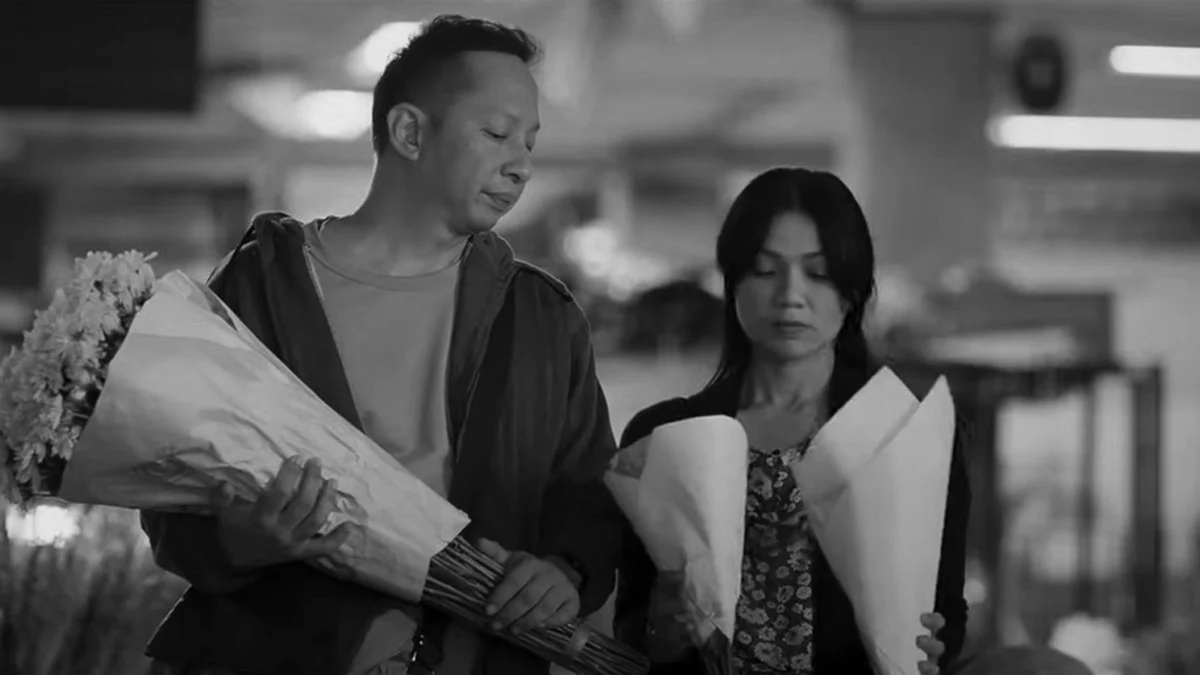
Yandy Laurens chooses a more visceral, monochromatic path. The film oscillates between two distinct realities: the "real" world, rendered in vibrant color, and the "film-within-a-film" script being penned by the protagonist, Bagus (played by Ringgo Agus), which is presented entirely in black-and-white. This choice is far from a superficial aesthetic gimmick. The black-and-white format serves as a somber shroud for the character of Hana (Nirina Zubir), reflecting her state of grief, while simultaneously acting as a narrative marker that keeps the audience grounded in the distinction between fiction and reality.
In an era where color is a cinematic standard rather than a luxury, the decision to go monochrome is a calculated creative necessity. Bagus’s script is rooted in the mundane—conversations in supermarkets, flower shops, and bustling nasi Padang eateries. By muting the colors of these everyday settings, Laurens strips away the visual noise, forcing the audience to focus exclusively on the raw emotions and the interpersonal friction between Bagus and Hana. It renders the banal, cinematic.
The Romantic Myth vs. The Cinematic Reality
William Siska, in his seminal work Metacinema: A Modern Necessity, posits that self-reflexive cinema functions through two primary avenues: the filmmaker reflecting on their medium, and the filmmaker reflecting on themselves. Jatuh Cinta Seperti di Film-film excels at both.
The film serves as a rigorous critique of the romantic genre’s conventional tropes. Early in the narrative, Hana openly criticizes La La Land (2016), arguing that it romanticizes breakups that could have been resolved through simple, honest conversation. By the conclusion, Hana finds more romance in a quiet, candid dialogue with Bagus than in the grand, performative gestures designed for the screen. She explicitly rejects the "final kiss" trope—a scene involving a character with a broken leg—as an absurd, manufactured moment that lacks the dignity of true human interaction.
Initially, Bagus views his film as a grand, romantic gesture to win over a grieving Hana. However, the process of creation proves to be a crucible of reflection. With the intervention of colleagues like Cheline (Sheila Dara), Dion (Dion Wiyoko), and Julie (Julie Estelle), Bagus is forced to gain distance from his own narrative. He begins to grapple with the ethics of consent—the realization that using a person’s life as raw material for a story without their permission is not romantic; it is an act of exploitation.
The Industry Under the Microscope: A Critique of "Safe" Cinema
Beyond the personal, the film offers a biting commentary on the Indonesian film industry. Through the character of Pak Yoram (Alex Abbad), the film presents an archetype of the "toxic producer"—one who views cinema through the lens of intellectual property (IP) and profitability rather than creative integrity.

Pak Yoram represents the systemic push toward "safe" content, where explorative scripts are dismissed as liabilities. His insistence on adapting soap operas and his suggestion that Bagus’s script be rebranded as Jatuh Cinta Seperti di Film-film Horor (Falling in Love Like in Horror Films) hits home for many contemporary observers. This is a pointed critique of the current market saturation of horror films and the reliance on pre-existing IP over original storytelling.
What makes this critique effective is that it is not delivered through outside commentary or social media discourse; it is delivered through the medium itself. By integrating these industry tensions into the narrative, Laurens highlights how the pursuit of commercial "safety" often compromises the empathy required to tell a truly human story.
Supporting Data: The Cast and Production Context
The film’s success relies heavily on the nuanced performances of its ensemble cast, who navigate the blurred lines between their real-world characters and their on-screen counterparts.
- Ringgo Agus Rahman (Bagus): Portrays the vulnerability of a writer who must reconcile his artistic ego with his moral responsibilities.
- Nirina Zubir (Hana): Delivers a performance that balances profound grief with a refreshing, sharp-witted pragmatism.
- The Supporting Ensemble: Sheila Dara, Dion Wiyoko, and Julie Estelle provide the essential "meta" commentary, acting as the voice of reason that forces the protagonist to question his own artistic choices.
Production Summary:
- Release Date: 2023
- Duration: 118 minutes
- Director/Writer: Yandy Laurens
- Production Houses: Imajinari, Jagartha, Trinity Entertainment, Cerita Film
- Country: Indonesia
Implications: The Luxury of Self-Awareness
Jatuh Cinta Seperti di Film-film serves as a poignant reminder that cinema, at its best, is an instrument of empathy. While some films exploit their subjects for profit, Bagus’s film—and by extension, Yandy Laurens’—demonstrates that true romance, and true cinema, are found in the small, quiet, and often messy realities of life.
The film suggests that "romance" in adulthood is not about grand, public gestures or manipulative storytelling. It is found in being present—in the daily, unglamorous acts of listening, shopping, and supporting a partner through their work.
Ultimately, the film posits that "self-awareness" is a necessity for the modern filmmaker. When actors like Dion and Julie begin to question the scripts they are given, and when creators like Bagus begin to prioritize consent over the "perfect shot," the industry moves one step closer to maturity. While a film industry populated entirely by such introspective figures may be an utopia, Jatuh Cinta Seperti di Film-film asserts that this level of awareness is a luxury the audience deserves and a standard the industry must strive toward.
In the end, the film leaves the audience with a simple, yet profound truth: the most romantic things aren’t found in the scripts of the movies we watch, but in the unscripted, honest conversations we have with the people we love. By deconstructing the romantic genre, Yandy Laurens has managed to craft one of the most honest and deeply moving love stories of recent years, proving that the best way to fall in love is to step out of the frame and into the light of reality.