Syrup, Slime, and Subversion: An In-Depth Look at Rocko Zevenbergen’s ‘Flapjax’
In the landscape of modern independent horror, the "do-it-yourself" aesthetic is often dismissed as a lack of resources rather than a stylistic choice. However, writer-director Rocko Zevenbergen’s latest feature, Flapjax, challenges that notion by leaning into the raw, unpolished, and frankly repulsive sensibilities of midnight-movie culture. It is a film that wears its influences—Troma, Yuzna, and the grotesque satire of 80s body horror—not just on its sleeve, but smeared across its face.
Flapjax is a cinematic contradiction: a film that feels like it was dragged through a Fury Road battle on its way to the screen, yet possesses a surprising, beating heart that anchors its more absurd, stomach-churning excesses.
The Premise: A Recipe for Disaster
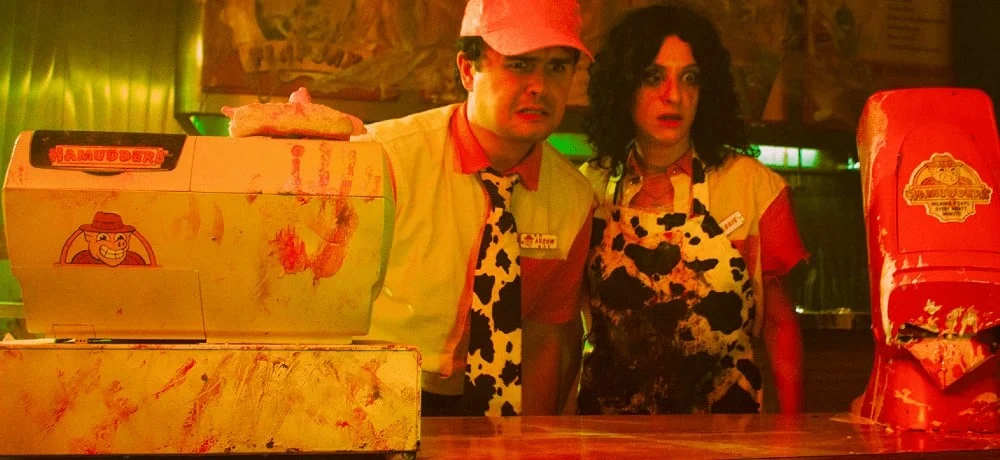
The narrative centers on Arrow Bentley (Gabriel Cagan), an aggressively optimistic and painfully plucky manager at "Hamudders," a fast-food chain that serves as his only sanctuary. While his colleague and subordinate, Louie (Georgia Kate Haege), encourages him to seek out a life beyond the grease traps and corporate mandates, Arrow is singularly obsessed with the company’s latest, ill-fated initiative: the reintroduction of a dangerous, mysterious menu item known as "Flapjax."
To ensure the product launch is a national sensation, Arrow pulls a strings-attached favor from his mother, Eleanor (also played by Georgia Kate Haege), a washed-up, one-hit-wonder pop star known for her penchant for guilt-tripping and helicopter parenting. What begins as a misguided corporate promotion quickly spirals into a descent into culinary madness, as the titular pancakes summon horrors that neither Arrow nor his corporate overlords are prepared to handle.
Chronology of a Cult Classic
The viewing experience of Flapjax is distinctly divided into two halves. The first act operates as a dark, satirical sitcom. We are introduced to the claustrophobic world of Hamudders, a place where underpaid employees worship at the altar of a porcine mascot named Pauley Pig.
For the first 47 minutes, the film is essentially Clerks II filtered through a lens of desperate, low-budget melodrama. The pacing here is arguably the film’s greatest obstacle. Zevenbergen forces the audience to sit with the mundane, hackneyed interactions of his characters: the mother-son tension, the unaddressed professional stagnation, and the general "doofy" enthusiasm of the staff.
It is a deliberate, if testing, exercise in patience. However, once the narrative foundation is laid and the first face-melting practical effect arrives, the film sheds its sitcom skin. The third act is where Flapjax truly unhinges itself. The restaurant becomes a stage for a "go-for-broke" takeover of gore, mutation, and cosmic insanity. It is here that the film transitions from a slow-burn character study into a visceral, slime-drenched spectacle that pays homage to classics like The Stuff, From Beyond, and The Greasy Strangler.
Supporting Data: The Anatomy of the Production
Flapjax is, by its own admission, a spiritual successor to Lloyd Kaufman’s Poultrygeist: Night of the Chicken Dead. The influence is not subtle; the film frequently references the "American Chicken Bunker," and Kaufman himself makes a cameo, effectively bestowing his blessing upon the project.
Technically, the film is a masterclass in resourceful production design. It is held together by what could be described as "Scotch tape and papier-mâché," yet the practical effects are consistently inventive. When the gore hits, it hits hard. The "cream-based mutations" that plague the consumers of the Flapjax pancakes serve as a biting commentary on consumerism and the search for happiness through perfectionism.
The decision to intercut the main narrative with black-and-white Japanese subplots adds a layer of surrealist confusion that will either delight or alienate the viewer. It is a bold, albeit uneven, stylistic choice that emphasizes the film’s "gonzo" nature.
The Human Element: Beyond the Slime
Despite the overt silliness, Flapjax maintains a grounded, emotional core. The relationship between Arrow and Eleanor is fraught with a complicated, near-incestuous codependency that gives the film a weirdly human texture. As the chaos reaches its zenith, the film posits a surprisingly poignant question: Why do we sacrifice our sanity for the sake of a brand?
Zevenbergen uses the horror of the pancakes to represent the hollowness of corporate success. Arrow’s desperate need to make the Flapjax launch a success is a manifestation of his fear that, without the validation of his job, he has nothing. In the final scenes, when the film cracks open the core of this perfectionist misery, it succeeds in creating a moment of genuine, earned melancholy—a feat rarely achieved in movies that also feature giant, sentient pancake-creatures.
Official Responses and Audience Reception
Early critical reception to Flapjax has been predictably polarized. The film currently holds a 3/5 score, reflecting its status as a "genre-value meal" that requires a very specific appetite to enjoy.
Proponents of the film argue that its flaws—the pacing issues, the overselling of performances, and the structural unevenness—are integral to its charm. It is a film for those who appreciate the aesthetic of "Troma Lite." Critics, however, point to the long, dialogue-heavy first act as a significant barrier to entry, suggesting that the film’s reliance on "bottom-of-the-barrel" humor may wear thin for viewers who aren’t already steeped in indie-horror lore.
Implications for the Indie Horror Genre
The existence of Flapjax highlights a growing trend in the independent film circuit: the resurgence of high-concept, low-budget practical effects horror. By eschewing CGI in favor of tactile, messy, and physical sets, Zevenbergen joins a cohort of filmmakers who are effectively reclaiming the 80s and 90s aesthetic for a new generation.
The implications for the industry are twofold:
- The Power of Niche Distribution: Films like Flapjax demonstrate that there is a robust, albeit small, audience for hyper-niche, "gross-out" horror that rejects traditional studio polish.
- The "Third Act" Strategy: Zevenbergen’s structural choice to hold back his best effects until the final half-hour highlights a risky but effective strategy in sustaining interest in films with limited budgets. By front-loading the character development and back-loading the spectacle, he ensures that the film leaves a lasting, visceral impression, even if the middle portions are uneven.
Final Verdict
Flapjax is not for the faint of heart, nor is it for the casual viewer who demands narrative fluidity and high-end production values. It is a messy, occasionally tedious, but ultimately triumphant piece of exploitation cinema.
If you are the type of viewer who enjoys movies like Mutant Blast or Sator, and you possess the patience to wade through a sea of hackneyed workplace banter to reach a buffet of delightful, stomach-churning grotesquery, then Flapjax will likely become a staple of your collection. It is a film that asks us to look at the horrors of capitalism, laugh at the absurdity of our own desires, and perhaps, think twice before ordering the pancakes.
Zevenbergen has crafted a film that, like its subject matter, is a bit of a sludge-fest—but it is a sludge-fest made with love, passion, and an uncompromising, unhinged vision. While it may not be a cinematic masterpiece in the traditional sense, it is an undeniable experience, and in the world of independent horror, that is often more than enough.